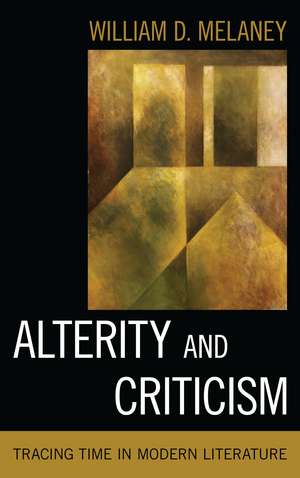
Alterity and Criticism: Tracing Time in Modern Literature
Autor William D. Melaneyen Limba Engleză Paperback – 18 apr 2019
Alterity and Criticism: Retracing Time in Modern Literature argues that the role of time in canonical literature underlies the experience of alterity and requires a new hermeneutic to clarify how the self emerges in literary texts. Romantic poetry from Goethe to Shelley and the modern prose tradition from Flaubert to Butor constitute different traditions but also indicate, on a textual basis, how alterity performs a crucial role in reading, thus encouraging us to interpret literary texts in terms of the related concerns of self, other and time. The author examines the phenomenology of Emmanuel Lévinas and Wolfgang Iser, as well as the cultural semiotics of Julia Kristeva, to argue that modern literature provides the occasion for a new understanding of the self in time and, in this way, addresses some of the pressing literary problems of our own period.
Preț: 285.17 lei
Preț vechi: 371.01 lei
-23%
Puncte Express: 428
Carte tipărită la comandă
Livrare economică 30 noiembrie-14 decembrie
Livrare prin curier în România Termenul estimat este afișat lângă disponibilitate.
Transport gratuit de la 400.00 lei Plată online sau ramburs, în funcție de opțiunile comenzii.
Retur gratuit în 14 zile Comandă securizată și suport în română.
Specificații
ISBN-13: 9781786601506
ISBN-10: 1786601508
Pagini: 238
Dimensiuni: 148 x 228 x 18 mm
Greutate: 0.35 kg
Editura: Bloomsbury Publishing
Colecția Rowman & Littlefield
Locul publicării:New York, United States
ISBN-10: 1786601508
Pagini: 238
Dimensiuni: 148 x 228 x 18 mm
Greutate: 0.35 kg
Editura: Bloomsbury Publishing
Colecția Rowman & Littlefield
Locul publicării:New York, United States
V-ar putea interesa
-
 The Hippie NarrativeScott MacFarlanePreț: 271.47 lei
 -
 Literary AmazoniaNicomedes Suárez-AraúzPreț: 131.08 lei
 -
 Preț: 387.02 lei
 -
 -8%Preț: 537.16 lei583.87 lei
 -
 Conversations with Contemporary Chicana and Chicano WritersHector A. TorresPreț: 242.46 lei
 -
 -22%Preț: 332.57 lei428.04 lei
 -
 Theorizing Glissant: Sites and CitationsJohn E. Drabinski-29%Preț: 342.63 lei482.47 lei
 -
 -19%Preț: 328.98 lei406.90 lei
 -
 -23%Preț: 402.79 lei523.10 lei
 -
 From Shadow to PresenceJelena Sesnic-11%Preț: 675.86 lei759.38 lei
Cuprins
1. Introduction: Alterity in Literary Texts / Part I: Romanticism as Beginning Alterity / 2. Time in Goethe's Faust I: A Poetics of Disruption / 3. Reassessing the Byronic Sublime: A Critique of Pure Autonomy / 4. Coleridge as Poet-Critic: Imagination and Other Life / 5. Shelley and the Myth of Poetry: The 'Return' of Metaphor / Part II: Alterity and the Prose Tradition / 6. Flaubert's Dislocations: Rethinking a Crisis in Reading / 7. Eliot and the Uses of Dante: Thresholds of the Unsayable / 8. Joyce and Metaphor in Excess: Art, Encounter, Semiosis / 9. Butor's Rite of Passage: Reference and Repetition / Part III: Critical Discourses of Alterity / 10. Lévinas and Psychoanalysis: Engaging Alterity in Language / 11. Iser's Aesthetic Phenomenology: Reading, Time and World / 12. Alterity and Future Criticism: Modern Literature in Context / Bibliography / Index
Recenzii
Melaney intricately connects the dissolution of subject-centered consciousness, interrupted by "alterity" as audaciously expressed in modern literature, to reflections of phenomenology, semiotics, hermeneutics, and psychoanalysis. He highlights broken circuits of reflexivity as key to reading in the mode that in the modern period gives us "literature" - provocatively presented as a creation of criticism.
Melaney's book is a welcome addition to ethical criticism because it eschews the danger of merely stating the alterity of the Other. The strength of Melaney is his philosophical rigor allied with an attention to textual detail, historical context, and theoretical conversations that illuminate the texts discussed, from Goethe to Joyce, from the Romantics to Eliot and Butor. Alterity appears here less as a recurrent theme than as a question posed to literature so as to prevent semiotic closure: texts are shown to be irreducibly open to the time of the Other.
Melaney's book is a welcome addition to ethical criticism because it eschews the danger of merely stating the alterity of the Other. The strength of Melaney is his philosophical rigor allied with an attention to textual detail, historical context, and theoretical conversations that illuminate the texts discussed, from Goethe to Joyce, from the Romantics to Eliot and Butor. Alterity appears here less as a recurrent theme than as a question posed to literature so as to prevent semiotic closure: texts are shown to be irreducibly open to the time of the Other.