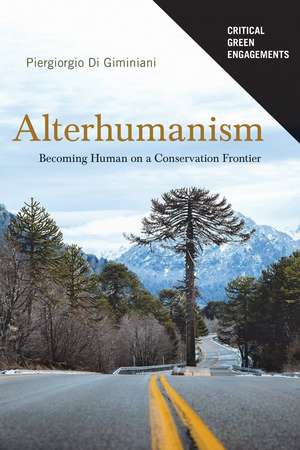
Alterhumanism: Becoming Human on a Conservation Frontier: Critical Green Engagements: Investigating the Green Economy and its Alternatives
Autor Piergiorgio Di Giminianien Limba Engleză Hardback – 11 noi 2025
Reflecting on more than a decade of ethnographic fieldwork with smallholding settlers, Indigenous Mapuche farmers, environmental activists, entrepreneurs, and conservation scientists, Di Giminiani brings to light how these diverse groups navigate the enduring impacts of settler-caused environmental depletion and their aspirations for new ethics of care. Di Giminiani challenges traditional Western humanism, proposing a more relational and open-ended understanding of humanity shaped by interactions with nonhuman others.
Rather than seeking fixed answers, the book explores the fluid and multifaceted nature of becoming human through the lens of conservation politics. By highlighting the entangled, multispecies worlds of southern Chile, Di Giminiani offers a novel approach to understanding the political project of becoming human in the Anthropocene. Alterhumanism is a rich, ethnographically grounded perspective on humanity’s evolving relationship with the natural world.




Preț: 609.59 lei
Preț vechi: 752.58 lei
-19%
Puncte Express: 914
Carte disponibilă
Livrare economică 18 noiembrie-02 decembrie
Livrare prin curier în România Termenul estimat este afișat lângă disponibilitate.
Transport gratuit pentru acest produs Plată online sau ramburs, în funcție de opțiunile comenzii.
Retur gratuit în 14 zile Comandă securizată și suport în română.
Specificații
ISBN-13: 9780816555710
ISBN-10: 0816555710
Pagini: 306
Ilustrații: 11 b&w photos, 1 map
Dimensiuni: 152 x 229 x 23 mm
Greutate: 0.45 kg
Editura: University of Arizona Press
Colecția University of Arizona Press
Seria Critical Green Engagements: Investigating the Green Economy and its Alternatives
ISBN-10: 0816555710
Pagini: 306
Ilustrații: 11 b&w photos, 1 map
Dimensiuni: 152 x 229 x 23 mm
Greutate: 0.45 kg
Editura: University of Arizona Press
Colecția University of Arizona Press
Seria Critical Green Engagements: Investigating the Green Economy and its Alternatives
V-ar putea interesa
-
 Harris, M: All We WantMichael HarrisPreț: 105.52 lei
 -
 Against the MachinePaul KingsnorthPreț: 193.57 lei
 -
 Preț: 136.52 lei
 -
 The PosthumanRosi BraidottiPreț: 132.98 lei
 -
 The ThinningInga Simpson-24%Preț: 86.56 lei114.61 lei
 -
 -24%Preț: 134.10 lei176.73 lei
 -
 -13%Preț: 213.04 lei244.24 lei
 -
 Unsettling ExtinctionRoman Bartosch-22%Preț: 183.55 lei234.01 lei
 -
 In Praise of the EarthByung-Chul HanPreț: 113.34 lei
 -
 Anthropocene FeminismRichard GrusinPreț: 211.18 lei
 -
 Arts of Living on a Damaged Planet: Ghosts and Monsters of the AnthropoceneAnna Lowenhaupt TsingPreț: 160.18 lei
 -
 Indigenous Inhumanities: California Indian Studies after the ApocalypseMark Minch-de LeonPreț: 199.77 lei
 -
 Hope Dies LastAlan WeismanPreț: 125.56 lei
 -
 -33%Preț: 549.31 lei815.18 lei
 -
 -18%Preț: 118.23 lei144.62 leiRecomandat
 -
 Finding Our Niche: Toward A Restorative Human EcologyPhilip A. Loring-18%Preț: 131.44 lei160.12 lei
 -
 We Are Green and TremblingGabriela Cabezón CámaraPreț: 135.93 lei
 -
 HumankindTimothy MortonPreț: 135.23 lei
 -
 Darwin's SavagesMatthew CarrPreț: 224.01 lei
 -
 How to Survive: Living with Care in the Climate CrisisFrancesca Du Brock-22%Preț: 207.95 lei266.30 lei
Notă biografică
Piergiorgio Di Giminiani is an associate professor in anthropology at the Pontificia Universidad Católica de Chile. He is the author of Sentient Lands: Indigeneity, Property, and Political Imagination in Neoliberal Chile.
Recenzii
“In this fascinating account, Piergiorgio Di Giminiani examines the diverse ways ‘being human’ emerges in a conservation frontier in southern Chile. Based on years of fieldwork with Indigenous settlers, forest lovers, timber harvesters, and avian ecologists, among others, Alterhumanism helps us see humanity as a kind of ongoing experiment, full of possibility and contradictions—an important reminder to all of us.”—Laura A. Ogden, author of Loss and Wonder at the World’s End
“Piergiorgio Di Giminiani provides an ethnographically rich and intellectually provocative study of the Anthropocene within the conservation frontier of southern Chile. Plural renderings of ‘the human’ emerge within the entangled, multispecies worlds of Indigenous farmers, national settlers, ecotourists, conservation scientists, birds, and forests. Di Giminiani develops an innovative theoretical approach termed ‘alterhumanism’ that will reward engaged readers within the fields of environmental anthropology, multispecies ethnography, posthumanism, and Latin American studies.”—Marcos Mendoza, author of The Patagonian Sublime: The Green Economy and Post-Neoliberal Politics
“Piergiorgio Di Giminiani provides an ethnographically rich and intellectually provocative study of the Anthropocene within the conservation frontier of southern Chile. Plural renderings of ‘the human’ emerge within the entangled, multispecies worlds of Indigenous farmers, national settlers, ecotourists, conservation scientists, birds, and forests. Di Giminiani develops an innovative theoretical approach termed ‘alterhumanism’ that will reward engaged readers within the fields of environmental anthropology, multispecies ethnography, posthumanism, and Latin American studies.”—Marcos Mendoza, author of The Patagonian Sublime: The Green Economy and Post-Neoliberal Politics
Descriere
On the conservation frontier of southern Chile, the lives of smallholding settlers, Indigenous Mapuche farmers, environmental activists, entrepreneurs, and conservation scientists all grapple with the enduring impacts of settler-caused environmental depletion, aspirations for a new ethics of care, and the promises of an ecotourism boom. Here, the question of what it means to be human is not simply an existential concern but the reflexive result of experiences of becoming human through and with nonhuman others in an increasingly uncertain world.