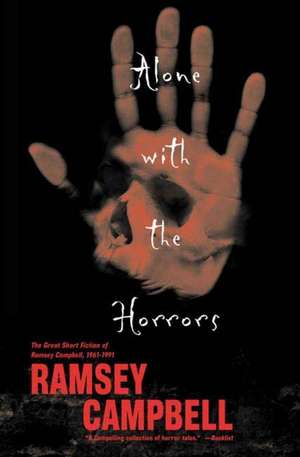
Alone with the Horrors
Autor Ramsey Campbellen Limba Engleză Paperback – 5 sep 2000
Cât de mult din teroarea care ne bântuie este proiecția propriei minți și cât aparține unei realități exterioare, infinit mai reci? În Alone with the Horrors, observăm o cartografiere minuțioasă a fricii, realizată de cel care este considerat cel mai onorat autor de literatură horror în viață. Această antologie nu este doar o simplă culegere, ci o retrospectivă personală a primilor treizeci de ani de activitate ai lui Ramsey Campbell, cuprinzând piese fundamentale scrise între 1961 și 1991. Suntem de părere că forța acestor texte rezidă în capacitatea autorului de a transforma banalul cotidian într-un coșmar palpabil, o tehnică rafinată prin decenii de exercițiu stilistic. Volumul amintește de Ghosts and Grisly Things prin explorarea neliniștitoare a psihicului uman, dar se diferențiază prin perspectiva istorică oferită de prefața autorului, care dezvăluie corespondența sa cu August Derleth și datoria literară față de HP Lovecraft. În contextul operei sale, dacă Isolation: The Horror Anthology se concentra pe singurătatea fizică, această colecție pătrunde în izolarea existențială a personajelor sale, demonstrând de ce criticii îl consideră pe Campbell un maestru al atmosferei. Ritmul povestirilor este unul de acumulare lentă, unde teroarea nu explodează vizual, ci se strecoară insidios prin detalii arhitecturale și umbre urbane, oferind o experiență de lectură densă și profund perturbatoare.
Preț: 122.59 lei
Carte disponibilă
Livrare economică 17 noiembrie-01 decembrie
Specificații
ISBN-10: 0765307685
Pagini: 450
Dimensiuni: 140 x 216 x 25 mm
Greutate: 0.5 kg
Editura: St. Martins Press-3pl
V-ar putea interesa
-
 The Museum of Dr. MosesJoyce Carol OatesPreț: 108.40 lei
 -
 Nightmare at 20,000 FeetRichard MathesonPreț: 139.79 lei
 -
 The Horror Stories of Robert E. HowardRobert E. Howard-37%Preț: 109.40 lei172.54 lei
 -
 Preț: 146.26 lei
 -
 Preț: 87.41 lei
 -
 By Horror HauntedCelia FremlinPreț: 71.69 lei
 -
 Necronomicon: The Best Weird Tales of H.P. LovecraftHP LovecraftPreț: 248.17 lei
 -
 All the Fear of the FairEdward ParnellPreț: 76.89 lei
 -
 Preț: 90.01 lei
 -
 -27%Preț: 250.63 lei345.53 lei
 -
 -12%Preț: 78.97 lei89.24 lei
 -
 Greatest HitsHarlan Ellison-29%Preț: 88.41 lei124.86 lei
 -
 The IncubationsRamsey Campbell-10%Preț: 129.68 lei144.19 lei
 -
 The Damnations: M.R. James Short StoriesM R James-10%Preț: 129.68 lei144.19 lei
 -
 The Invocations: H.P. Lovecraft Short StoriesH P Lovecraft-13%Preț: 123.78 lei141.98 lei
 -
 When Things Get DarkCarmen Maria Machado-16%Preț: 111.54 lei132.56 lei
 -
 We Should Have Left Well Enough AloneRonald MalfiPreț: 71.74 lei
 -
 Horror MoviePaul Tremblay-18%Preț: 59.66 lei72.62 lei
 -
 The Call of Cthulhu & Other StoriesHP Lovecraft-31%Preț: 50.03 lei72.28 lei
De ce să citești această carte
Recomandăm această antologie oricărui cititor care dorește să înțeleagă rădăcinile horror-ului modern britanic. Alone with the Horrors oferă o selecție esențială de proză scurtă, fiind un punct de intrare ideal în universul lui Ramsey Campbell. Veți câștiga nu doar o colecție de povestiri premiate, ci și o lecție de măiestrie narativă despre cum se construiește atmosfera fără a apela la clișee.
Despre autor
Ramsey Campbell (născut la 4 ianuarie 1946) este un scriitor englez de ficțiune horror, editor și critic cu o carieră de peste cincizeci de ani. Autor a peste 30 de romane și sute de povestiri, el este cel mai premiat scriitor din domeniul său, deținând multiple distincții World Fantasy și British Fantasy. Criticii îl consideră succesorul legitim al tradiției literare stabilite de Lovecraft sau Blackwood, opera sa fiind descrisă ca una dintre realizările monumentale ale ficțiunii populare moderne. Campbell este recunoscut pentru precizia stilistică și pentru modul în care a influențat evoluția genului weird fiction în a doua jumătate a secolului XX.
Descriere scurtă
Three decades into his career, Campbell paused to review his body of short fiction and selected the stories that were, to his mind, the very best of his works. Alone With the Horrors collects nearly forty tales from the first thirty years of Campbell's writing, including several award-winners.
Campbell crowns the book with a length preface-revised for this edition-which traces his early publication history, discusses his youthful correspondence with August Derleth, and illuminates the influence of H.P. Lovecraft on his work.
Alone With the Horrors provides readers with a close look at a powerful writer's development of his craft.
Notă biografică
That's how I introduce myself at readings and on panels, and in conversation too if the opportunity arises. I quite enjoy being told that people don't like horror, which they don't read (a situation that prompts me to ponder how they can know). Sometimes they even tell me that they don't like the sort of thing I write, although they haven't read it. On occasion they approach me to let me know as much. Admittedly the sort of fun this affords is limited, and I think there's a better reason for me to keep up the image. I believe I'm in a minority of writers who say that they write horror.
Some of those who made their name with it seem eager to show they've moved on. Some might even like to convince us that they never entered the field, and seek to erase all traces of their presence as they flee the scene of the crime. I won't be doing either. Perhaps I was lucky to encounter the classics of the genre first - anything that found its way between hard covers and into the public library - but I've never faltered in my conviction that horror is a branch of literature, however much of it lets that tradition down. I started writing horror in an attempt to pay back some of the pleasure the field has given me, and I haven't by any means finishedI don't expect to choose to, ever.
Lovecraft declared that the weird tale - by which he meant much of what I mean by horror fiction - could only ever be a portrayal of a certain type of human mood. Certainly one of the pleasures of some of the greatest work in the field is the aesthetic experience of terror (which involves appreciating the structure of the piece and, in prose fiction, of the selection of language). I don't see this as limited. There's surely no more reason to criticise a piece for conveying only this experience than there is to object to a comedy for being nothing except funny (as might be said of Laurel and Hardy, surely the greatest exponents on film) or a tragedy for making its audience weep. Indeed, I wish more of the field still assailed me with dread: these days little besides the darker films of David Lynch achieve it. However, the field is capable of much more, and frequently succeeds - as satire or as comedy (however black), as social comment, as psychological enquiry, and perhaps best of all when it aspires to the awesome, the sense of something larger than can be directly shown. One reason I stay in the field is that I haven't found its boundaries.
Some years ago at a literary conference I attended a panel on which the speakers seemed to be hailing the death of genre (by cross-fertilisation, I believe). There's certainly nothing wrong with expanding genres by enriching them from without; indeed, writers who read purely within their own fields tend to end up buried in them (although bringing lived experience to bear on them is at least as important as reading more widely). All the same, I had the impression that the panel felt that the destruction of genre was a good thing, and I failed to grasp how. I almost spoke up to ask whether, since I didn't feel constrained by my field, I was somehow inadequate. It would have been a silly question, since I know my answer.
(continued at www.RamseyCampbell.com)