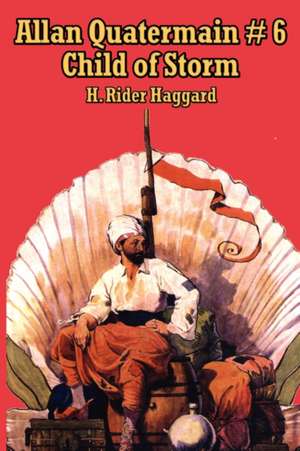
Allan Quatermain # 6
Autor H. Rider Haggarden Limba Engleză Paperback – 9 aug 2007
Preț: 80.10 lei
Puncte Express: 120
Carte tipărită la comandă
Livrare economică 04-18 ianuarie 27
Livrare prin curier în România Termenul estimat este afișat lângă disponibilitate.
Transport gratuit de la 400.00 lei Plată online sau ramburs, în funcție de opțiunile comenzii.
Retur gratuit în 14 zile Comandă securizată și suport în română.
Specificații
ISBN-13: 9781604590319
ISBN-10: 1604590319
Pagini: 168
Dimensiuni: 152 x 229 x 10 mm
Greutate: 0.25 kg
Editura: A & D Publishing
Locul publicării:United States
ISBN-10: 1604590319
Pagini: 168
Dimensiuni: 152 x 229 x 10 mm
Greutate: 0.25 kg
Editura: A & D Publishing
Locul publicării:United States
V-ar putea interesa
-
 -23%Preț: 656.17 lei852.17 lei
-
 MR Meeson S WillH. Rider HaggardPreț: 132.15 lei
-
 CaeliaDanielle MoriartyPreț: 47.79 lei
-
 CA Andonga, Mara N y BurundangaJaime Sa Z.Preț: 101.91 lei
-
 Preț: 254.00 lei
-
 The Caldarian ConflictMike KalmbachPreț: 87.05 lei
-
 Caged by DamnationJ. D. StroubePreț: 102.42 lei
-
 Calen HarperD. A. RicciPreț: 101.43 lei
-
 The Bzou CurseChristina Smith BelcherPreț: 54.15 lei
-
 By the Light of the Arch DragonMichael MeffordPreț: 90.03 lei
-
 By Blood BetrayedDavid J. HouptPreț: 95.95 lei
-
 By the Blood, Book One, RevelationGeoffrey GangesPreț: 83.54 lei
-
 Calista's CourtSusan HulcherPreț: 70.36 lei
-
 By the BloodMegan Pointer-PellerinPreț: 115.63 lei
-
 Drowning in the DarkPippa DacostaPreț: 87.06 lei
-
 Ties That BindPippa DacostaPreț: 87.89 lei
-
 Occult Assassin #2William MassaPreț: 60.34 lei
-
 Relentless FireAni'a Melanie DuttonPreț: 95.60 lei
-
 The Moon MaidEdgar Rice BurroughsPreț: 89.52 lei
-
 The Other WorldsChristopher K. GregerPreț: 93.61 lei
-
 Allan Quatermain # 5H. Rider HaggardPreț: 97.86 lei
-
 Heart of the WorldH. Rider HaggardPreț: 115.91 lei
-
 Preț: 133.19 lei
Notă biografică
H. Rider Haggard (1856-1925) was an English novelist whose adventure fiction grew partly out of years spent in southern Africa. Born in Norfolk, he went to Natal in 1875 as a young man and worked in British colonial administration. He was in the Transvaal during the period of British annexation and later returned to England. These experiences supplied settings and political material for his books, which he wrote for an audience at the height of Britain's imperial expansion.King Solomon's Mines (1885) made Haggard widely known and introduced Allan Quatermain, a hunter and guide who tells his own story. She (1887) followed travelers into the domain of the long-lived Ayesha. Haggard also wrote historical fiction, including Montezuma's Daughter, and returned repeatedly to Quatermain. The recurring narrator gave him a way to tell stories across different parts of the character's life and to make adventures sound like recollections exchanged among acquaintances.Maiwa's Revenge appeared in book form in 1888. In this shorter Quatermain tale, a hunt becomes entangled with a woman's effort to avenge her child and save the man who helped her escape. Haggard gives the telling to the English adventurer while making the plot depend on Maiwa's knowledge, initiative, and claim on her father. That balance is one reason the work stands apart within the Quatermain stories. A reader can follow the outward action and also notice how much of it the narrator learns only when Maiwa chooses to tell him.Haggard's interests extended beyond fiction. He wrote about farming and rural conditions, including in Rural England, and took part in public inquiries and policy discussions concerning agriculture and settlement. His wide readership as a novelist rested chiefly on the momentum of the romances, where an expedition could cross abruptly from a recognizable landscape into unfamiliar political or supernatural territory. Later readers have also examined the way those books reflect and help shape British ideas about empire. In his shorter tales the conventions are particularly easy to see at work. The authority claimed by the traveler's voice can sit beside a recognition that travelers know far less about the places they enter than the people they meet there.