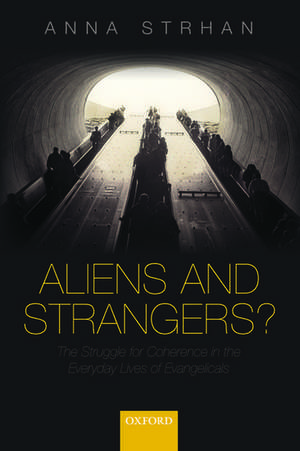
Aliens & Strangers?: The Struggle for Coherence in the Everyday Lives of Evangelicals
Autor Anna Strhanen Limba Engleză Paperback – 26 sep 2019
Preț: 214.14 lei
Preț vechi: 273.54 lei
-22%
Puncte Express: 321
Carte tipărită la comandă
Livrare economică 27 noiembrie-08 decembrie
Livrare prin curier în România Termenul estimat este afișat lângă disponibilitate.
Transport gratuit de la 400.00 lei Plată online sau ramburs, în funcție de opțiunile comenzii.
Retur gratuit în 14 zile Comandă securizată și suport în română.
Specificații
ISBN-13: 9780198842385
ISBN-10: 0198842384
Pagini: 256
Dimensiuni: 155 x 233 x 14 mm
Greutate: 0.36 kg
Editura: OUP OXFORD
Colecția OUP Oxford
Locul publicării:Oxford, United Kingdom
ISBN-10: 0198842384
Pagini: 256
Dimensiuni: 155 x 233 x 14 mm
Greutate: 0.36 kg
Editura: OUP OXFORD
Colecția OUP Oxford
Locul publicării:Oxford, United Kingdom
V-ar putea interesa
-
 The Weight of GloryC. S. LewisPreț: 77.29 lei
 -
 Anglicanism: A Very Short IntroductionMark Chapman-20%Preț: 57.15 lei71.12 lei
 -
 -11%Preț: 509.89 lei572.90 lei
 -
 -34%Preț: 730.85 lei1102.29 lei
 -
 -31%Preț: 870.91 lei1263.88 lei
 -
 -31%Preț: 694.63 lei1008.68 lei
 -
 Confirmation Book for AdultsSharon SwainPreț: 79.69 lei
 -
 Preț: 169.49 lei
 -
 Preț: 326.40 lei
 -
 Preț: 79.11 lei
 -
 Preț: 73.46 lei
 -
 My Journey So FarAndrew WhitePreț: 116.59 lei
 -
 Episcopal Questions, Episcopal AnswersC K RobertsonPreț: 94.73 lei
 -
 The Episcopal HandbookChurch Publishing IncorporatedPreț: 156.98 lei
Notă biografică
Anna Strhan is Lecturer in Sociology at the University of York. Her research interests are in the sociology of religion, in conversation with the sociology of the family, childhood studies, urban sociology, the sociology of the body, and the anthropology of religion and ethics. She is the author of Levinas, Subjectivity, Education: Towards an Ethics of Radical Responsibility (2012).
Cuprins
- 1: Modernity, Faith, and the City
- 2: Dividing the Subject: Embodiment, Interrelationality, and Ethical Subjectivity
- 3: Speaking Subjects: Difference, Indifference, and Moral Fragmentation
- 4: The Listening 'I'
- 5: What does God want? Coherence, Love, and the Personality of God
- 6: Of Time, the Body and the City: Belief, Absence, and Incompleteness
- Conclusion: The Conflict and Tragedy of Culture
- Bibliography
Recenzii
This is an outstanding book. Well-written, accessible and thought-provoking, it needs to be read not only by students and scholars of contemporary evangelical Christianity but by all those interested in contemporary (un)settlements of religion and the city.
Both ethnographically rich and theoretically rigorous, this is an important book that speaks to multiple concerns and disciplines.
Aliens and Strangers? compels us to reconsider positions we may have held, and to reconcile competing narratives of what it means to be religious in a secular and cosmopolitan environment. In essence, Strhan invites us to struggle along with her and her participants to make sense of religious life.
Aliens and strangers? is a book significantly and creatively engaged with work in the anthropology of Christianity focused on materiality, language, embodiment, values, and morality. But its profound reckoning with the Simmelian themes of fragmentation and the quest for coherence is genuinely novel within that literature, and the ring of ethnographic truth these themes achieve in this study of St Johnâs recommends them strongly as topics for further investigation.
This is a fantastic book. Anna Strhan brings us, through her wonderful ethnography, into the heart of a Christian congregation in the belly of the City of London. Her observations of the ways in which these Christians navigate work and faith, Church and culture, are deeply revealing of the fault lines and fissures in secular modernity. But what really sweeps the reader away is her theoretical sophistication, her ability to bring the sociological theory, the anthropology of Christianity, and urban studies into a distinctive configuration. Strhan is a major new voice in the sociology of religion. Aliens and Strangers? Lucky us. We'll be reading it for a long time to come
If you read only one book about evangelicalism, make it this one. No other scholar has accessed the ways this movement provides specific epistemological resources to survive in everyday modernity. Strhan does this, developing a richly human portrait of the ways certain evangelical metaphors, social relations, and interpretive systems offer usable hermeneutic tools for people trying to reckon with the contradictions of capitalist desire and the inevitability of physical, material, and emotional suffering. This is a book that doesn't apply theory to individual lives, but instead discerns how individuals theoretically reason between many competing concepts of self and society. Anna Strhan is an impeccable ethnographer, but even more: in this book, she shines as an incomparable humanist
This is a wonderful book that leads us into some unexpected places. The everyday lives of conservative evangelicals in London are portrayed with immense subtlety. We learn about faith but also doubt, triumph but also shame, religious subjectivity alongside metropolitan sensibility. By the end, we have to reconsider what we thought we knew about religious coherence-and about conservatism itself
Both ethnographically rich and theoretically rigorous, this is an important book that speaks to multiple concerns and disciplines.
Aliens and Strangers? compels us to reconsider positions we may have held, and to reconcile competing narratives of what it means to be religious in a secular and cosmopolitan environment. In essence, Strhan invites us to struggle along with her and her participants to make sense of religious life.
Aliens and strangers? is a book significantly and creatively engaged with work in the anthropology of Christianity focused on materiality, language, embodiment, values, and morality. But its profound reckoning with the Simmelian themes of fragmentation and the quest for coherence is genuinely novel within that literature, and the ring of ethnographic truth these themes achieve in this study of St Johnâs recommends them strongly as topics for further investigation.
This is a fantastic book. Anna Strhan brings us, through her wonderful ethnography, into the heart of a Christian congregation in the belly of the City of London. Her observations of the ways in which these Christians navigate work and faith, Church and culture, are deeply revealing of the fault lines and fissures in secular modernity. But what really sweeps the reader away is her theoretical sophistication, her ability to bring the sociological theory, the anthropology of Christianity, and urban studies into a distinctive configuration. Strhan is a major new voice in the sociology of religion. Aliens and Strangers? Lucky us. We'll be reading it for a long time to come
If you read only one book about evangelicalism, make it this one. No other scholar has accessed the ways this movement provides specific epistemological resources to survive in everyday modernity. Strhan does this, developing a richly human portrait of the ways certain evangelical metaphors, social relations, and interpretive systems offer usable hermeneutic tools for people trying to reckon with the contradictions of capitalist desire and the inevitability of physical, material, and emotional suffering. This is a book that doesn't apply theory to individual lives, but instead discerns how individuals theoretically reason between many competing concepts of self and society. Anna Strhan is an impeccable ethnographer, but even more: in this book, she shines as an incomparable humanist
This is a wonderful book that leads us into some unexpected places. The everyday lives of conservative evangelicals in London are portrayed with immense subtlety. We learn about faith but also doubt, triumph but also shame, religious subjectivity alongside metropolitan sensibility. By the end, we have to reconsider what we thought we knew about religious coherence-and about conservatism itself