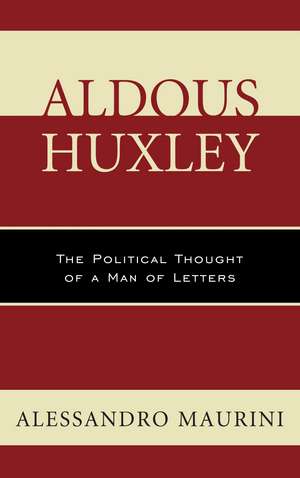
Aldous Huxley: The Political Thought of a Man of Letters: Politics, Literature, & Film
Autor Alessandro Maurinien Limba Engleză Paperback – 3 dec 2018
Huxley clearly grasped the unsolved issues of contemporary liberalism, and the importance of his influence on many twentieth-century and present-day political thinkers ensures that his ideas remain indispensable in the current liberal-democratic debate. Brave New World is without doubt Huxley's most successful political manifesto. While examining the impassioned struggle for the development of all human potentialities, it yet manages not to close the doors definitively on the rebirth of utopia in the age of dystopia.
Din seria Politics, Literature, & Film
- 33%
 Preț: 610.70 lei
 - 36%
 Preț: 523.76 lei
 - 32%
 Preț: 595.30 lei
 - 27%
 Preț: 267.85 lei
 - 26%
 Preț: 286.85 lei
 - 32%
 Preț: 492.86 lei
 - 23%
 Preț: 320.41 lei
 - 27%
 Preț: 261.59 lei
 - 32%
 Preț: 551.67 lei
 - 27%
 Preț: 255.41 lei
 - 33%
 Preț: 549.74 lei
 - 32%
 Preț: 585.00 lei
 - 27%
 Preț: 269.73 lei
 - 36%
 Preț: 731.91 lei
 - 27%
 Preț: 253.44 lei
 - 31%
 Preț: 530.79 lei
 - 32%
 Preț: 551.24 lei
 - 27%
 Preț: 256.60 lei
 - 32%
 Preț: 584.46 lei
 - 33%
 Preț: 542.52 lei
 - 33%
 Preț: 550.43 lei
 - 23%
 Preț: 321.18 lei
 - 33%
 Preț: 549.63 lei
 - 26%
 Preț: 286.06 lei
 - 11%
 Preț: 504.56 lei
 - 36%
 Preț: 523.68 lei
 - 33%
 Preț: 581.93 lei
 - 24%
 Preț: 309.72 lei
 - 30%
 Preț: 534.50 lei
 - 27%
 Preț: 271.53 lei
 - 27%
 Preț: 256.31 lei
 - 27%
 Preț: 261.13 lei
 - 33%
 Preț: 549.46 lei
 - 27%
 Preț: 257.60 lei
 - 33%
 Preț: 548.38 lei
 - 34%
 Preț: 597.72 lei
 - 27%
 Preț: 252.91 lei
 - 33%
 Preț: 549.82 lei
 - 33%
 Preț: 550.36 lei
 - 31%
 Preț: 528.50 lei
 - 31%
 Preț: 529.05 lei
 - 33%
 Preț: 549.82 lei
Preț: 263.53 lei
Preț vechi: 359.88 lei
-27%
Puncte Express: 395
Carte tipărită la comandă
Livrare economică 30 noiembrie-14 decembrie
Livrare prin curier în România Termenul estimat este afișat lângă disponibilitate.
Transport gratuit de la 400.00 lei Plată online sau ramburs, în funcție de opțiunile comenzii.
Retur gratuit în 14 zile Comandă securizată și suport în română.
Specificații
ISBN-13: 9781498513791
ISBN-10: 1498513794
Pagini: 192
Dimensiuni: 149 x 230 x 13 mm
Greutate: 0.34 kg
Editura: Bloomsbury Publishing
Colecția Lexington Books
Seria Politics, Literature, & Film
Locul publicării:New York, United States
ISBN-10: 1498513794
Pagini: 192
Dimensiuni: 149 x 230 x 13 mm
Greutate: 0.34 kg
Editura: Bloomsbury Publishing
Colecția Lexington Books
Seria Politics, Literature, & Film
Locul publicării:New York, United States
Cuprins
Chapter One. Beyond Marxism and Positivism: the Formative Years
Chapter Two. Huxley's Political Thinking: the Lesson of Vilfredo Pareto
Chapter Three. Mass Society and Fordism
Chapter Four. The Totalitarian Elite
Chapter Five. Democratic Elitism for Peace and Democracy
Chapter Six. Political Thought between Utopia and Dystopia
Chapter Seven. Huxley within Contemporary Political Thought
Chapter Two. Huxley's Political Thinking: the Lesson of Vilfredo Pareto
Chapter Three. Mass Society and Fordism
Chapter Four. The Totalitarian Elite
Chapter Five. Democratic Elitism for Peace and Democracy
Chapter Six. Political Thought between Utopia and Dystopia
Chapter Seven. Huxley within Contemporary Political Thought
Recenzii
Alessandro Maurini's new book, Aldous Huxley: The Political Thought of a Man of Letters (Lanham: Lexington Books, 2017) successfully draws out Huxley's own views, and places him in the context of early twentieth-century political philosophy. Maurini's book will be of interest both to fans of Huxley's work, and scholars engaged with questions of technology and totalitarianism.... Maurini's Aldous Huxley: The Political Thought of a Man of Letters is an engaging and illuminating portrait of one of the twentieth-century's most important literary thinkers. Maurini carefully outlines those who influence Huxley, and those whom Huxley influences, demonstrating that Huxley's literary offerings come with a philosophical purpose behind them.... Maurini's book does an admirable job showing the complexity of Huxley's navigation of the worlds of political philosophy and literature. It will be of value to any scholar seeking greater understanding of the continuing legacy of twentieth-century anti-utopian political thought.
Here for the first time we have a critical appraisal of Huxley's political thought. Maurini, with an excellent knowledge of the broad corpus of Huxley's work, reveals why Huxley was not only a novelist but a political theorist whose views remain relevant. Readers will find this masterful analysis of Huxley's political theories timely and engaging.
A book-length study of Aldous Huxley's political philosophy has long been a desideratum in Huxley criticism: Alessandro Maurini fills this gap with a perceptive analysis of Huxley's development as a political thinker, from his radical scepticism of any ideologies (including democracy) à la Vilfredo Pareto via his pacifism of the mid-1930s to his later warnings against the misuse of science and technology at the hands of dictators and oligarchies, in conjunction with his plea for a kind of ecological communitarianism towards the end of his career: this is, all in all, a stimulating book with many good insights and even new findings, such as Maurini's concluding rediscovery of the dissentious debate between Huxley and the Italian philosopher Giuseppe Prezzolini in 1958 about the future of mankind.
Here for the first time we have a critical appraisal of Huxley's political thought. Maurini, with an excellent knowledge of the broad corpus of Huxley's work, reveals why Huxley was not only a novelist but a political theorist whose views remain relevant. Readers will find this masterful analysis of Huxley's political theories timely and engaging.
A book-length study of Aldous Huxley's political philosophy has long been a desideratum in Huxley criticism: Alessandro Maurini fills this gap with a perceptive analysis of Huxley's development as a political thinker, from his radical scepticism of any ideologies (including democracy) à la Vilfredo Pareto via his pacifism of the mid-1930s to his later warnings against the misuse of science and technology at the hands of dictators and oligarchies, in conjunction with his plea for a kind of ecological communitarianism towards the end of his career: this is, all in all, a stimulating book with many good insights and even new findings, such as Maurini's concluding rediscovery of the dissentious debate between Huxley and the Italian philosopher Giuseppe Prezzolini in 1958 about the future of mankind.