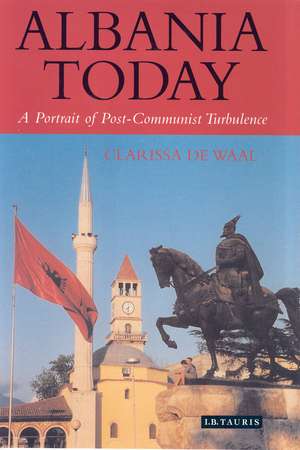
Albania: Portrait of a Country in Transition
Autor Clarissa de Waalen Limba Engleză Hardback – 29 noi 2012
Preț: 592.80 lei
Preț vechi: 887.18 lei
-33%
Puncte Express: 889
Carte disponibilă
Livrare economică 16-30 noiembrie
Livrare prin curier în România Termenul estimat este afișat lângă disponibilitate.
Transport gratuit pentru acest produs Plată online sau ramburs, în funcție de opțiunile comenzii.
Retur gratuit în 14 zile Comandă securizată și suport în română.
Specificații
ISBN-13: 9781780760698
ISBN-10: 1780760698
Pagini: 352
Ilustrații: 150 bw integrated
Dimensiuni: 138 x 216 x 36 mm
Greutate: 0.92 kg
Ediția:New.
Editura: Bloomsbury Publishing
Colecția I.B.Tauris
Locul publicării:London, United Kingdom
ISBN-10: 1780760698
Pagini: 352
Ilustrații: 150 bw integrated
Dimensiuni: 138 x 216 x 36 mm
Greutate: 0.92 kg
Ediția:New.
Editura: Bloomsbury Publishing
Colecția I.B.Tauris
Locul publicării:London, United Kingdom
V-ar putea interesa
-
 Inventing the IndividualLarry SiedentopPreț: 80.55 lei
 -
 Between East and WestAnne Applebaum-19%Preț: 75.81 lei93.37 lei
 -
 Preț: 117.27 lei
 -
 Somme MudE P F Lynch-29%Preț: 66.88 lei94.51 lei
 -
 -24%Preț: 175.74 lei231.86 lei
 -
 The Georgian Menagerie: Exotic Animals in Eighteenth-Century LondonChristopher Plumb-20%Preț: 341.99 lei427.38 lei
 -
 PalmerstonDenis Judd-22%Preț: 123.22 lei158.81 lei
 -
 The Shadow Man: At the Heart of the Cambridge Spy CircleGeoff Andrews-12%Preț: 332.10 lei379.02 lei
 -
 Kitchener: Hero and Anti-HeroC. Brad Faught-21%Preț: 382.49 lei483.89 lei
 -
 -18%Preț: 354.16 lei433.30 lei
 -
 British Imperial: What the Empire Wasn'tProfessor Bernard Porter-20%Preț: 330.15 lei412.75 lei
 -
 Across the Floor: A Life in Dissenting PoliticsPeter Temple-Morris-18%Preț: 357.68 lei436.90 lei
 -
 Forever England: The Countryside at War 1914-1918Caroline Dakers-20%Preț: 146.75 lei184.49 lei
 -
 -25%Preț: 372.43 lei496.64 lei
 -
 -25%Preț: 368.19 lei494.06 lei
 -
 The Metaxas Myth: Dictatorship and Propaganda in GreeceMarina Petrakis-24%Preț: 259.81 lei343.31 lei
 -
 London Was Ours: Diaries and Memoirs of the London BlitzAmy Helen Bell-18%Preț: 192.87 lei236.54 lei
 -
 Preț: 110.30 lei
 -
 -16%Preț: 270.09 lei320.69 lei
Notă biografică
Oliver Gilkes is Senior Research Associate at the Institute of World Archaeology, University of East Anglia. He has worked extensively on the excavations at Butrint and in collaboration with The Butrint Foundation.
Cuprins
IntroductionUsing this guideVisiting archaeological sites in AlbaniaArchaeology in AlbaniaAlbania: An archaeological and historical overviewSites:5.Amantia6.Antigoneia7.Apollonia8.Arapaj9.Ballsh10.Berat11.Bader12.Bashtova13.Borsh (Sopot)14.Bradashesh15.ButrintThe Vrina PlainDiaporitKalivo16.Byllis17.Çiflik18.Çuka e Ajtoit19.DelvinaRusanShen Jan20.Dema21.Durres22.Elbasan23.Finiq (Phoenice)24.Gjirokastra25.Goranxi26.Grama Bay27.Jogucat28.Kamenica29.Kruja30.Labova e Kryqit31.Lin32.Loefkend33.Malathrea34.Maliq35.Mesopotam36.Oricum37.Paleokaster38.Petrela39.Porto Palermo40.Preza41.Rodon42.SarandaThe Church of the Forty Martyrs LekuresMetoq and Çuka43.Selce44.Shkodra45.Sofratika46.Teplena47.Tirana48.Tren49.Voskopoja50.ZgerdheshTravel Agents and AccommodationGlossarySpelling and Punctuation Guide
Descriere
Descriere de la o altă ediție sau format:
Catapulted from totalitarianism to free market capitalism in 1991, Albania emerged from half a century of isolation to find itself an anomaly in Europe: a third world country economically, but first world in terms of education, literature and the arts. How has Albania transformed since then? Clarissa de Waal here explains Albania's 'transition' from Communism via the experiences of a diverse range of families, highland villagers, urban elite and shanty dwellers - whose lives she has followed since 1992. De Waal shows that whilst the archaic world of customary law continues to pervade highland life, and squatters on state farmland live under constant threat of eviction, members of the ex-communist elite in Tirana embrace rentier capitalism. Albania, it seems, is a country wracked by contradictions. With unparalleled insights into the region, this book is a unique history told from the perspective of the participants. It will inform and engage all those interested in Albania and south-east Europe, and prove essential reading for students and specialists.
Catapulted from totalitarianism to free market capitalism in 1991, Albania emerged from half a century of isolation to find itself an anomaly in Europe: a third world country economically, but first world in terms of education, literature and the arts. How has Albania transformed since then? Clarissa de Waal here explains Albania's 'transition' from Communism via the experiences of a diverse range of families, highland villagers, urban elite and shanty dwellers - whose lives she has followed since 1992. De Waal shows that whilst the archaic world of customary law continues to pervade highland life, and squatters on state farmland live under constant threat of eviction, members of the ex-communist elite in Tirana embrace rentier capitalism. Albania, it seems, is a country wracked by contradictions. With unparalleled insights into the region, this book is a unique history told from the perspective of the participants. It will inform and engage all those interested in Albania and south-east Europe, and prove essential reading for students and specialists.