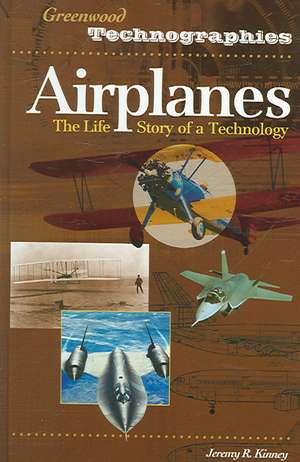
Airplanes: The Life Story of a Technology: Greenwood Technographies
Autor Jeremy Kinneyen Limba Engleză Hardback – 30 iun 2006
The volume includes a glossary of terms, a timeline of important events, and a selected bibliography of useful resources for further information.



Preț: 233.68 lei
Preț vechi: 417.74 lei
-44%
Puncte Express: 351
Carte tipărită la comandă
Livrare economică 03-17 decembrie
Livrare prin curier în România Termenul estimat este afișat lângă disponibilitate.
Transport gratuit de la 400.00 lei Plată online sau ramburs, în funcție de opțiunile comenzii.
Retur gratuit în 14 zile Comandă securizată și suport în română.
Specificații
ISBN-13: 9780313331503
ISBN-10: 0313331502
Pagini: 184
Dimensiuni: 156 x 235 x 20 mm
Greutate: 0.42 kg
Editura: Bloomsbury Publishing
Colecția Greenwood
Seria Greenwood Technographies
Locul publicării:New York, United States
ISBN-10: 0313331502
Pagini: 184
Dimensiuni: 156 x 235 x 20 mm
Greutate: 0.42 kg
Editura: Bloomsbury Publishing
Colecția Greenwood
Seria Greenwood Technographies
Locul publicării:New York, United States
V-ar putea interesa
-
 -39%Preț: 351.76 lei572.55 lei
 -
 Electronics: The Life Story of a TechnologyDavid Morton-44%Preț: 244.66 lei437.10 lei
 -
 Preț: 79.80 lei
 -
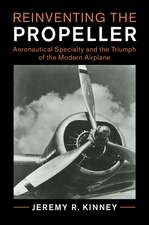 Reinventing the PropellerJeremy R Kinney-32%Preț: 694.86 lei1015.97 lei
 -
 Preț: 370.91 lei
 -
 Alaska and the Airplane: A Century of FlightJulie Decker-16%Preț: 121.58 lei144.52 lei
 -
 Vascularization for Tissue Engineering and Regenerative MedicineWolfgang Holnthoner-18%Preț: 3137.38 lei3826.07 lei
 -
 HochleistungsfaserverbundwerkstoffeLeif A. CarlssonPreț: 315.40 lei
 -
 Fabrikbetriebslehre 1Thomas BauernhanslPreț: 304.87 lei
Cuprins
Timeline of Events
Preface
Introduction: Higher, Faster, and Farther
The Origins of Powered Flight
The First War in the Air, 1914-1918
The Aeronautical Revolution, 1918-1938
World War II in the Air, 1939-1945
The Second Aeronautical Revolution, 1930-1960
The Jet Airplane as a Military Weapon, 1945-Present
The Commercial Airplane, 1945-Present
General Aviation, 1920-Present
Conclusion: Higher, Ever Higher
Selected Bibliography
Glossary
Index
Preface
Introduction: Higher, Faster, and Farther
The Origins of Powered Flight
The First War in the Air, 1914-1918
The Aeronautical Revolution, 1918-1938
World War II in the Air, 1939-1945
The Second Aeronautical Revolution, 1930-1960
The Jet Airplane as a Military Weapon, 1945-Present
The Commercial Airplane, 1945-Present
General Aviation, 1920-Present
Conclusion: Higher, Ever Higher
Selected Bibliography
Glossary
Index
Recenzii
Another in a Greenwood Press series of monographs, Greenwood Technographies, this publication by Kinney gives a detailed, informative picture of the history and advancement of the airplane, which has evolved from its beginnings with the first flight at Kitty Hawk in 1903 to the maneuverable jets that can break the sound barrier today. This book is written in a very general and understandable style. The author manages to do an impressive job of thoroughly discussing the details and specifics of the way that airplane technology improved and the political movements, world events, and social change that brought about these improvements. The introduction also offers an excellent overview of the physics of flight and the time line of the evolution of the airplane. Recommended. General readers; lower-division undergraduates; two-year technical program students.
The Wrights called it a flyer, not an airplane. Wiley Post's luck ran out in 1935, but first he wore the world's first pressure suit at about 50,000 feet. The first American turboprop airliner debuted in 1958, but dragged six years after the British. Kinney, curator of the Aeronautics Division at the National Air and Space Museum, covers the efforts of everyone from a hapless flying monk in Malmesbury in the 1100s, Newton (lift and drag), Smeaton (cambered wings) and the remarkable Cayley who had most of it figured out in the first half of the nineteenth century. He is careful to keep his narrative accessible to general readers and includes a manageable glossary and list of related reading. He rightly devotes substantial space to the contributions of military and commercial flight but also describes general aviation and the more recent advances in going higher, faster and farther.
The Wrights called it a flyer, not an airplane. Wiley Post's luck ran out in 1935, but first he wore the world's first pressure suit at about 50,000 feet. The first American turboprop airliner debuted in 1958, but dragged six years after the British. Kinney, curator of the Aeronautics Division at the National Air and Space Museum, covers the efforts of everyone from a hapless flying monk in Malmesbury in the 1100s, Newton (lift and drag), Smeaton (cambered wings) and the remarkable Cayley who had most of it figured out in the first half of the nineteenth century. He is careful to keep his narrative accessible to general readers and includes a manageable glossary and list of related reading. He rightly devotes substantial space to the contributions of military and commercial flight but also describes general aviation and the more recent advances in going higher, faster and farther.