
Vascularization for Tissue Engineering and Regenerative Medicine: Reference Series in Biomedical Engineering
Editat de Wolfgang Holnthoner, Andrea Banfi, James Kirkpatrick, Heinz Redlen Limba Engleză Hardback – 9 iun 2021
Structura acestui tratat academic, Vascularization for Tissue Engineering and Regenerative Medicine, este riguros organizată pentru a ghida cititorul de la mecanismele moleculare de bază până la implementările clinice complexe. Prima parte a volumului se concentrează pe inducția angiogenezei, analizând rolul factorilor de semnalizare și al stabilizării HIF, urmată de o examinare detaliată a stimulării fizice, unde remarcăm includerea unor tehnologii de ultimă oră precum undele de șoc. Progresia materialului continuă cu metodele de (pre)vascularizare, explorând utilizarea canalelor, a mulajelor mecanice și a arborilor vasculari decelularizați pentru crearea rețelelor microvasculare. Această ediție din 2021, publicată de Springer International Publishing, se distinge printr-o perspectivă integrată asupra limfogenezei și a strategiilor de inginerie a compozitelor tisulare vascularizate la nivel dual. Considerăm că volumul oferă un echilibru necesar între rigoarea teoretică și aplicabilitatea practică, dedicând capitole extinse grefelor vasculare și utilizării lor în medicina regenerativă actuală. Manual de referință comparabil cu Vascularization de Eric M. Brey, dar actualizat conform progreselor tehnologice din 2021, lucrarea de față pune un accent mai mare pe fabricarea aditivă și pe controlul micromediului celular pentru asamblarea rețelelor vasculare funcționale. Stilul este unul clinic și precis, reflectând expertiza colectivă a editorilor în cadrul seriei Tissue Engineering and Regeneration. Volumul nu se limitează la descrierea fenomenelor, ci analizează critic limitările actuale ale scafoldelor sintetice în raport cu cele biologice, oferind o resursă esențială pentru cercetătorii care doresc să depășească bariera difuziei oxigenului în țesuturile de mari dimensiuni create în laborator.

Preț: 3137.38 lei
Preț vechi: 3826.07 lei
-18%
Carte disponibilă
Livrare economică 18 decembrie 26 - 01 ianuarie 27
Specificații
ISBN-10: 3319545841
Pagini: 588
Ilustrații: XXI, 565 p. 92 illus., 86 illus. in color.
Dimensiuni: 160 x 241 x 35 mm
Greutate: 1.09 kg
Ediția:1st ed. 2021
Editura: Springer
Colecția Reference Series in Biomedical Engineering
Seriile Reference Series in Biomedical Engineering, Vascularization for Tissue Engineering and Regenerative Medicine
Locul publicării:Cham, Switzerland
V-ar putea interesa
-
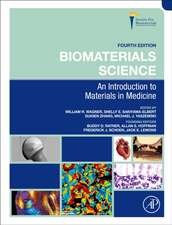 Biomaterials Science: An Introduction to Materials in MedicineWilliam R Wagner-27%Preț: 959.02 lei1311.66 lei
-
 Sabiston Textbook of Surgery: The Biological Basis of Modern Surgical PracticeDouglas Scott Tyler-28%Preț: 1185.20 lei1644.95 leiRecomandat
-
 Methods in Cardiovascular and Lymphatic BiologyEvangelia Papadimitriou-5%Preț: 1475.48 lei1553.13 lei
-
 -29%Preț: 837.23 lei1183.02 lei
-
 Plastic and Reconstructive SurgeryMaria Z. Siemionow-5%Preț: 1083.44 lei1140.46 lei
-
 Organ ManufacturingXiaohong Wang-27%Preț: 2072.77 lei2823.83 lei
-
 Evidence for Vascular Surgery: 2nd EditionJ J Earnshaw-19%Preț: 435.76 lei537.16 lei
-
 Tissue Engineering in Oral and Maxillofacial SurgeryRiitta Seppänen-Kaijansinkko-23%Preț: 622.10 lei807.92 lei
-
 Tissue EngineeringJeong-Yeol YoonPreț: 445.04 lei
-
 -18%Preț: 900.27 lei1097.89 lei
-
 Fundamentals of Vascular BiologyMargarethe Geiger-15%Preț: 628.14 lei738.98 lei
-
 Engineering Mineralized and Load Bearing TissuesLuiz E. Bertassoni-18%Preț: 991.51 lei1209.16 lei
-
 3D Printing and BiofabricationAleksandr Ovsianikov-18%Preț: 2584.91 lei3152.33 lei
-
 Tissue Engineering: From Lab to ClinicNorbert Pallua-5%Preț: 1099.74 lei1157.63 lei
-
 Adipose Stem Cells and Regenerative MedicineYves-Gerard Illouz-5%Preț: 1115.38 lei1174.09 lei
-
 The Dental PulpMichel Goldberg-5%Preț: 844.44 lei888.89 lei
-
 Therapeutic AngiogenesisYukihito Higashi-5%Preț: 1207.03 lei1270.55 lei
-
 Natural Product Inspired ScaffoldsMohit Kumar-18%Preț: 1268.54 lei1547.01 lei
De ce să citești această carte
Recomandăm această lucrare specialiștilor în inginerie biomedicală și medicină regenerativă care se confruntă cu provocarea integrării vasculare a grefelor. Cititorul câștigă o înțelegere profundă a tehnicilor de 3D bioprinting și a semnalizării biofizice necesare pentru a menține viabilitatea țesuturilor complexe. Este o resursă esențială pentru a trece de la modelele in vitro la soluții clinice durabile, oferind protocoale actualizate pentru vascularizarea scafoldelor.
Despre autor
Echipa editorială este formată din experți de renume mondial în domeniul ingineriei tisulare. Wolfgang Holnthoner și Heinz Redl sunt figuri centrale în cadrul Institutului Ludwig Boltzmann pentru Traumatologie Clinică și Experimentală, având o experiență vastă în regenerarea vasculară. James Kirkpatrick este recunoscut pentru contribuțiile sale fundamentale la interacțiunea biomaterial-celulă, în timp ce Andrea Banfi de la Universitatea din Basel este un pionier în controlul terapeutic al angiogenezei. Împreună, acești autori aduc o perspectivă multidisciplinară asupra provocărilor pe care le ridică vascularizarea în medicina modernă.
Cuprins
Notă biografică
Andrea Banfi directs the Cell and Gene Therapy research group at the University Hospital of Basel, Switzerland. He previously worked in Genova (Italy) and Stanford (CA, USA). His research focuses on: 1) understanding the basic principles governing the growth of blood vessels, particularly the molecular crosstalk between endothelium, mural cells and inflammatory monocytes, in order to identify druggable targets for therapeutic vascular growth; and 2) translating these concepts into novel regenerative medicine approaches, particularly to generate vascularized tissue-engineered grafts and to treat ischemic diseases.
James Kirkpatrick has a triple doctorate in science and medicine (M.D., Ph.D., D.Sc.) from the Queen’s University of Belfast (N. Ireland) and was chairman and professor of pathology at the University Medical Center of the Johannes Gutenberg University (JGU) in Mainz from 1993 to 2015. His prior academic appointments were in pathology at the University of Ulm (1980– 1985), Manchester University, UK (1985–1987), and RWTH (University of Technology), Aachen (1987– 1993). He is a fellow of the Royal College of Pathologists (FRCPath), London (since 1997), and has honorary and visiting professorships in Sweden, China, Singapore, and Cuba. Currently, he is distinguished visiting fellow at the University of Cambridge, UK, and distinguished professor at the Johann Wolfgang Goethe University in Frankfurt, where his current research is being carried out. His principal research interests are in life science aspects of biomaterials in tissue engineering and regenerative medicine, with special focus on human co-culture systems to study vascularization. A special methodological emphasis in his research over the past 30 years has been the development of in vitro cellular systems which have complexity well beyond the simple monocellular system. Thus, how non-vascular cells contribute to the proliferation, differentiation, and architectural organization of microvessel-like structures has xiv About the Editors been a particular focus. For example, his group has pioneered studies which show that cellular crosstalk between osteoblasts or fibroblasts and endothelial cells direct microvessel formation on open porous 3D scaffolds of all material classes (metals, ceramics, and polymers). Kirkpatrick’s researchactivity has been supported over many years by the German Research Foundation (DFG), the Federal Ministry of Education & Research (BMBF), The German-Israeli Foundation (GIF), and the European Commission (EC).
Textul de pe ultima copertă
The book concludes with a discussion of current clinical approaches and the use of vascular grafts in the context of providing clinical practice with new tissue engineering strategies.