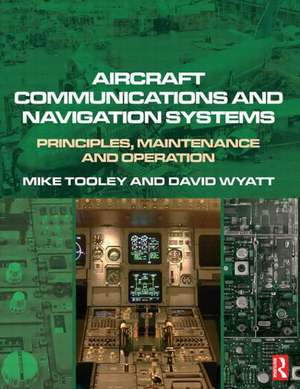
Aircraft Communications and Navigation Systems
Autor Mike Tooley, David Wyatten Limba Engleză Paperback – 14 aug 2007
În industria aerospațială, precizia comunicațiilor și a navigației reprezintă coloana vertebrală a siguranței zborului. Aircraft Communications and Navigation Systems se poziționează ca o resursă tehnică fundamentală, concepută special pentru a răspunde cerințelor riguroase de certificare pentru inginerii de întreținere a aeronavelor. Ne-a atras atenția modul sistematic în care autorii abordează standardele Air Transport Association (ATA), capitolele 23 și 34, integrându-le în modulele 11 și 13 ale programei EASA Part-66. Volumul nu se limitează la teorie, ci oferă o bază practică solidă pentru mecanicii de celulă și motoare (A&P) care vizează obținerea licenței.
Structura cursului este una progresivă: debutează cu bazele fizice ale spectrului de radiofrecvență și propagării undelor în atmosferă, continuă cu analiza detaliată a antenelor (de la dipolul semi-undă la Yagi) și culminează cu arhitecturile complexe ale sistemelor de emisie-recepție digitale. Comparativ cu Aeronautical Radio Communication Systems and Networks de Dale Stacey, care se concentrează pe rețelele de comunicații și infrastructura globală, lucrarea de față pune un accent mai mare pe componentele hardware specifice de la bordul aeronavei și pe mentenanța acestora. Complementar lui Aircraft Systems – Instruments, Communications, Navigation, and Control, volumul de față acoperă mult mai aplicat cerințele specifice de examinare EASA și FAR-147, fiind un instrument de studiu direct pentru examene.
Mike Tooley și David Wyatt reușesc să mențină un echilibru între rigoarea științifică și accesibilitate, oferind diagrame alb-negru explicite și o secțiune bogată de întrebări cu răspuns multiplu la finalul fiecărui capitol. Această a treia ediție reflectă evoluțiile recente din sistemele critice pentru siguranță, asigurând că viitorii ingineri sunt pregătiți pentru tehnologiile moderne de gestionare a traficului aerian.
Preț: 288.06 lei
Preț vechi: 355.23 lei
-19%
Carte tipărită la comandă
Livrare economică 27 noiembrie-11 decembrie
Specificații
ISBN-10: 0750681373
Pagini: 336
Ilustrații: 1, black & white illustrations
Dimensiuni: 190 x 244 x 19 mm
Greutate: 0.65 kg
Editura: Taylor & Francis
V-ar putea interesa
-
 Advanced Aircraft SystemsDavid LombardoPreț: 250.84 lei
 -
 How Radio Signals WorkJim Sinclair-37%Preț: 244.19 lei387.99 lei
 -
 Radar Handbook, Third EditionMerrill Skolnik-23%Preț: 1292.51 lei1678.59 lei
 -
 Ace The Technical Pilot Interview 2/EGary Bristow-32%Preț: 172.37 lei254.30 lei
 -
 -19%Preț: 430.60 lei531.60 lei
 -
 Aircraft Electricity and Electronics, Seventh EditionThomas Eismin-32%Preț: 626.79 lei923.10 lei
 -
 Principles of Electronic Communication Systems ISELouis Frenzel-24%Preț: 361.54 lei472.63 lei
 -
 Communication Systems Engineering with Gnu RadioJean-Michel Friedt-23%Preț: 692.21 lei898.97 lei
 -
 Yachtmaster for Sail and Power 6th EditionRoger Seymour-19%Preț: 197.57 lei242.99 lei
 -
 -26%Preț: 379.75 lei514.78 lei
 -
 Preț: 180.65 lei
 -
 -17%Preț: 389.08 lei468.89 lei
 -
 -11%Preț: 693.58 lei779.31 lei
 -
 -18%Preț: 1065.47 lei1299.34 lei
 -
 Instrument Flying Handbook (2026)Federal Aviation Administration (Faa)Preț: 161.23 lei
 -
 Preț: 63.57 lei
 -
 Aeronautical Knowledge MeteorologyJeremy M PrattPreț: 112.34 lei
 -
 Preț: 175.21 lei
 -
 Air Pilot's Manual - Radio Navigation and Instrument FlyingJonathan ShooterPreț: 258.57 lei
 -
 Radio-Electronic Equipment in Civil AviationSergey Viktorovich Dvornikov-19%Preț: 535.21 lei660.75 lei
Public țintă
Aircraft Maintenance Engineers and those following EASA Part-66 and related training programmes in the UK, Europe, Africa, India, Australasia and the Far East; Airframe and Propulsion Mechanics, Certifying Mechanics, Technicians and Engineers in the US; pilots and flight crew wishing to gain an insight into the principles and practice of a wide range of modern aircraft communications and navigation systemsDe ce să citești această carte
Recomandăm acest volum studenților și inginerilor care se pregătesc pentru examenele EASA Part-66 sau BTEC National. Veți câștiga o înțelegere clară a sistemelor radio și de navigație, susținută de exerciții practice care simulează condițiile de examinare. Este resursa ideală pentru a face trecerea de la teoria undelor radio la aplicarea lor directă în mentenanța avioanelor moderne, oferind totodată acces la resurse interactive suplimentare online.
Despre autor
Mike Tooley și David Wyatt sunt autori consacrați în literatura tehnică de aviație și inginerie. Mike Tooley are o experiență vastă în educația tehnică, scriind lucrări de referință precum Engineering Science și BTEC First Engineering. În contextul aeronautic, colaborarea lor pentru Aircraft Engineering Principles a stabilit un standard în pregătirea personalului de întreținere din Europa, conform cerințelor ECAR 66. Expertiza lor combinată transformă concepte complexe de electronică și avionică în materiale de studiu structurate, fiind recunoscuți pentru capacitatea de a alinia conținutul editorial cu standardele stricte ale autorităților de reglementare în aviație.
Descriere scurtă
This book provides an introduction to the principles of communications and navigation systems. It is written for anyone pursuing a career in aircraft maintenance engineering or a related aerospace engineering discipline, and in particular will be suitable for those studying for licensed aircraft maintenance engineer status. The book systematically addresses the relevant sections (ATA chapters 23/34) of modules 11 and 13 of part-66 of the EASA syllabus. It is ideal for anyone studying as part of an EASA and FAR-147 approved course in aerospace engineering.
Cuprins
1.1 The radio frequency spectrum
1.2 Electromagnetic waves
1.3 Frequency and wavelength
1.4 The atmosphere
1.5 Radio wave propagation
1.6 The ionosphere
1.7 MUF and LUF
1.8 Silent zone and skip distance
1.9 Multiple choice questions
Chapter 2 Antennas
2.1 The isotropic radiator
2.2 The half-wave dipole
2.3 Impedance and radiation resistance
2.4 Radiated power and efficiency
2.5 Antenna gain
2.6 The Yagi beam antenna
2.7 Directional characteristics
2.8 Other practical antennas
2.9 Feeders
2.10 Connectors
2.11 Standing wave ratio
2.12 Waveguide
2.13 Multiple choice questions
Chapter 3 Transmitters and receivers
3.1 A simple radio system
3.2 Modulation and demodulation
3.3 AM transmitters
3.4 FM transmitters
3.5 Tuned radio frequency receivers
3.6 Superhet receivers
3.7 Selectivity
3.8 Image channel rejection
3.9 Automatic gain control
3.10 Double superhet receivers
3.11 Digital frequency synthesis
3.12 A design example
3.13 Multiple choice questions
Chapter 4 VHF communications
4.1 VHF range and propagation
4.2 DSB modulation
4.3 Channel spacing
4.4 Depth of modulation
4.5 Compression
4.6 Squelch
4.7 Data modes
4.8 ACARS
4.9 VHF radio equipment
4.10 Multiple choice questions
Chapter 5 HF communications
5.1 HF range and propagation
5.2 SSB modulation
5.3 SELCAL
5.4 HF data link
5.5 HF radio equipment
5.6 HF antennas and coupling units
5.7 Multiple choice questions
Chapter 6 Flight-deck audio systems
6.1 Flight interphone system
6.2 Cockpit voice recorder
6.3 Multiple choice questions
Chapter 7 Emergency locator transmitters
7.1 Types of ELT
7.2 Maintenance and testing of ELT
7.3 ELT mounting requirements
7.4 Typical ELT
7.5 CospasߝSarsat satellites
7.6 Multiple choice questions
Chapter 8 Aircraft navigation
8.1 The earth and navigation
8.2 Dead reckoning
8.3 Position fixing
8.4 Maps and charts
8.5 Navigation terminology
8.6 Navigation systems development
8.7 Navigation systems summary
8.8 Multiple choice questions
Chapter 9 Automatic direction finder
9.1 Introducing ADF
9.2 ADF principles
9.3 ADF equipment
9.4 Operational aspects of ADF
9.5 Multiple choice questions
Chapter 10 VHF omnidirectional range
10.1 VOR principles
10.2 Airborne equipment
10.3 Operational aspects of VOR
10.4 Multiple choice questions
Chapter 11 Distance measuring equipment
11.1 Radar principles
11.2 DME overview
11.3 DME operation
11.4 Equipment overview
11.5 En route navigation using radio navigation aids
11.6 Multiple choice questions
Chapter 12 Instrument landing system
12.1 ILS overview
12.2 ILS ground equipment
12.3 ILS airborne equipment
12.4 Low range radio altimeter
12.5 ILS approach
12.6 Autoland
12.7 Operational aspects of the ILS
12.8 Multiple choice questions
Chapter 13 Microwave landing system
13.1 MLS overview
13.2 MLS principles
13.3 Aircraft equipment
13.4 Ground equipment
13.5 MLS summary
13.6 Multiple choice questions
Chapter 14 Hyperbolic radio navigation
14.1 Hyperbolic position fixing
14.2 Loran overview
14.3 Loran-C operation
14.4 Loran-C ground equipment
14.5 Loran-C airborne equipment
14.6 Enhanced Loran (eLoran)
14.7 Multiple choice questions
Chapter 15 Doppler navigation
15.1 The Doppler effect
15.2 Doppler navigation principles
15.3 Airborne equipment overview
15.4 Typical Doppler installations
15.5 Doppler summary
15.6 Other Doppler applications
15.7 Multiple choice questions
Chapter 16 Area navigation
16.1 RNAV overview
16.2 RNAV equipment
16.3 Kalman filters
16.4 Required navigation performance
16.5 Multiple choice questions
Chapter 17 Inertial navigation systems
17.1 Inertial navigation principles
17.2 System overview
17.3 System description
17.4 Alignment process
17.5 Inertial navigation accuracy
17.6 Inertial navigation summary
17.7 System integration
17.8 Multiple choice questions
Chapter 18 Global navigation satellite system
18.1 GPS overview
18.2 Principles of wave propagation
18.3 Satellite navigation principles
18.4 GPS segments
18.5 GPS signals
18.6 GPS operation
18.7 Other GNSS
18.8 The future of GNSS
18.9 Multiple choice questions
Chapter 19 Flight management systems
19.1 FMS overview
19.2 Flight management computer system
19.3 System initialisation
19.4 FMCS operation
19.5 FMS summary
19.6 Multiple choice questions
Chapter 20 Weather radar
20.1 System overview
20.2 Airborne equipment
20.3 Precipitation and turbulence
20.4 System enhancements
20.5 Lightning detection
20.6 Multiple choice questions
Chapter 21 Air traffic control system
21.1 ATC overview
21.2 ATC transponder modes
21.3 Airborne equipment
21.4 System operation
21.5 Automatic dependent surveillance-broadcast
21.6 Communications, navigation and surveillance/air traffic management
21.7 Multiple choice questions
Chapter 22 Traffic alert and collision avoidance system
22.1 Airborne collision avoidance systems
22.2 TCAS overview
22.3 TCAS equipment
22.4 System operation
22.5 Multiple choice questions
Appendices
1 Abbreviations and acronyms
2 Revision papers
3 Answers
4 Decibels
Index
Notă biografică
David Wyatt has over 45 years’ experience in the aviation industry. After a technician apprenticeship in BOAC he progressed as a development engineer at BA. After a period as an avionics engineering lecturer in further education, David went on to become Head of Airworthiness at Gama Aviation. David is the author of several popular books in the Routledge Aircraft Engineering Series.
Descriere
Introducing the principles of communications and navigation systems, this is ideal for students on an EASA and FAR-147-approved course in aerospace engineering. This new edition offers an overview of the latest technologies.