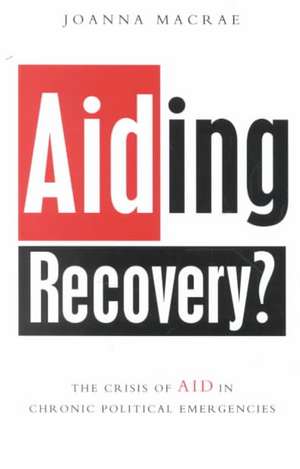
Aiding Recovery: The Crisis of Aid in Chronic Political Emergencies
Autor Joanna Macraeen Limba Engleză Paperback – iul 2001
International aid has traditionally assumed the existence of stable, sovereign states capable of making policy. In a number of developing countries, including post-conflict regimes like Cambodia, Uganda or Kosovo, this is no longer the case. The big donor agencies have usually responded by suspending development aid and substituting some kind of emergency or relief assistance. Now, as the author shows, there are calls to make relief more development-oriented and for it to address the underlying conflicts which causes these crises. But she concludes from her investigations on the ground in a number of countries that relief and development aid are very distinct processes. In the absence of public policy-making authorities, aid becomes highly fragmented, often inadequate in scale, and certainly not capable of building local sustainability for particular programmes.
The international aid system, she concludes, faces real dilemmas and remains ill-equipped to respond to the peculiar challenges of quasi-statehood that characterize chronic political emergencies and their aftermath.
Preț: 166.70 lei
Preț vechi: 199.96 lei
-17%
Puncte Express: 250
Carte tipărită la comandă
Livrare economică 28 noiembrie-12 decembrie
Livrare prin curier în România Termenul estimat este afișat lângă disponibilitate.
Transport gratuit de la 400.00 lei Plată online sau ramburs, în funcție de opțiunile comenzii.
Retur gratuit în 14 zile Comandă securizată și suport în română.
Specificații
ISBN-13: 9781856499415
ISBN-10: 1856499413
Pagini: 208
Dimensiuni: 138 x 216 x 15 mm
Greutate: 0.27 kg
Editura: Bloomsbury Publishing
Colecția Zed Books
Locul publicării:London, United Kingdom
ISBN-10: 1856499413
Pagini: 208
Dimensiuni: 138 x 216 x 15 mm
Greutate: 0.27 kg
Editura: Bloomsbury Publishing
Colecția Zed Books
Locul publicării:London, United Kingdom
V-ar putea interesa
-
 Dead AidDambisa Moyo-20%Preț: 63.04 lei78.35 lei
 -
 Toxic Aid: Economic Collapse and Recovery in TanzaniaSebastian Edwards-31%Preț: 570.20 lei826.31 lei
 -
 -31%Preț: 854.23 lei1240.23 lei
 -
 -31%Preț: 772.18 lei1122.58 lei
 -
 -27%Preț: 68.17 lei93.16 lei
 -
 Hope in HellDan BortolottiPreț: 130.52 lei
 -
 -23%Preț: 926.72 lei1209.80 lei
 -
 -25%Preț: 196.16 lei261.23 lei
 -
 -17%Preț: 215.11 lei259.93 lei
 -
 Carbonnier, G: Humanitarian EconomicsGilles Carbonnier-23%Preț: 229.64 lei297.67 lei
 -
 -19%Preț: 121.61 lei149.31 lei
 -
 Aid, NGOs and the Realities of Women's LivesTina WallacePreț: 232.41 lei
Cuprins
1. Introduction and overview
2. Aid, war and the state: 1945-1989
3. Aid beyond the state: the emergence of a 'new' aid orthodoxy?
4. The context of recovery: an overview of war and its impact in Cambodia, Ethiopia and Uganda
5. Aid in a vacuum: the legitimacy dilemma
6. The Sustainability Dilemma
7. Conclusion
2. Aid, war and the state: 1945-1989
3. Aid beyond the state: the emergence of a 'new' aid orthodoxy?
4. The context of recovery: an overview of war and its impact in Cambodia, Ethiopia and Uganda
5. Aid in a vacuum: the legitimacy dilemma
6. The Sustainability Dilemma
7. Conclusion
Recenzii
Basing her analysis on extensive fieldwork in Africa and Asia, Joanna Macrae challenges the emerging orthodoxy that international aid should play a role in the management of conflict, and that it should promote development in the midst of war. An important new book that provides a sobering reassessment of the role and impact of aid in unstable states.
Anyone wishing to understand the new humanitarianism and the growing use of aid as a strategic tool of conflict resolution and social reconstruction in zones of instability will find this book a comprehensive and provocative guide...essential reading for academics and practitioners alike.
Macrae has successfully brought clarity to one of the most complex challenges the humanitarian community now has to face: the role of ostensibly neutral humanitarian assistance in a world of social upheaval and uncertain sovereignty. She has done so with remarkable insight and persuasiveness.
The provision of aid to ensure recovery from conflict and a durable peace has become a central issue in debates about human security and development. Joanna Macrae has written an important book that promises to inform thinking and action in this field and encourages us to think deeply about new ways of responding in these complex emergencies.
Anyone wishing to understand the new humanitarianism and the growing use of aid as a strategic tool of conflict resolution and social reconstruction in zones of instability will find this book a comprehensive and provocative guide...essential reading for academics and practitioners alike.
Macrae has successfully brought clarity to one of the most complex challenges the humanitarian community now has to face: the role of ostensibly neutral humanitarian assistance in a world of social upheaval and uncertain sovereignty. She has done so with remarkable insight and persuasiveness.
The provision of aid to ensure recovery from conflict and a durable peace has become a central issue in debates about human security and development. Joanna Macrae has written an important book that promises to inform thinking and action in this field and encourages us to think deeply about new ways of responding in these complex emergencies.