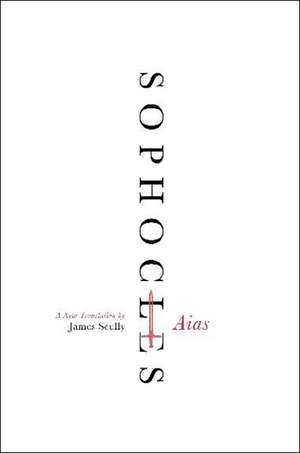
Aias: A New Translation
Autor Sophoclesen Limba Engleză Paperback – 6 aug 2012
Still powerful and remarkably timely thousands of years after its creation, Aias is the moving story of a soldier returning home victorious from the Trojan War, only to discover he has lost his life’s purpose. This is Sophocles, vibrant and alive, for a new generation.
Preț: 63.21 lei
Puncte Express: 95
Carte disponibilă
Livrare economică 05-19 noiembrie
Livrare prin curier în România Termenul estimat este afișat lângă disponibilitate.
Transport gratuit de la 400.00 lei Plată online sau ramburs, în funcție de opțiunile comenzii.
Retur gratuit în 14 zile Comandă securizată și suport în română.
Specificații
ISBN-13: 9780062132147
ISBN-10: 0062132148
Pagini: 160
Dimensiuni: 135 x 203 x 9 mm
Greutate: 0.11 kg
Editura: HarperCollins Publishers
Colecția HarperPerennial
ISBN-10: 0062132148
Pagini: 160
Dimensiuni: 135 x 203 x 9 mm
Greutate: 0.11 kg
Editura: HarperCollins Publishers
Colecția HarperPerennial
V-ar putea interesa
-
 Grettir's SagaJesse ByockPreț: 70.41 lei
 -
 -17%Preț: 54.63 lei65.92 lei
 -
 Hyperides: Funeral OrationJudson Herrman-31%Preț: 568.02 lei824.99 lei
 -
 TrachiniaeSophocles-25%Preț: 175.98 lei233.24 lei
 -
 Aristophanis Fabvlae IIN. G. Wilson-26%Preț: 191.99 lei260.93 lei
 -
 A Commentary on Horace: Odes Book IIIR. G. M. Nisbet-31%Preț: 532.99 lei771.16 lei
 -
 MetamorphosesOvidPreț: 56.55 lei
 -
 The Poems of CatullusCatullusPreț: 68.65 lei
 -
 The Tale of SinuheR. B. ParkinsonPreț: 64.51 lei
 -
 -31%Preț: 707.55 lei1032.90 lei
 -
 Preț: 92.44 lei
 -
 Oedipus TyrannusSophoclesPreț: 93.48 lei
 -
 The Ajax: With Short English NotesSophoclesPreț: 97.44 lei
 -
 Preț: 109.70 lei
 -
 Preț: 116.35 lei
 -
 Preț: 223.95 lei
 -
 Preț: 222.94 lei
 -
 Preț: 231.07 lei
 -
 Preț: 223.41 lei
 -
 Preț: 207.64 lei
 -
 Preț: 231.32 lei
 -
 Preț: 286.08 lei
 -
 Preț: 239.16 lei
 -
 Tacite. Tome 4 (Éd.1827)TacitePreț: 277.09 lei
Textul de pe ultima copertă
A suspenseful and necessary new translation of Sophocles' provocative drama that demystifies the death of a warrior and challenges the civic value of Greece's heroic legacy
Achilles is dead. Aias, Greece's next greatest warrior, should inherit his armor, but Agamemnon and Menelaos award it to Odysseus. Enraged, Aias sets out to kill them all, but Athena deludes him into slaughtering the war spoil of the Greek army: defenseless sheep, goats, oxen, and herdsmen. When Aias realizes what he has done, his shame is irremediable. His only recourse is one final, desperate act that will leave all who depended on him to fend for themselves. In place of a heroic ethos in which everyone relies on one towering individual, the survivors embrace a social ethos based on the interdependence of all—including, here, a speechless child.
In this masterful translation, James Scully puts readers and actors in touch with the performative dynamism of the drama, which resonates with issues crucial to our own time. This rendering enables the emotions and arguments of Sophocles' era to register on the pulse of a contemporary audience.
Achilles is dead. Aias, Greece's next greatest warrior, should inherit his armor, but Agamemnon and Menelaos award it to Odysseus. Enraged, Aias sets out to kill them all, but Athena deludes him into slaughtering the war spoil of the Greek army: defenseless sheep, goats, oxen, and herdsmen. When Aias realizes what he has done, his shame is irremediable. His only recourse is one final, desperate act that will leave all who depended on him to fend for themselves. In place of a heroic ethos in which everyone relies on one towering individual, the survivors embrace a social ethos based on the interdependence of all—including, here, a speechless child.
In this masterful translation, James Scully puts readers and actors in touch with the performative dynamism of the drama, which resonates with issues crucial to our own time. This rendering enables the emotions and arguments of Sophocles' era to register on the pulse of a contemporary audience.
Notă biografică
Sophocles (496-406 BC) was one of the three great tragic playwrights of ancient Greece; he wrote 123 plays during a career of 60 years and was still writing at the age of 90. Only seven tragedies survive, of which the most famous is Oedipus Rex.
Descriere
Descriere de la o altă ediție sau format:
In this new translation, Sophocles early masterpiece comes boldly to life. In Greek tradition, Aias is the outmoded warrior whom time passes by. In Sophocles play, he becomes the man who moves resolutely beyond time. Most previous versions and interpretations have equivocated over Sophocles bold vision. This version attempts to translate precisely that transformation of the hero from the bygone figure to the man who stops time. In Homer, Aias is the immovable bulwark of the Achaians, second only to Achilles in battle prowess and size. But when Achilles dies, his armor is given to the wily Odysseus, not Aias. Shamed, and driven to madness, Aias dies a dishonorable death by suicide. He becomes, in death, the symbol of greatness lost; his death signals the end of a heroic age; in the visual arts, draped hideously over his huge sword, he becomes a momento mori. Sophocles plays upon his audiences expectation of all this. In the first scene Aias appears as the Homeric warrior turned mad butcher. It is harder to imagine a more degraded image of the hero. But with each scene, Aias moves from darkness into greater and greater light, and speaks, contrary to the audiences expectations, more like a Heraclitean philosopher of the worlds flux than the laconic figure known from Homer. In fact, Sophocles Aias clearly sees his madness and the betrayal by the Greeks as merely symptomatic of a world in which nothing remains constant, not loyalties, not oaths, not friendship, not love. Not content to live in a world where nothing lasts, he resolves to live and therefore to die in accord with the more absolute law of his own inner nature. He thereby transforms his death into destiny, dying with his grip on the absolute rather than living on in a world of uncertainties. In death, he thus becomes the paradigm of permanence, of the human possibility of snatching the eternal from the desperately fleeting. This version embodies, and the introduction and notes hope to elucidate, how Sophocles brings this tragic vision of human greatness powerfully to life.
In this new translation, Sophocles early masterpiece comes boldly to life. In Greek tradition, Aias is the outmoded warrior whom time passes by. In Sophocles play, he becomes the man who moves resolutely beyond time. Most previous versions and interpretations have equivocated over Sophocles bold vision. This version attempts to translate precisely that transformation of the hero from the bygone figure to the man who stops time. In Homer, Aias is the immovable bulwark of the Achaians, second only to Achilles in battle prowess and size. But when Achilles dies, his armor is given to the wily Odysseus, not Aias. Shamed, and driven to madness, Aias dies a dishonorable death by suicide. He becomes, in death, the symbol of greatness lost; his death signals the end of a heroic age; in the visual arts, draped hideously over his huge sword, he becomes a momento mori. Sophocles plays upon his audiences expectation of all this. In the first scene Aias appears as the Homeric warrior turned mad butcher. It is harder to imagine a more degraded image of the hero. But with each scene, Aias moves from darkness into greater and greater light, and speaks, contrary to the audiences expectations, more like a Heraclitean philosopher of the worlds flux than the laconic figure known from Homer. In fact, Sophocles Aias clearly sees his madness and the betrayal by the Greeks as merely symptomatic of a world in which nothing remains constant, not loyalties, not oaths, not friendship, not love. Not content to live in a world where nothing lasts, he resolves to live and therefore to die in accord with the more absolute law of his own inner nature. He thereby transforms his death into destiny, dying with his grip on the absolute rather than living on in a world of uncertainties. In death, he thus becomes the paradigm of permanence, of the human possibility of snatching the eternal from the desperately fleeting. This version embodies, and the introduction and notes hope to elucidate, how Sophocles brings this tragic vision of human greatness powerfully to life.