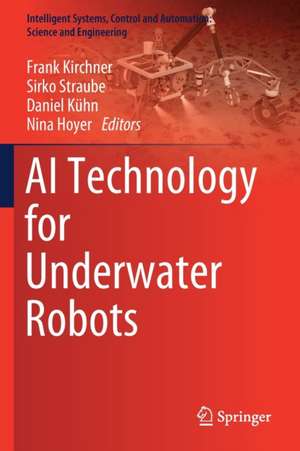
AI Technology for Underwater Robots
Editat de Frank Kirchner, Sirko Straube, Daniel Kühn, Nina Hoyeren Limba Engleză Paperback – 6 noi 2020
Deploying and using even the most simple and robust mechanical tools is presenting a challenge, and is often associated with an enormous amount of preparation, continuous monitoring, and maintenance.
Therefore, all disciplinary aspects (e.g. system design, communication, machine learning, mapping and coordination, adaptive mission planning) are examined in detail and together this gives an extensive overview on research areas influencing next generation underwater robots.
These robotic underwater systems will operate autonomously with the help of the most modern artificial intelligence procedures and perform environmental monitoring as well as inspection and maintenance of underwater structures. The systems are designed as modular and reconfigurable systems for long term autonomy to remain at the site for longer periods of time. New communication methods using AI enable missions of hybrid teams of humans and heterogeneous robots.
Thus this volume will be an important reference for scientists on every qualification level in the field of underwater technologies, industrial maritime applications, and maritime science.
Preț: 976.15 lei
Preț vechi: 1190.42 lei
-18%
Puncte Express: 1464
Carte tipărită la comandă
Livrare economică 02-16 decembrie
Livrare prin curier în România Termenul estimat este afișat lângă disponibilitate.
Transport gratuit pentru acest produs Plată online sau ramburs, în funcție de opțiunile comenzii.
Retur gratuit în 14 zile Comandă securizată și suport în română.
Specificații
ISBN-13: 9783030306854
ISBN-10: 3030306852
Pagini: 204
Ilustrații: X, 193 p. 71 illus., 65 illus. in color.
Dimensiuni: 155 x 235 x 12 mm
Greutate: 0.29 kg
Ediția:1st ed. 2020
Editura: Springer
Locul publicării:Cham, Switzerland
ISBN-10: 3030306852
Pagini: 204
Ilustrații: X, 193 p. 71 illus., 65 illus. in color.
Dimensiuni: 155 x 235 x 12 mm
Greutate: 0.29 kg
Ediția:1st ed. 2020
Editura: Springer
Locul publicării:Cham, Switzerland
Cuprins
Preface.- Part I: Underwater Robots: Challenges and Applications.- A Survey of Challenges and Potentials for AI-Technologies.- Intelligent Sensor Technology: A ‘must-have’ for Next-Century Marine Science.- Challenges for Deepwater Operations: An Industry Perspective.- Part II: System Design, Dynamics and Control.- Intelligent Skin – Advanced Materials and Manufacturing for a Modular and Multipurpose Hull.- Modular and Reconfigurable System Design for Underwater Vehicles.- Intelligent Propulsion.- Challenges and Opportunities in Communications for Autonomous Underwater Vehicles.- Modular Underwater Manipulators for Autonomous Underwater Intervention.- Part III: Intervention and Environment Analysis.- Machine Learning and Dynamic Whole Body Control for Underwater Manipulation.- Adaptive Control for Underwater Gripping Systems.- Challenges in Underwater Visual Navigation and SLAM.- Underwater Multi-Modal Sensing for Environmental Mapping and Vehicle Navigation.- Towards a Simulation Framework for Underwater Intervention Analysis and Training.- Part IV: Autonomy and Mission Planning.- Novel Directions for Autonomous Underwater Vehicle Navigation in Confined Spaces.- Verification for Autonomous Underwater Systems.- Interactive Strategic Mission Management System for Intuitive Human-Robot Cooperation.
Textul de pe ultima copertă
This book provides exclusive insight into the development of a new generation of robotic underwater technologies.
Deploying and using even the most simple and robust mechanical tools is presenting a challenge, and is often associated with an enormous amount of preparation, continuous monitoring, and maintenance.
Therefore, all disciplinary aspects (e.g. system design, communication, machine learning, mapping and coordination, adaptive mission planning) are examined in detail and together this gives an extensive overview on research areas influencing next generation underwater robots.
These robotic underwater systems will operate autonomously with the help of the most modern artificial intelligence procedures and perform environmental monitoring as well as inspection and maintenance of underwater structures. The systems are designed as modular and reconfigurable systems for long term autonomy to remain at the site for longer periods of time. New communication methods using AI enable missions of hybrid teams of humans and heterogeneous robots.
Thus this volume will be an important reference for scientists on every qualification level in the field of underwater technologies, industrial maritime applications, and maritime science.
Deploying and using even the most simple and robust mechanical tools is presenting a challenge, and is often associated with an enormous amount of preparation, continuous monitoring, and maintenance.
Therefore, all disciplinary aspects (e.g. system design, communication, machine learning, mapping and coordination, adaptive mission planning) are examined in detail and together this gives an extensive overview on research areas influencing next generation underwater robots.
These robotic underwater systems will operate autonomously with the help of the most modern artificial intelligence procedures and perform environmental monitoring as well as inspection and maintenance of underwater structures. The systems are designed as modular and reconfigurable systems for long term autonomy to remain at the site for longer periods of time. New communication methods using AI enable missions of hybrid teams of humans and heterogeneous robots.
Thus this volume will be an important reference for scientists on every qualification level in the field of underwater technologies, industrial maritime applications, and maritime science.
Caracteristici
Details interdisciplinary developments in underwater technologies Each chapter provides a compact overview of a whole area Includes the most modern artificial intelligence procedures?