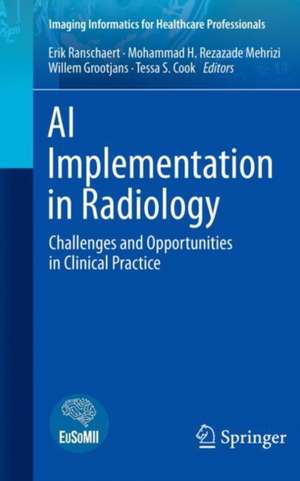
AI Implementation in Radiology: Imaging Informatics for Healthcare Professionals
Editat de Erik Ranschaert, Mohammad H. Rezazade Mehrizi, Willem Grootjans, Tessa S. Cooken Limba Engleză Paperback – 27 noi 2024
Remarcăm în AI Implementation in Radiology o abordare riguroasă a scenariilor clinice în care instituțiile medicale se confruntă cu dificultăți în adoptarea inteligenței artificiale. Volumul nu se limitează la prezentarea algoritmilor, ci analizează de ce multe implementări eșuează în practica de zi cu zi, oferind un cadru metodologic pentru transformarea procesului clinic. Reținem accentul pus pe managementul schimbării, esențial pentru a asigura o tranziție fără sincope și pentru a minimiza perturbările în fluxul de lucru radiologic. Structura volumului reflectă o progresie logică, de la identificarea nevoii de schimbare și selecția soluțiilor AI adecvate, până la integrarea efectivă și instruirea personalului. Capitolele dedicate aspectelor legale și etice sunt fundamentale în contextul reglementărilor actuale, asigurând o desfășurare responsabilă a tehnologiei. Remarcăm, de asemenea, analiza impactului AI asupra raportării radiologice, un punct critic pentru eficiența operațională. Cuprinsul este organizat astfel încât să ghideze managerii de sănătate și radiologii prin toate etapele: planificare, implicarea părților interesate și evaluarea continuă a performanței. Acesta este un manual de referință comparabil cu Artificial Intelligence in Medical Imaging, dar actualizat conform ghidurilor din 2024, punând un accent mult mai mare pe factorul uman și organizațional. Față de AI for Radiology de Oge Marques, care se concentrează pe analiza imaginilor medicale, lucrarea de față prioritizează „Translational Medicine” și pașii concreți necesari pentru ca AI să devină un instrument standardizat în spitalele moderne.

Preț: 584.16 lei
Preț vechi: 614.91 lei
-5%
Carte disponibilă
Livrare economică 06-20 noiembrie
Specificații
ISBN-10: 3031689410
Pagini: 192
Ilustrații: Approx. 180 p. 20 illus. in color.
Dimensiuni: 127 x 203 x 11 mm
Greutate: 0.24 kg
Ediția:2024
Editura: Springer
Colecția Imaging Informatics for Healthcare Professionals
Seria Imaging Informatics for Healthcare Professionals
Locul publicării:Cham, Switzerland
V-ar putea interesa
-
 Dr. Bot: Why Doctors Can Fail Us—and How AI Could Save LivesCharlotte Blease-5%Preț: 142.01 lei149.48 lei
 -
 Radiology Business Practice: How to SucceedDavid M. Yousem-5%Preț: 752.48 lei792.08 lei
 -
 -5%Preț: 656.48 lei691.03 lei
 -
 -5%Preț: 561.53 lei591.08 lei
 -
 AI for RadiologyOge Marques-20%Preț: 204.35 lei255.44 lei
 -
 -24%Preț: 262.76 lei347.95 lei
 -
 -5%Preț: 281.14 lei295.94 lei
 -
 AI-Driven Innovations in Healthcare: Best Practices and Case StudiesJames R. Langabeer, PhD-5%Preț: 400.44 lei421.52 lei
 -
 Generative AI: Unlocking the Next Chapter in HealthcareRohit Mahajan-5%Preț: 288.69 lei303.88 lei
 -
 AI at Work: How to Build a Full Stack OrganizationJames Poulter-32%Preț: 128.36 lei189.50 lei
 -
 Preț: 218.21 lei
 -
 Project Management with AI For DummiesDaniel Stanton-20%Preț: 140.32 lei175.39 lei
 -
 -35%Preț: 134.23 lei206.56 lei
 -
 -17%Preț: 66.97 lei80.66 lei
 -
 How to Make AI UsefulMagnus Reiner-11%Preț: 84.37 lei94.27 lei
 -
 -20%Preț: 1232.26 lei1540.31 lei
 -
 -5%Preț: 1318.01 lei1387.38 lei
 -
 -16%Preț: 169.44 lei202.18 lei
 -
 -24%Preț: 168.11 lei221.52 lei
 -
 Reimagining Government: Achieving the Promise of AIFaisal Hoque-35%Preț: 84.13 lei129.87 lei
De ce să citești această carte
Recomandăm această carte liderilor din domeniul sănătății și medicilor radiologi care doresc să treacă de la faza experimentală a AI la utilizarea clinică de rutină. Cititorul câștigă o strategie clară de management al schimbării, învățând cum să navigheze barierele etice și tehnice. Este un ghid esențial pentru a optimiza diagnosticul și eficiența operațională într-un departament de imagistică modern.
Despre autor
Erik Ranschaert este un radiolog cu o vastă expertiză în informatică medicală, fiind unul dintre pionierii integrării AI în practica radiologică europeană. Împreună cu co-editorii Mohammad H. Rezazade Mehrizi, Willem Grootjans și Tessa S. Cook, acesta aduce o perspectivă multidisciplinară ce îmbină medicina clinică, știința datelor și managementul organizațional. Contribuțiile lor în seria Imaging Informatics for Healthcare Professionals sunt recunoscute pentru rigoarea academică și aplicabilitatea practică în transformarea digitală a radiologiei.
Descriere scurtă
Change management in the context of AI in medicine and radiology involves a systematic approach to identify, plan, implement, and evaluate the integration of AI technologies into healthcare systems. It engages the necessary stakeholders at the appropriate points in the process to ensure that change is implemented properly. By effectively managing the change, healthcare organizations can harness the potential of AI to enhance patient care, improve diagnosis accuracy, and optimize operational efficiency in radiology and other medical specialties.
Throughout this change management process, organizations should prioritize ethical considerations, data privacy, and regulatory compliance to ensure that AI technologies are deployed responsibly and in accordance with relevant guidelines and regulations.
Cuprins
Notă biografică
Mohammad H. Rezazade Mehrizi is an Associate Professor at KIN Center for Digital Innovation, at Vrije Universiteit Amsterdam. He is also an affiliated Organizational Learning Advisor to Leiden Medical Center, Radiology Department. He holds a PhD in Science and Technology Policy from Sharif University of Technology (in collaboration with SPRU), Iran, and a second PhD in Management Sciences from ESADE Business School, Barcelona. His interest lies in understanding and helping organizations and their associated communities to unlock their historical chains that prevent them from making a better future. He is research centers around how knowledge work and expertise are shaped by modern technologies, particularly by studying the effect of algorithmic technologies on professional work and organizing knowledge work. His scholarly work has contributed to numerous academic communities, and he has engaged with organizations and practitioners from various domains such as healthcare, digital technologies, financial services, and education.
Dr. Willem Grootjans is an assistant professor and technical physician at the department of Radiology at the Leiden University Medical Center. He graduated cum laude from the Technical University of Twente at the faculty of Science and Technology in Technical Medicine with a specialization in Robotics and Imaging. In 2012, he started his PhD at the department of Radiology and Nuclear Medicine of the Radboud University Medical Center in Nijmegen, focusing on the use of positron emission tomography for personalizing clinical management of patients with lung cancer. In 2016 he obtained his PhD at the Radboud faculty of Medical Sciences and started as a postdoctoral fellow at the Leiden University Medical Center at the department of Radiology. In 2018 he formed a specialized image processing group, at the department of Radiology of the Leiden University Medical Center, responsible for extracting relevant information from medical images for diagnosis and image-guided treatment decisions, also known as the ‘Imaging Services Group’ (ISG). Since 2019 he is head of the ISG which is now responsible for delivering high quality quantitative information to radiologists by using state-of-the art image processing software (including AI) that can be used for radiological reporting in clinical routine. Willem continues his mission to research and implement new technological innovations to improve the quality of healthcare, while keeping in mind the needs of the patient, healthcare professional, and society at the same time.
Dr. Tessa Cook is an Associate Professor of Radiology at the Perelman School of Medicine at the University of Pennsylvania in Philadelphia, and Vice Chair of Practice Transformation in the Department of Radiology. She is an active member of multiple radiology societies, including the RSNA, ACR, SIIM, and AUR. She is the director of the Penn Radiology Imaging Informatics Fellowship and Modality Chief of 3-D and Advanced Imaging. In 2020, Dr. Cook was inducted into the College of Fellows of the Society for Imaging Informatics in Medicine (SIIM) and received SIIM’s Dr. Ruth Dayhoff Award for the Advancement of Women in Medical Imaging Informatics. She was Chair of the SIIM Board of Directors from 2022-2024. Dr. Cook pursues innovative methods to enhance care delivery in radiology and improve radiologists' workflow.