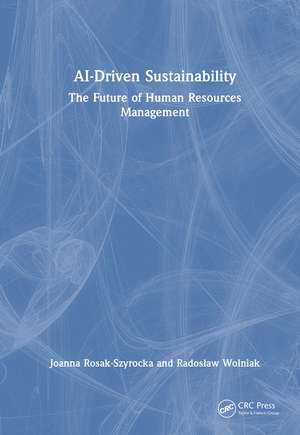
AI-Driven Sustainability: The Future of Human Resources Management
Autor Joanna Rosak-Szyrocka, Radosław Wolniaken Limba Engleză Hardback – 25 noi 2025
The role of AI as a support to the existing HR processes and a comprehensive changer of organizational, ethical, social, and environmental values is reviewed by authors. By providing readers with the wide scale of explanatory case studies among global business corporations and with a thorough review of law-ethical and technological issues in 10 chapters, the book suggests a “green model” of AI implementation in HR dimensions.
A must-read publication for researchers, practitioners, and leaders who want to make their business part of the conscious future in labor in the environment of digitalization.
Preț: 938.51 lei
Preț vechi: 1173.13 lei
-20%
Puncte Express: 1408
Carte tipărită la comandă
Livrare economică 30 noiembrie-14 decembrie
Livrare prin curier în România Termenul estimat este afișat lângă disponibilitate.
Transport gratuit pentru acest produs Plată online sau ramburs, în funcție de opțiunile comenzii.
Retur gratuit în 14 zile Comandă securizată și suport în română.
Specificații
ISBN-13: 9781041131434
ISBN-10: 1041131437
Pagini: 224
Dimensiuni: 178 x 254 x 17 mm
Greutate: 0.57 kg
Ediția:1
Editura: CRC Press
Colecția CRC Press
ISBN-10: 1041131437
Pagini: 224
Dimensiuni: 178 x 254 x 17 mm
Greutate: 0.57 kg
Ediția:1
Editura: CRC Press
Colecția CRC Press
V-ar putea interesa
-
 -14%Preț: 203.71 lei237.84 lei
 -
 The Power of Design and Convergence of AITai Lee Siang-20%Preț: 419.95 lei524.93 lei
 -
 -17%Preț: 166.91 lei199.93 lei
 -
 Preț: 103.34 lei
 -
 -20%Preț: 201.82 lei252.28 lei
 -
 Our Planet Powered by AIMark Minevich-20%Preț: 134.85 lei168.56 lei
 -
 Preț: 218.21 lei
 -
 -35%Preț: 134.23 lei206.56 lei
 -
 Preț: 284.86 lei
 -
 Human Resource ManagementJonathan Crawshaw-18%Preț: 417.10 lei508.66 lei
 -
 Contemporary Human Resource ManagementAdrian Wilkinson-18%Preț: 419.40 lei511.47 lei
 -
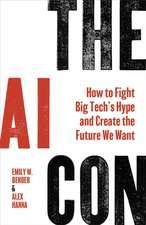 The AI ConEmily M. BenderPreț: 151.96 lei
 -
 How to Make AI UsefulMagnus ReinerPreț: 94.13 lei
 -
 Artificial Intelligence and Business TransformationMaría Teresa Del Val Núñez-18%Preț: 1152.62 lei1405.64 lei
 -
 HRM, Artificial Intelligence and the Future of WorkOlatunji David Adekoya-18%Preț: 1153.92 lei1407.22 lei
 -
 Empire of AIKaren HaoPreț: 163.45 lei
 -
 HBR Guide to Generative AI for ManagersElisa Farri-20%Preț: 104.95 lei131.19 lei
 -
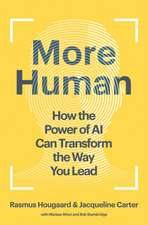 More HumanRasmus HougaardPreț: 188.05 lei
 -
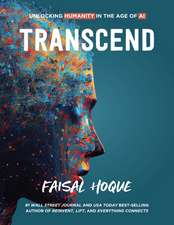 Transcend: Unlocking Humanity in the Age of AIFaisal Hoque-18%Preț: 128.32 lei157.10 lei
Public țintă
Academic, Postgraduate, Professional Practice & Development, and Undergraduate AdvancedCuprins
Chapter 1 Introduction to AI in HRM and Sustainability. Chapter 2. Theoretical Foundations of AI-Driven Sustainable HRM. Chapter 3 AI in Talent Acquisition and Recruitment. Chapter 4 Employee Experience, Well-being, and AI. Chapter 5 AI for Sustainable Workforce Management. Chapter 6 Ethical Considerations and AI Governance in HRM. Chapter 7 AI and Corporate Social Responsibility (CSR) in HRM. Chapter 8 Case Studies: AI in Sustainable HRM Practices. Chapter 9 Policy and Regulatory Frameworks for AI in HRM. Chapter 10 Policy and Regulatory Frameworks for AI in HRM.
Notă biografică
Joanna Rosak-Szyrocka is an assistant professor and Erasmus+ programme coordinator at the Faculty of Management, Czestochowa University of Technology. Her areas of expertise include sustainable development, digitalization, Industry 4.0, Quality 4.0, education, artificial intelligence (AI), and quality management.
She has participated in numerous teaching mobilities under the Erasmus+ programme in countries such as Italy, the United Kingdom, Slovenia, Hungary, the Czech Republic, Slovakia, and France. She actively collaborates with many academic institutions both in Poland and abroad. At the Faculty of Management, she is involved in various research teams, including interdisciplinary groups. She is also a member of the faculty’s committees for dean’s office research and course progression in the field of occupational health and safety, as well as the technical evaluation committee.
Her achievements have been recognized on several occasions: in 2012, she received a certificate of recognition from the Dean of the Faculty of Management for her publishing activity; in 2017, she was awarded the Dean’s Medal for long-standing cooperation with the faculty; and in 2023, she was honored with the Medal for Long Service by the President of the Republic of Poland.
Radosław Wolniak is a full professor at the Department of Economics and Informatics at the Silesian University of Technology (Poland). For over 20 years, he has been dealing with issues of management, including Industry 4.0, Smart City, digitalization, artificial intelligence, and sustainability. His achievements include over 600 publications issued by national and international publishers, as well as many undertakings and projects implemented in cooperation with the business environment. He's on the Stanford List of Top 2% Scientists most cited across the globe for 2023.
Scientific interests: management, AI in management, sustainability, Industry 4.0, Smart City, digitalization, innovativeness, smart factory.
She has participated in numerous teaching mobilities under the Erasmus+ programme in countries such as Italy, the United Kingdom, Slovenia, Hungary, the Czech Republic, Slovakia, and France. She actively collaborates with many academic institutions both in Poland and abroad. At the Faculty of Management, she is involved in various research teams, including interdisciplinary groups. She is also a member of the faculty’s committees for dean’s office research and course progression in the field of occupational health and safety, as well as the technical evaluation committee.
Her achievements have been recognized on several occasions: in 2012, she received a certificate of recognition from the Dean of the Faculty of Management for her publishing activity; in 2017, she was awarded the Dean’s Medal for long-standing cooperation with the faculty; and in 2023, she was honored with the Medal for Long Service by the President of the Republic of Poland.
Radosław Wolniak is a full professor at the Department of Economics and Informatics at the Silesian University of Technology (Poland). For over 20 years, he has been dealing with issues of management, including Industry 4.0, Smart City, digitalization, artificial intelligence, and sustainability. His achievements include over 600 publications issued by national and international publishers, as well as many undertakings and projects implemented in cooperation with the business environment. He's on the Stanford List of Top 2% Scientists most cited across the globe for 2023.
Scientific interests: management, AI in management, sustainability, Industry 4.0, Smart City, digitalization, innovativeness, smart factory.
Descriere
This book provides an interdisciplinary and practice-oriented exploration of how artificial intelligence (AI) might be used in human resource management (HRM) in order to ensure organizations' sustainability.