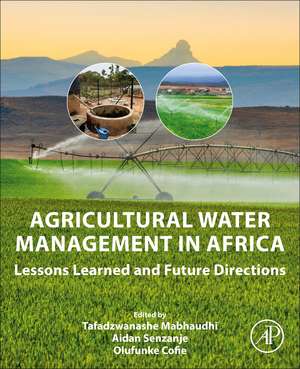
Agricultural Water Management in Africa: Lessons Learned and Future Directions
Editat de Tafadzwanashe Mabhaudhi, Aidan Senzanje, Olufunke Cofieen Limba Engleză Paperback – 23 ian 2026
At the heart of Africa’s push for agricultural transformation is the African Union’s (AU) Framework for Irrigation Development and Agricultural Water Management. This framework lays out four key development pathways to drive impactful change in water management across the continent: (i) enhanced water control and watershed management in rain-fed agriculture; (ii) farmer-led irrigation development that empowers local growers; (iii) modernization and expansion of irrigation schemes; (iv) utilization of unconventional water sources for sustainable irrigation.
The book maps out the progress and potential of these pathways on a continental scale, showcasing how the AU-IDAWM framework can shape Africa’s water-secure agricultural future. To enrich this perspective, it also draws on case studies from Asia and Latin America, creating space for meaningful South–South knowledge exchange. It thoughtfully examines cross-cutting themes such as the water–energy–food nexus and the circular economy, placing AWM in the broader context of sustainability and climate resilience.
Whether you are a policymaker, researcher, practitioner, or development partner, this volume delivers critical insights into how smarter water management can drive agricultural growth, food security, and environmental stewardship in Africa and beyond.
- Highlights fit-for-purpose irrigation strategies at scale and identifies opportunities and challenges of irrigation practices
- Expands understanding of the pathways for AWM, presenting operation and maintenance procedures
- Includes bespoke designs guided by the AWM pathway approach
Preț: 1112.60 lei
Preț vechi: 1356.83 lei
-18% Precomandă
Puncte Express: 1669
Preț estimativ în valută:
196.89€ • 229.60$ • 172.87£
196.89€ • 229.60$ • 172.87£
Carte nepublicată încă
Doresc să fiu notificat când acest titlu va fi disponibil:
Se trimite...
Preluare comenzi: 021 569.72.76
Specificații
ISBN-13: 9780443215841
ISBN-10: 0443215847
Pagini: 400
Dimensiuni: 191 x 235 mm
Editura: ELSEVIER SCIENCE
ISBN-10: 0443215847
Pagini: 400
Dimensiuni: 191 x 235 mm
Editura: ELSEVIER SCIENCE
Cuprins
1. Agricultural water management: an overview of concepts
2. The transformative role of treated wastewater in North Africa: lessons learned and future directions
3. Effects of forage plantation on soil quality in the subhumid Ethiopian Highlands: implications for sustainable agriculture
4. Current status of agricultural water management in Africa: progress, challenges, and opportunities
5. Agricultural water management in maize-based systems: challenges, opportunities, and sustainable solutions in Kenya, Malawi, Zambia, and Zimbabwe
6. The critical role of water in facilitating agroecology transitions in semi-arid regions of sub-Saharan Africa
7. Optimizing water productivity: challenges and opportunities in smallholder irrigation schemes—a case study from South Africa
8. AquaCrop model as a tool to forecast crop yield during the growing season: lessons from Nepal, South Asia
9. Assessment of drip and conventional surface Irrigation in poorly drained, naturally irrigated lands of the Khorezm Region: lessons from Central Asia
10. Impacts and interventions for extreme weather events in Southern Africa
11. Integrated water and land management practices: demand-driven participatory research in the semiarid region of central Tanzania
12. Gender equality and social inclusion in agricultural water management
13. Gender dynamics and power relations in water management and agricultural innovations: a case study of the Mpegnesso’s lowlands in Mali
14. Institutions and governance for agricultural water management in support of resilient food systems
15. Summary: crop-water productivity, the basis of agricultural water management
2. The transformative role of treated wastewater in North Africa: lessons learned and future directions
3. Effects of forage plantation on soil quality in the subhumid Ethiopian Highlands: implications for sustainable agriculture
4. Current status of agricultural water management in Africa: progress, challenges, and opportunities
5. Agricultural water management in maize-based systems: challenges, opportunities, and sustainable solutions in Kenya, Malawi, Zambia, and Zimbabwe
6. The critical role of water in facilitating agroecology transitions in semi-arid regions of sub-Saharan Africa
7. Optimizing water productivity: challenges and opportunities in smallholder irrigation schemes—a case study from South Africa
8. AquaCrop model as a tool to forecast crop yield during the growing season: lessons from Nepal, South Asia
9. Assessment of drip and conventional surface Irrigation in poorly drained, naturally irrigated lands of the Khorezm Region: lessons from Central Asia
10. Impacts and interventions for extreme weather events in Southern Africa
11. Integrated water and land management practices: demand-driven participatory research in the semiarid region of central Tanzania
12. Gender equality and social inclusion in agricultural water management
13. Gender dynamics and power relations in water management and agricultural innovations: a case study of the Mpegnesso’s lowlands in Mali
14. Institutions and governance for agricultural water management in support of resilient food systems
15. Summary: crop-water productivity, the basis of agricultural water management