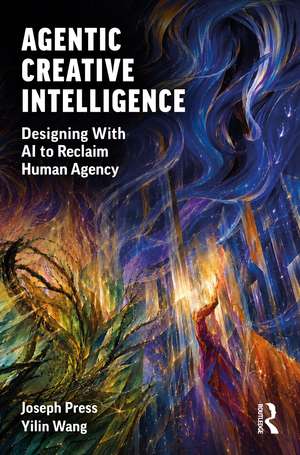
Agentic Creative Intelligence: Designing With AI to Reclaim Human Agency
Autor Joseph Press, Yilin Wangen Limba Engleză Hardback – 22 dec 2026
Agentic Creative Intelligence responds to this crisis by arguing that creativity can be rejuvenated by configuring our relationships with agents. We propose intelligent intermediaries called dæmons to raise aesthetic awareness, extend engagement, adapt intention, and express influence. Together they converge into a Creative Council that enables a new chain of co-creation: practitioner, dæmon, agent.
Grounded in the practices of iconic practitioners and drawing on Chinese philosophy, this book explores how these capacities can be sustained in speculative scenarios across seven creative disciplines. It then examines human agency where innovators, educators, and changemakers apply the framework for systemic change.
We are in an agentic era, a new Pandæmonium of industry and intelligence, where creation is shared with non-humans. Agentic Creative Intelligence asks designers, innovators, and educators: will we proactively define our relationship between human and machine, or relinquish our agency for good?
Preț: 1123.03 lei
Preț vechi: 1595.88 lei
-30% Precomandă
Puncte Express: 1685
Carte nepublicată încă
Livrare prin curier în România Precomanda se expediază când titlul devine disponibil.
Transport gratuit pentru acest produs Plată online sau ramburs, în funcție de opțiunile comenzii.
Retur gratuit în 14 zile Comandă securizată și suport în română.
Doresc să fiu notificat când acest titlu va fi disponibil:
Se trimite...
Specificații
ISBN-13: 9781041211259
ISBN-10: 1041211252
Pagini: 356
Ilustrații: 170
Dimensiuni: 178 x 254 mm
Ediția:1
Editura: Taylor & Francis
Colecția Routledge
Locul publicării:Oxford, United Kingdom
ISBN-10: 1041211252
Pagini: 356
Ilustrații: 170
Dimensiuni: 178 x 254 mm
Ediția:1
Editura: Taylor & Francis
Colecția Routledge
Locul publicării:Oxford, United Kingdom
Public țintă
Professional Practice & Development and Professional ReferenceCuprins
Introduction. Part 1: Creative Capabilities in the Agentic Era 1. Extended Engagement: Hands Form the Mind 2. Aesthetic Awareness: When Presence Reveals Clarity 3. Adaptive Coherence: The Thread Through Abundance 4. Expressive Influence: Catalysts of the Social Kind 5. Agentic Creative Intelligence: Creative Convergence Part 2: Creative Disciplines in a Near-Future 6. The Fine Arts: Image as Witness 7. The Built Arts: Monumental Metabolism 8. The Tangible Arts: Object as Organism 9. The Moving Arts: Fluidity of Time 10. The Sensory Arts: Body of Mind 11. The Playful Arts: Gaming Agency 12. The Performing Arts: Constructing Shared Realities 13. The Reflective Arts: Where Thought Emerges Part 3: Creative Complexities in Systemic Change 14. Changemakers: Preparing the Terrain 15. Innovators: Augmenting a Maker Community 16. Educators: Growing the Person 17: A Day of Creative Change Conclusion: The Agentic Creative Path Epilogue: Toward an Agentic Transhumanism
Recenzii
“Innovation has learned to optimize. It now has to remember how to mean. ACI makes the case that creative capability is cultivated through resistance, a claim I find both original and true, and gives leaders a way to hold meaning and machines together. Read it, then lead your innovation differently.”
Roberto Verganti, The Josefsson Family Chair in Art and Innovation, Stockholm School of Economics.
“We all have been using AI too much, without thinking about it enough. It is one of the most consequential challenges humanity has ever faced, and learning how to coexist with it will require many different strategies—especially in the realm of creativity. Joseph Press has been theorizing hard on the topic of AI and human creativity for years, and this book is a milestone in shaping how we understand and practice creativity in the age of AI, and serious practitioners and theorists cannot afford to overlook it.”
Dajuin Yao, Chairman, Global AI Creativity Alliance; Director, Mixed Reality Media Lab, China Academy of Art.
“Agentic Creative Intelligence reframes AI as a partner in a designer's development, not a replacement for it. As our systems grow more autonomous and more complex, that distinction becomes the one that matters most, while the choice of what we hand over is still ours.”
Greg Demchak, VP of Emerging Technologies, Bentley Systems Labs.
“When design education begins to confront the “agentic turn,” what is urgently needed is no longer a mere accumulation of methodologies, but a framework capable of housing its own philosophical stance. Agentic Creative Intelligence offers precisely such a rare anchor here— It brings together Chinese design thinking and the latest technological tools—not as a forced combination, but as a way for each to inform the other in everyday classroom practice. With this approach, educators can more confidently guide students through an increasingly agent‑driven design landscape, while holding onto what matters most in design: human sensibility and judgment. For any school rethinking its design curriculum, this is a worthwhile read.”
Lou Yongqi, President, Shanghai University of Engineering Science.
"Design earns its authority when it keeps the human at the center, and this book shows how to hold that center as AI enters the studio. Agentic Creative Intelligence offers the profession a mindset and practices for developing creative capability instead of surrendering it to AI — Press and Wang's 'dæmon,' a provocateur rather than an accelerator, is a genuinely useful tool for any designer trying to keep judgment in the loop. It belongs with every designer and design leader shaping what comes next."
Srini R. Srinivasan, CEO, Don Norman Design Award, and Senator and Past-President, World Design Organization.
“Foresight will have its greatest value when it increases our clarity, but moderates our certainty. Much of GenAI focuses on making things easier and faster, but Press and Wang want us to focus on the clarity of making things better. Human discernment and creative friction in our use of this medium will be required and the authors show us how--with a variety of engaging visuals and models. This book is applied futures at its best: a ten-year lens trained on what we can choose to become.”
Bob Johansen, Futurist and Author, Institute for the Future.
“Agentic Creative Intelligence is a profound and timely contribution to the future of creative practice. Drawing from profound experience across design, technology, education, and east / west cultural contexts, it addresses the human agency in an AI‑accelerated world with clarity, courage, and compassion. The book bridges human and machine capabilities without surrendering what makes creative work meaningful. By incorporating philosophy, foresight, and lived practice, it illuminates how creative agency—personal and collective—can be strengthened to meet the situations of our era. For designers, educators, innovators, futurists and anyone committed to shaping culture with caring intention, this book is a recommended reading.”
Richard Hsu, Dean, School of Design, Shanghai University of Engineering Science.
“We are building the tools this book is about, so I read it closely. It is the clearest account I know of how to keep creative people growing stronger as their tools do, and it turns that into a practice a product team can design for. Rigorous, moving, and immediately useful.”
Itay Schiff, Co-founder and Chief Creative Officer, Figma Weave.
“A bracing, generous book that refuses both the hype and the despair around AI. It hands creative professionals something rare, a practice for growing stronger as the tools grow more capable. I will be recommending it widely.”
Olivier Marin, Computer Scientist and Program Head, Humans+Machines, Shanghai University of Engineering Science.
"I invest at the convergence of AI, digital infrastructure, and next-generation technology, so I read for where durable value will settle. This book makes the sharpest case I have seen that human creative capability is that value, and it hands founders and creators a practice for compounding it as the tools race ahead. For anyone building at the frontier of AI and creativity, it is a map worth keeping close."
James CK Ho, Head of Animoca Ventures.
“As we navigate the shifting paradigms of intelligent technologies, Agentic Creative Intelligence arrives as a vital intervention. Press and Wang tackle the existential paradox of our discipline: if the machine can finish the work, what is left to learn? Their answer is both timeless and strictly necessary—that the act of making is fundamentally about shaping the maker. Grounded in a rigorous synthesis of Western practice and Eastern philosophy, this text transcends mere technological critique. It is a profound manifesto for cultivating the deep, systemic intuition that algorithms cannot replicate."
Hsin-Hsien Chiu, Distinguished Dean, Future Design School, Harbin Institute of Technology, Shenzhen.
“A design philosophy our schools have been waiting for. Agentic Creative Intelligence unites Chinese thought with frontier technology, enabling each to sharpen and elevate the other. It provides design educators with a new paradigm for preparing designers to thrive in an agentic world—without losing the empathy, creativity, and humanity that define great design. It belongs in every design curriculum that seeks not only to respond to the future, but to shape it.”
Dennis Jie Sun, Principal & Dean, College of Fashion and Design at Donghua University.
"The contemporary creative industry is awash with objective AI tools, each marketed like it has a personality of its own, competing to dominate a practice built on subjectivity. Press and Wang address that clash directly, nailing digital jelly to a wall in a moment of genuine innovation and genuine angst — an early marker for the work that will doubtless follow.
Sebastian Shaw, Strategy, Partnerships, and Growth for Enterprise in GenAI and Creative Software, Adobe.
Roberto Verganti, The Josefsson Family Chair in Art and Innovation, Stockholm School of Economics.
“We all have been using AI too much, without thinking about it enough. It is one of the most consequential challenges humanity has ever faced, and learning how to coexist with it will require many different strategies—especially in the realm of creativity. Joseph Press has been theorizing hard on the topic of AI and human creativity for years, and this book is a milestone in shaping how we understand and practice creativity in the age of AI, and serious practitioners and theorists cannot afford to overlook it.”
Dajuin Yao, Chairman, Global AI Creativity Alliance; Director, Mixed Reality Media Lab, China Academy of Art.
“Agentic Creative Intelligence reframes AI as a partner in a designer's development, not a replacement for it. As our systems grow more autonomous and more complex, that distinction becomes the one that matters most, while the choice of what we hand over is still ours.”
Greg Demchak, VP of Emerging Technologies, Bentley Systems Labs.
“When design education begins to confront the “agentic turn,” what is urgently needed is no longer a mere accumulation of methodologies, but a framework capable of housing its own philosophical stance. Agentic Creative Intelligence offers precisely such a rare anchor here— It brings together Chinese design thinking and the latest technological tools—not as a forced combination, but as a way for each to inform the other in everyday classroom practice. With this approach, educators can more confidently guide students through an increasingly agent‑driven design landscape, while holding onto what matters most in design: human sensibility and judgment. For any school rethinking its design curriculum, this is a worthwhile read.”
Lou Yongqi, President, Shanghai University of Engineering Science.
"Design earns its authority when it keeps the human at the center, and this book shows how to hold that center as AI enters the studio. Agentic Creative Intelligence offers the profession a mindset and practices for developing creative capability instead of surrendering it to AI — Press and Wang's 'dæmon,' a provocateur rather than an accelerator, is a genuinely useful tool for any designer trying to keep judgment in the loop. It belongs with every designer and design leader shaping what comes next."
Srini R. Srinivasan, CEO, Don Norman Design Award, and Senator and Past-President, World Design Organization.
“Foresight will have its greatest value when it increases our clarity, but moderates our certainty. Much of GenAI focuses on making things easier and faster, but Press and Wang want us to focus on the clarity of making things better. Human discernment and creative friction in our use of this medium will be required and the authors show us how--with a variety of engaging visuals and models. This book is applied futures at its best: a ten-year lens trained on what we can choose to become.”
Bob Johansen, Futurist and Author, Institute for the Future.
“Agentic Creative Intelligence is a profound and timely contribution to the future of creative practice. Drawing from profound experience across design, technology, education, and east / west cultural contexts, it addresses the human agency in an AI‑accelerated world with clarity, courage, and compassion. The book bridges human and machine capabilities without surrendering what makes creative work meaningful. By incorporating philosophy, foresight, and lived practice, it illuminates how creative agency—personal and collective—can be strengthened to meet the situations of our era. For designers, educators, innovators, futurists and anyone committed to shaping culture with caring intention, this book is a recommended reading.”
Richard Hsu, Dean, School of Design, Shanghai University of Engineering Science.
“We are building the tools this book is about, so I read it closely. It is the clearest account I know of how to keep creative people growing stronger as their tools do, and it turns that into a practice a product team can design for. Rigorous, moving, and immediately useful.”
Itay Schiff, Co-founder and Chief Creative Officer, Figma Weave.
“A bracing, generous book that refuses both the hype and the despair around AI. It hands creative professionals something rare, a practice for growing stronger as the tools grow more capable. I will be recommending it widely.”
Olivier Marin, Computer Scientist and Program Head, Humans+Machines, Shanghai University of Engineering Science.
"I invest at the convergence of AI, digital infrastructure, and next-generation technology, so I read for where durable value will settle. This book makes the sharpest case I have seen that human creative capability is that value, and it hands founders and creators a practice for compounding it as the tools race ahead. For anyone building at the frontier of AI and creativity, it is a map worth keeping close."
James CK Ho, Head of Animoca Ventures.
“As we navigate the shifting paradigms of intelligent technologies, Agentic Creative Intelligence arrives as a vital intervention. Press and Wang tackle the existential paradox of our discipline: if the machine can finish the work, what is left to learn? Their answer is both timeless and strictly necessary—that the act of making is fundamentally about shaping the maker. Grounded in a rigorous synthesis of Western practice and Eastern philosophy, this text transcends mere technological critique. It is a profound manifesto for cultivating the deep, systemic intuition that algorithms cannot replicate."
Hsin-Hsien Chiu, Distinguished Dean, Future Design School, Harbin Institute of Technology, Shenzhen.
“A design philosophy our schools have been waiting for. Agentic Creative Intelligence unites Chinese thought with frontier technology, enabling each to sharpen and elevate the other. It provides design educators with a new paradigm for preparing designers to thrive in an agentic world—without losing the empathy, creativity, and humanity that define great design. It belongs in every design curriculum that seeks not only to respond to the future, but to shape it.”
Dennis Jie Sun, Principal & Dean, College of Fashion and Design at Donghua University.
"The contemporary creative industry is awash with objective AI tools, each marketed like it has a personality of its own, competing to dominate a practice built on subjectivity. Press and Wang address that clash directly, nailing digital jelly to a wall in a moment of genuine innovation and genuine angst — an early marker for the work that will doubtless follow.
Sebastian Shaw, Strategy, Partnerships, and Growth for Enterprise in GenAI and Creative Software, Adobe.
Notă biografică
Joseph Press is a futurist, educator, and author. Trained as an architect, he embarked on a15+ year career in management consulting and 10+ years in applied foresight, before turning to creative education. He currently leads the Strategy + Management program at the School of Design at Shanghai University of Engineering Science, where he prepares the next generation of design leaders for the agentic era. He previously held positions at China Academy of Art, Parsons the New School of Design, and Politecnico di Milano in both the Management and Design programs. He has co-authored five books on design, digital innovation, and leadership-led transformation.
Yilin Wang is a designer and lecturer at Shanghai University of Engineering Science, where she joined in 2025. She holds a Ph.D. from the College of Design and Innovation at Tongji University and an M.A. from the Royal College of Art. Her work sits at the intersection of creative practice, community engagement, and AI. She represents a new generation of Chinese educators and designers committed to shaping more sustainable futures.
Yilin Wang is a designer and lecturer at Shanghai University of Engineering Science, where she joined in 2025. She holds a Ph.D. from the College of Design and Innovation at Tongji University and an M.A. from the Royal College of Art. Her work sits at the intersection of creative practice, community engagement, and AI. She represents a new generation of Chinese educators and designers committed to shaping more sustainable futures.
Descriere
AI is accelerating creative production at an unprecedented scale. As creatives delegate more to generative systems, meaning erodes through our deteriorating expectations. Agentic Creative Intelligence responds to this crisis by arguing that creativity can be rejuvenated by configuring our relationships with agents.