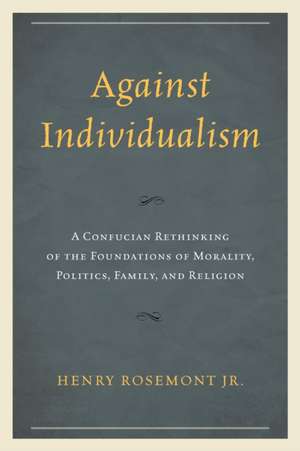
Against Individualism: A Confucian Rethinking of the Foundations of Morality, Politics, Family, and Religion: Philosophy and Cultural Identity
Autor Henry Rosemont Jr.en Limba Engleză Paperback – 14 noi 2016
In the second and larger part of the book Rosemont proffers a different vision of being human gleaned from the texts of classical Confucianism, namely, that we are first and foremost interrelated and thus interdependent persons whose uniqueness lies in the multiplicity of roles we each live throughout our lives. This leads to an ethics based on those mutual roles in sharp contrast to individualist moralities, but which nevertheless reflect the facts of our everyday lives very well. The book concludes by exploring briefly a number of implications of this vision for thinking differently about politics, family life, justice, and the development of a human-centered authentic religiousness. This book will be of value to all students and scholars of philosophy, political theory, and Religious, Chinese, and Family Studies, as well as everyone interested in the intersection of morality with their everyday and public lives.
| Toate formatele și edițiile | Preț | Express |
|---|---|---|
| Paperback (1) | 326.85 lei 6-8 săpt. | |
| Bloomsbury Publishing – 14 noi 2016 | 326.85 lei 6-8 săpt. | |
| Hardback (1) | 602.59 lei 6-8 săpt. | |
| Bloomsbury Publishing – 25 mar 2015 | 602.59 lei 6-8 săpt. |


Preț: 326.85 lei
Preț vechi: 421.93 lei
-23%
Puncte Express: 490
Preț estimativ în valută:
57.84€ • 67.60$ • 50.22£
57.84€ • 67.60$ • 50.22£
Carte tipărită la comandă
Livrare economică 19 februarie-05 martie
Preluare comenzi: 021 569.72.76
Specificații
ISBN-13: 9780739199824
ISBN-10: 073919982X
Pagini: 226
Dimensiuni: 146 x 226 x 16 mm
Greutate: 0.3 kg
Editura: Bloomsbury Publishing
Colecția Lexington Books
Seria Philosophy and Cultural Identity
Locul publicării:New York, United States
ISBN-10: 073919982X
Pagini: 226
Dimensiuni: 146 x 226 x 16 mm
Greutate: 0.3 kg
Editura: Bloomsbury Publishing
Colecția Lexington Books
Seria Philosophy and Cultural Identity
Locul publicării:New York, United States
V-ar putea interesa
-
 The Art of WarSun TzuPreț: 27.22 lei
 -
 The Tree of YogaB. K. S. IyengarPreț: 67.91 lei
 -
 The Art of WarSun-TzuPreț: 62.81 lei
 -
 Perception: An Essay on Classical Indian Theories of KnowledgeBimal Krishna Matilal-18%Preț: 375.39 lei458.31 lei
 -
 -27%Preț: 629.91 lei861.33 lei
 -
 The Guide of the Perplexed, Volume 2Moses MaimonidesPreț: 263.91 lei
 -
 The Essential HuainanziKing Of Huainan LiPreț: 255.82 lei
 -
 Preț: 195.13 lei
 -
 -30%Preț: 261.14 lei374.54 lei
 -
 -27%Preț: 341.88 lei465.74 lei
 -
 The Serpent PowerArthur Avalon-19%Preț: 119.09 lei146.74 lei
 -
 A Source Book in Chinese PhilosophyWing-Tsit ChanPreț: 351.45 lei
 -
 Meditation Now or NeverSteve Hagen-21%Preț: 58.69 lei74.61 lei
 -
 The Art of WarSun Tzu-22%Preț: 41.54 lei53.56 lei
 -
 Notes on Spiritual Discourses of Shri Atmananda: Volume 1Atmananda Shri AtmanandaPreț: 83.95 lei
 -
 Eastern PhilosophyMel ThompsonPreț: 163.55 lei
 -
 The Art of WarSun TzuPreț: 45.73 lei
 -
 Preț: 113.68 lei
 -
 Preț: 102.34 lei
 -
 Die Kuh, die weinteAjahn BrahmPreț: 130.11 lei
Cuprins
Prologue
Chapter 1: Prolegomena
Chapter 2: Doing Ethics in a Global Context
Chapter 3: On the Existence of the Self, and Self-Identity
Chapter 4: Normative Dimensions of Belief in an Individual Self
Chapter 5: The Apotheosis of the Individual Self: Libertarianism
Chapter 6: Toward an Ethics of Roles
Chapter 7: Progressive Family Values
Chapter 8: On Religion and Ritual
Chapter 9: The Religious Dimensions of Role-Bearing Family Lives
Chapter 10: Role Ethics Beyond the Family
Epilogue
Chapter 1: Prolegomena
Chapter 2: Doing Ethics in a Global Context
Chapter 3: On the Existence of the Self, and Self-Identity
Chapter 4: Normative Dimensions of Belief in an Individual Self
Chapter 5: The Apotheosis of the Individual Self: Libertarianism
Chapter 6: Toward an Ethics of Roles
Chapter 7: Progressive Family Values
Chapter 8: On Religion and Ritual
Chapter 9: The Religious Dimensions of Role-Bearing Family Lives
Chapter 10: Role Ethics Beyond the Family
Epilogue
Recenzii
In this thoughtful and penetrating inquiry, Henry Rosemont undertakes the formidable challenge of confronting and rejecting the individualist doctrines that provide the foundation for the ethical theories that dominate western discourse and moral judgment, arguing instead for a "role-bearing" conception derived from Confucian thought and practice. A rewarding and thought-provoking study, reaching broadly to crucial issues of contemporary concern.
There is a growing body of literature on Confucianism and virtue ethics. It is worth noting that Rosemont's thought is probably the leading alternative to this paradigm in comparative moral philosophy. He takes an uncompromisingly critical attitude toward this particular effort to build a bridge from West to East by attributing to the Confucians a Western virtue ethics.
This book can be seen as a culmination of Henry Rosemont Jr.'s decades of work in the field of comparative philosophy. . . .Against Individualism is a natural progression of all these early groundworks that Rosemont has laid along the way.
The unique contribution of Henry Rosemont Jr.'s Against Individualism lies not only in criticizing individualism, which has been done by others, but in doing it through comparing individualism with Confucianism.. Rosemont spends three chapters (ch.3-5) on demonstrating, from philosophical, neuro-scientific, social, political and moral angles, that this individualism is fundamentally untenable and unjust, or 'at best a confused one [idea]' (57). I found his arguments convincing and clear, but see the following chapters as even more interesting because they provide a genuine theoretical and empirical alternative to individualism in Confucianism.. In sum, this is an insightful and timely book that addresses the main source of many tough problems faced by the modern individual, and brings to them a family-rooted Confucian morality, philosophy, and religion in arts. Some historians and scientists have hoped that Confucianism can help human beings have a brighter future, and this book enhances that hope.
Understood as a role-based ethics, Confucian ethics can offer a powerful alternative to mainstream Western ethical thinking.. In Against Individualism, Rosemont's aim is to show that the predominant Western view of human beings as 'most fundamentally free and rational, autonomous individual selves' (Rosemont 2015:xii) is both false and socially pernicious, and to defend an alternative Confucian view based on his view of humans as role-bearing persons.. [T]he time is ripe for a Confucian ethics centered on virtuous human relationships.
Henry Rosemont's book is by turns a passionate, eloquent, and honest account of a Confucian philosophy for today. It is not merely a sympathetic and well-researched study; it is also, I daresay, a spiritual and moral appropriation (or, as Roger Ames would put it, appreciation) of the core texts of classical Confucianism (including most importantly, but by no means exclusively, the Analects and the Mencius). Rosemont presents an intellectually impressive and often emotionally touching account of what is for him at the heart of Confucianism: an ancient role ethics that constitutes an important resource for addressing and alleviating the ills of the world we currently live in.. Against Individualism presents a comprehensive philosophical vision of Confucianism that challenges one of the major mainstream conceptual ghosts haunting not only contemporary philosophy, but mainstream discourse in all social spheres.
Rosemont's compelling book is thought-provoking, well written, and extremely engaging, but it is not for everyone. Those who delight in picking apart the details of other people's interpretations of the Chinese tradition, or who are steadfast in their own readings, should pass this book by.. But for those who are open-minded, interested in constructive philosophical arguments, looking for alternatives to old models, and fresh, interesting perspectives, there is little that Against Individualism does not have to offer.... And if one earnestly appreciates the work of China's most prominent philosophers, then clearly Rosemont's and Ames's notion of 'Confucian role ethics' is not far from the mark.
In this book, renowned comparativist scholar Henry Rosemont Jr. takes aim at one of the central shibboleths of Western thought: that of the isolated individual, the autonomous ego, the "self-made man." Drawing on his extensive familiarity with both Western and Confucian philosophy, Rosemont debunks this premise as untenable. All those who have suffered from the disastrous global effects of libertarian self-adulation will welcome his book as a breath of fresh air. Regardless of the pros and cons of the "role" conception of human life, Rosemont's argument in favor of the ultimate "relationality" of all beings and things is persuasive and, to me, irrefutable.
This is a landmark work. Rosemont's book presents us with a Confucian-inspired alternative to Western individualism. It transforms our vision of who and what we are. I like the way in which Rosemont blends theory with many examples, and shows the practical implications of his Confucian point of view. As an American philosopher and also one of the leading scholars of Confucius' thought, Rosemont is just the man for this imaginative project.
Like a master musician's rendering of a piece of great classical music, Rosemont's lucid, comprehensive and convincing articulation of the relational, role-bearing person and its rich philosophical, social, political and religious implications is simply brilliant. It well showcases what is valuable both in the teachings of early Confucianism that is still largely underestimated or misunderstood, and is equally brilliant in its own right, making this book itself a milestone in the continuous unfolding of the significance of Confucianism in dialogue with each age and stream of thought. It is comparative philosophy in its very best sense. It is informative, revealing, constructive, engaging, and most of all, relevant to the life of everyone living in this deeply troubled world today, and thus may become one of the most thought-provoking and enlightening books a person will ever read.
There is a growing body of literature on Confucianism and virtue ethics. It is worth noting that Rosemont's thought is probably the leading alternative to this paradigm in comparative moral philosophy. He takes an uncompromisingly critical attitude toward this particular effort to build a bridge from West to East by attributing to the Confucians a Western virtue ethics.
This book can be seen as a culmination of Henry Rosemont Jr.'s decades of work in the field of comparative philosophy. . . .Against Individualism is a natural progression of all these early groundworks that Rosemont has laid along the way.
The unique contribution of Henry Rosemont Jr.'s Against Individualism lies not only in criticizing individualism, which has been done by others, but in doing it through comparing individualism with Confucianism.. Rosemont spends three chapters (ch.3-5) on demonstrating, from philosophical, neuro-scientific, social, political and moral angles, that this individualism is fundamentally untenable and unjust, or 'at best a confused one [idea]' (57). I found his arguments convincing and clear, but see the following chapters as even more interesting because they provide a genuine theoretical and empirical alternative to individualism in Confucianism.. In sum, this is an insightful and timely book that addresses the main source of many tough problems faced by the modern individual, and brings to them a family-rooted Confucian morality, philosophy, and religion in arts. Some historians and scientists have hoped that Confucianism can help human beings have a brighter future, and this book enhances that hope.
Understood as a role-based ethics, Confucian ethics can offer a powerful alternative to mainstream Western ethical thinking.. In Against Individualism, Rosemont's aim is to show that the predominant Western view of human beings as 'most fundamentally free and rational, autonomous individual selves' (Rosemont 2015:xii) is both false and socially pernicious, and to defend an alternative Confucian view based on his view of humans as role-bearing persons.. [T]he time is ripe for a Confucian ethics centered on virtuous human relationships.
Henry Rosemont's book is by turns a passionate, eloquent, and honest account of a Confucian philosophy for today. It is not merely a sympathetic and well-researched study; it is also, I daresay, a spiritual and moral appropriation (or, as Roger Ames would put it, appreciation) of the core texts of classical Confucianism (including most importantly, but by no means exclusively, the Analects and the Mencius). Rosemont presents an intellectually impressive and often emotionally touching account of what is for him at the heart of Confucianism: an ancient role ethics that constitutes an important resource for addressing and alleviating the ills of the world we currently live in.. Against Individualism presents a comprehensive philosophical vision of Confucianism that challenges one of the major mainstream conceptual ghosts haunting not only contemporary philosophy, but mainstream discourse in all social spheres.
Rosemont's compelling book is thought-provoking, well written, and extremely engaging, but it is not for everyone. Those who delight in picking apart the details of other people's interpretations of the Chinese tradition, or who are steadfast in their own readings, should pass this book by.. But for those who are open-minded, interested in constructive philosophical arguments, looking for alternatives to old models, and fresh, interesting perspectives, there is little that Against Individualism does not have to offer.... And if one earnestly appreciates the work of China's most prominent philosophers, then clearly Rosemont's and Ames's notion of 'Confucian role ethics' is not far from the mark.
In this book, renowned comparativist scholar Henry Rosemont Jr. takes aim at one of the central shibboleths of Western thought: that of the isolated individual, the autonomous ego, the "self-made man." Drawing on his extensive familiarity with both Western and Confucian philosophy, Rosemont debunks this premise as untenable. All those who have suffered from the disastrous global effects of libertarian self-adulation will welcome his book as a breath of fresh air. Regardless of the pros and cons of the "role" conception of human life, Rosemont's argument in favor of the ultimate "relationality" of all beings and things is persuasive and, to me, irrefutable.
This is a landmark work. Rosemont's book presents us with a Confucian-inspired alternative to Western individualism. It transforms our vision of who and what we are. I like the way in which Rosemont blends theory with many examples, and shows the practical implications of his Confucian point of view. As an American philosopher and also one of the leading scholars of Confucius' thought, Rosemont is just the man for this imaginative project.
Like a master musician's rendering of a piece of great classical music, Rosemont's lucid, comprehensive and convincing articulation of the relational, role-bearing person and its rich philosophical, social, political and religious implications is simply brilliant. It well showcases what is valuable both in the teachings of early Confucianism that is still largely underestimated or misunderstood, and is equally brilliant in its own right, making this book itself a milestone in the continuous unfolding of the significance of Confucianism in dialogue with each age and stream of thought. It is comparative philosophy in its very best sense. It is informative, revealing, constructive, engaging, and most of all, relevant to the life of everyone living in this deeply troubled world today, and thus may become one of the most thought-provoking and enlightening books a person will ever read.