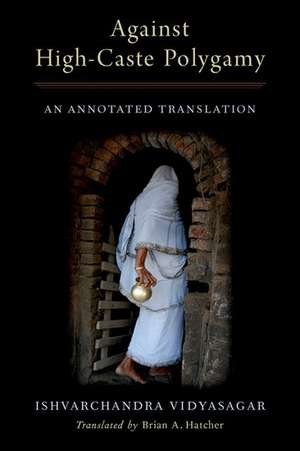
Against High-Caste Polygamy: An Annotated Translation: AAR RELIGION IN TRANSLATION
Autor Ishvarchandra Vidyasagar Traducere și comentarii de Brian A. Hatcheren Limba Engleză Hardback – 11 sep 2023
Preț: 411.90 lei
Preț vechi: 519.71 lei
-21%
Puncte Express: 618
Carte disponibilă
Livrare economică 06-17 noiembrie
Livrare express 27-31 octombrie pentru 51.16 lei
Livrare prin curier în România Termenul estimat este afișat lângă disponibilitate.
Transport gratuit pentru acest produs Plată online sau ramburs, în funcție de opțiunile comenzii.
Retur gratuit în 14 zile Comandă securizată și suport în română.
Specificații
ISBN-13: 9780197675908
ISBN-10: 0197675905
Pagini: 192
Dimensiuni: 237 x 162 x 18 mm
Greutate: 0.41 kg
Editura: Oxford University Press
Colecția OUP USA
Seria AAR RELIGION IN TRANSLATION
Locul publicării:New York, United States
ISBN-10: 0197675905
Pagini: 192
Dimensiuni: 237 x 162 x 18 mm
Greutate: 0.41 kg
Editura: Oxford University Press
Colecția OUP USA
Seria AAR RELIGION IN TRANSLATION
Locul publicării:New York, United States
V-ar putea interesa
-
 Eclecticism and Modern Hindu DiscourseBrian A. Hatcher-31%Preț: 772.69 lei1122.89 lei
 -
 -20%Preț: 305.82 lei382.22 lei
 -
 Hinduism in the Modern WorldBrian A. HatcherPreț: 485.23 lei
 -
 Imperial EncountersPeter Van Der VeerPreț: 373.00 lei
 -
 Jnana-YogaSwami VivekanandaPreț: 95.55 lei
 -
 New Consequence MachineKrishna's MercyPreț: 41.01 lei
 -
 Tales of the EastMR Matthew F. BennettPreț: 76.58 lei
 -
 Nine Principal UpanishadsRamananda PrasadPreț: 40.07 lei
 -
 Lord Krishna and His Essential TeachingsStephen KnappPreț: 124.99 lei
 -
 The 7 ChakrasM. a. HillPreț: 76.10 lei
 -
 Gujarati Vedant SaarAnil Pravinbhai ShuklaPreț: 70.97 lei
 -
 The Magic of AurasM. a. HillPreț: 69.33 lei
 -
 CompassionKim PaisolPreț: 225.77 lei
 -
 Chakras for BeginnersOlivia SummersPreț: 61.04 lei
Recenzii
Against High-Caste Polygamy departs from this pattern, by engaging a range of other rhetorical, interpretive, and explanatory methods. One does find the necessary overview of Hindu legal texts, but readers will discover much more.
This magnificent book demonstrates how precolonial Indian forms of textual exegesis and debate foundationally shaped the birth of the modern Indian public sphere. By unearthing the nexus between patriarchy and accumulation of capital, it provides us new intellectual resources to critique 'marital capitalism.' A tour de force-must-read for anyone interested in Indian intellectual and gender history.
Only Brian Hatcher could have so elegantly translated a text like Against High-Caste Polygamy. Hatcher's fascinating introduction highlights Vidyasagar's contribution toward an imaginative sociology of Bengal, embellished by an early data-driven perspective, and informed by enormous sympathy for Bengali women trapped in Kulin marriages. Hatchers voice merges with this sympathy, while retaining its analytical acumen. This book is central for understanding women's reform in colonial India and is a tremendous read.
A daunting task indeed-to make relevant a late-nineteenth century text on the plight of high-caste Hindu women, subject to, as Vidyasagar writes 'the practice of this hideous and cruel custom' of serial polygamy. Hatcher's seamless introduction and extremely readable translation successfully highlights Vidyasagar's fundamental ethical commitment to women's dignity. He neatly contextualizes the author's Brahmanical heritage that could have predicated an inherently patriarchal viewpoint.
The significance of Hatcher's work, an indispensable Vidyasagar scholar of our time, lies in the attempt to make the social reformer's works available to the English-speaking world.
Against High-Caste Polygamy is an important addition to the literature on 19th-century Hindu reformism.
The appendices and the bibliography are highly valuable and taken together this book marks a new height in Hatcher'sscholarly research on Vidyasagar and nineteenth-century Bengal.
This magnificent book demonstrates how precolonial Indian forms of textual exegesis and debate foundationally shaped the birth of the modern Indian public sphere. By unearthing the nexus between patriarchy and accumulation of capital, it provides us new intellectual resources to critique 'marital capitalism.' A tour de force-must-read for anyone interested in Indian intellectual and gender history.
Only Brian Hatcher could have so elegantly translated a text like Against High-Caste Polygamy. Hatcher's fascinating introduction highlights Vidyasagar's contribution toward an imaginative sociology of Bengal, embellished by an early data-driven perspective, and informed by enormous sympathy for Bengali women trapped in Kulin marriages. Hatchers voice merges with this sympathy, while retaining its analytical acumen. This book is central for understanding women's reform in colonial India and is a tremendous read.
A daunting task indeed-to make relevant a late-nineteenth century text on the plight of high-caste Hindu women, subject to, as Vidyasagar writes 'the practice of this hideous and cruel custom' of serial polygamy. Hatcher's seamless introduction and extremely readable translation successfully highlights Vidyasagar's fundamental ethical commitment to women's dignity. He neatly contextualizes the author's Brahmanical heritage that could have predicated an inherently patriarchal viewpoint.
The significance of Hatcher's work, an indispensable Vidyasagar scholar of our time, lies in the attempt to make the social reformer's works available to the English-speaking world.
Against High-Caste Polygamy is an important addition to the literature on 19th-century Hindu reformism.
The appendices and the bibliography are highly valuable and taken together this book marks a new height in Hatcher'sscholarly research on Vidyasagar and nineteenth-century Bengal.
Notă biografică
Brian A. Hatcher is Professor of Religion at Tufts University. He is the author of Idioms of Improvement: Vidyasagar and Cultural Encounter in Bengal and Hinduism Before Reform and the translator of Hindu Widow Marriage by Ishvarchandra Vidyasagar. He earned his PhD from Harvard University in the Comparative Study of Religion in 1992, specializing in the transformation of religion and intellectual life in colonial South Asia.
Cuprins
- Preface
- Note on the text and translation
- Introduction
- Against High-Caste Polygamy: the English translation
- Notice
- Against High-Caste Polygamy
- Conclusion
- Appendices
- Supplement One
- Supplement Two
- Conclusion to the Second Supplement
- Supporting evidence
- Glossary: English to Sanskrit/Bengali
- Glossary: Sanskrit/Bengali to English
- Bibliography
- Index