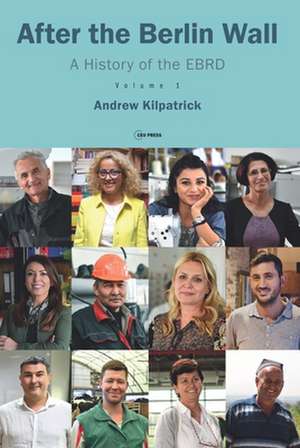
After the Berlin Wall: A History of the EBRD, Volume 1
Autor Andrew Kilpatricken Limba Engleză Paperback – 10 dec 2020
The first volume of a history in two parts, After the Berlin Wall charts the EBRD’s life from a fledgling high-risk, start-up investing in former socialist countries from 1991 to become an established member of the international financial community, which (as of May 2020) operates in almost 40 countries across three continents. This volume describes the multilateral negotiations that created this cosmopolitan institution with a ‘European character’ and the emergence of the EBRD’s unique business model: a focus on the private sector and a mission to deliver development impact with sustainable financial returns. The author recounts the challenges that ‘transition’ countries faced in moving from a defunct to a better economic system and maps the EBRD’s response to critical events, from the dissolution of the Soviet Union, to the safe confinement of the Chernobyl disaster site, the debt default in Russia and the onset of the global financial crisis in 2008.
Preț: 452.16 lei
Preț vechi: 491.47 lei
-8%
Puncte Express: 678
Carte disponibilă
Livrare economică 28 octombrie-11 noiembrie
Livrare prin curier în România Termenul estimat este afișat lângă disponibilitate.
Transport gratuit pentru acest produs Plată online sau ramburs, în funcție de opțiunile comenzii.
Retur gratuit în 14 zile Comandă securizată și suport în română.
Specificații
ISBN-13: 9789633863848
ISBN-10: 9633863848
Pagini: 420
Dimensiuni: 152 x 229 x 34 mm
Greutate: 0.78 kg
Ediția:1
Editura: Amsterdam University Press
Colecția Central European University Press
Locul publicării:Oxford, United Kingdom
ISBN-10: 9633863848
Pagini: 420
Dimensiuni: 152 x 229 x 34 mm
Greutate: 0.78 kg
Ediția:1
Editura: Amsterdam University Press
Colecția Central European University Press
Locul publicării:Oxford, United Kingdom
Public țintă
AcademicCuprins
Personal Foreword by Suma Chakrabarti, Preface
PART I Post-Cold War Pioneer
Chapter 1 A New International Development Institution Chapter 2 Creating the EBRD’s DNA Chapter 3 Difficult Early Years Chapter 4 Restoring Credibility
PART II Transition Mode
Chapter 5 Scaling Up through Financial Institutions Chapter 6 Supporting Privatisation and Restructuring Chapter 7 Developing Local Services Chapter 8 Environment Matters Chapter 9 Nuclear Safety Chapter 10 Embedding Impact in the Business Model
PART III Holding Course
Chapter 11 Russian Crisis Chapter 12 Recovery, Growth and Graduation. Appendix, Index
PART I Post-Cold War Pioneer
Chapter 1 A New International Development Institution Chapter 2 Creating the EBRD’s DNA Chapter 3 Difficult Early Years Chapter 4 Restoring Credibility
PART II Transition Mode
Chapter 5 Scaling Up through Financial Institutions Chapter 6 Supporting Privatisation and Restructuring Chapter 7 Developing Local Services Chapter 8 Environment Matters Chapter 9 Nuclear Safety Chapter 10 Embedding Impact in the Business Model
PART III Holding Course
Chapter 11 Russian Crisis Chapter 12 Recovery, Growth and Graduation. Appendix, Index
Notă biografică
Andrew Kilpatrick is a consultant to the European Bank for Reconstruction and Development (EBRD) and World Bank Group. Until 2018, he was executive counsellor to the Chief Economist at the EBRD and Director for Project and Sector Assessment in the Economics and Policy Group from 2008. He served on many of the Bank’s key committees during ten years at the EBRD, and in particular was responsible throughout this time for providing advice to the EBRD’s Operations Committee and Board of Directors relating to the transition of the Bank’s countries of operations towards sustainable market economies.
Prior to joining the EBRD, Andrew was a senior official at the UK’s HM Treasury. In that capacity he held several high profile positions, including heading the Group charged with tackling Financial Crime, Head of Global Economics, Head of Fiscal and Macroeconomic Policy and Deputy Press Secretary to the Chancellor of the Exchequer. Andrew Kilpatrick is the author of a number of academic publications and was an Advisory Board member of the Centre for Business Research at the Judge Business School. A former research fellow of Sidney Sussex College, Cambridge and research scholar of Trinity College, Cambridge, Andrew holds degrees in economics from Cambridge University.
Prior to joining the EBRD, Andrew was a senior official at the UK’s HM Treasury. In that capacity he held several high profile positions, including heading the Group charged with tackling Financial Crime, Head of Global Economics, Head of Fiscal and Macroeconomic Policy and Deputy Press Secretary to the Chancellor of the Exchequer. Andrew Kilpatrick is the author of a number of academic publications and was an Advisory Board member of the Centre for Business Research at the Judge Business School. A former research fellow of Sidney Sussex College, Cambridge and research scholar of Trinity College, Cambridge, Andrew holds degrees in economics from Cambridge University.
Descriere
After the Berlin Wall tells the inside story of an international financial institution, the European Bank for Reconstruction and Development (EBRD), created after the collapse of communism to help the countries of central and eastern Europe transition towards open market-oriented democratic economies.