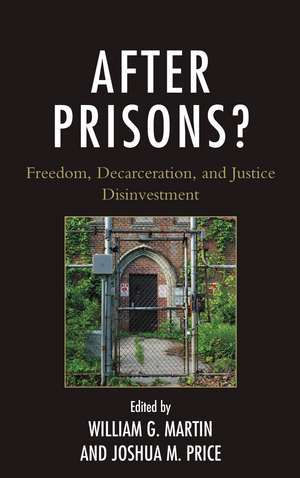
After Prisons?: Freedom, Decarceration, and Justice Disinvestment
Editat de William G. Martin, Joshua M. Price Contribuţii de John Major Eason, Luis R. Gonzalez, Chungse Jung, Brendan McQuade, Andrew J. Pragacz, Kevin Revieren Limba Engleză Hardback – 4 aug 2016
This book provides an answer. Drawing on original research from across New York State, the contributors argue that while massive decarceration is taking place, the outcome to date is not the one wished for by reformers, namely a more just system. While drug law reform is clearly upon us, for example, a moral panic about heroin addiction and phantom meth labs has recently reached a fever pitch. As the penitentiary population drops and prisons close, the number of people in jail has swelled. New intelligence-led policing, and the rise of a reentry industry together have led to more surveillance and less social justice. Together these developments lead to justice disinvestment as the state sheds direct responsibility for the criminal justice system to the private and non-profit sector, while it extends its reach through new forms of community-based supervision, surveillance and policing into poor neighborhoods and communities of color.
Celebration may be premature, in other words. Having endowed a group that is already disproportionately poor and people of color with the stigma of criminality, the state has left the formerly incarcerated and their communities to their fate. The future we face appears to be neither emancipatory reform nor simply the continuation of past mass incarceration. The challenge of freedom, on a scale not seen since the Reconstruction, remains before us.
Preț: 524.72 lei
Preț vechi: 768.84 lei
-32%
Puncte Express: 787
Carte tipărită la comandă
Livrare economică 28 noiembrie-12 decembrie
Livrare prin curier în România Termenul estimat este afișat lângă disponibilitate.
Transport gratuit pentru acest produs Plată online sau ramburs, în funcție de opțiunile comenzii.
Retur gratuit în 14 zile Comandă securizată și suport în română.
Specificații
ISBN-13: 9781498539159
ISBN-10: 1498539157
Pagini: 156
Ilustrații: 14 b/w illustrations; 2 tables;
Dimensiuni: 160 x 235 x 17 mm
Greutate: 0.36 kg
Editura: Bloomsbury Publishing
Colecția Lexington Books
Locul publicării:New York, United States
ISBN-10: 1498539157
Pagini: 156
Ilustrații: 14 b/w illustrations; 2 tables;
Dimensiuni: 160 x 235 x 17 mm
Greutate: 0.36 kg
Editura: Bloomsbury Publishing
Colecția Lexington Books
Locul publicării:New York, United States
Cuprins
Introduction: From Mass Imprisonment to Decarceration and Justice Disinvestment, William G. Martin
Chapter 1: The Prison Town Boom and Bust in the Empire State, William G. Martin, John Major Eason, and Luis R. Gonzalez
Chapter 2: Media and the New War on Drugs: Governing through Meth, Kevin Revier, Chungse Jung, and William G. Martin
Chapter 3: From the Carceral Leviathan to the Police State: Policing Decarceration in New York State, Brendan McQuade
Chapter 4: Serving Two Masters? Reentry Task Forces and Justice Disinvestment, Joshua M. Price
Chapter 5: Is This What Decarceration Looks Like? Rising Jail Incarceration in Upstate New York, Andrew J. Pragacz
Conclusion: A New Reconstruction?, Joshua M. Price and William G. Martin
Chapter 1: The Prison Town Boom and Bust in the Empire State, William G. Martin, John Major Eason, and Luis R. Gonzalez
Chapter 2: Media and the New War on Drugs: Governing through Meth, Kevin Revier, Chungse Jung, and William G. Martin
Chapter 3: From the Carceral Leviathan to the Police State: Policing Decarceration in New York State, Brendan McQuade
Chapter 4: Serving Two Masters? Reentry Task Forces and Justice Disinvestment, Joshua M. Price
Chapter 5: Is This What Decarceration Looks Like? Rising Jail Incarceration in Upstate New York, Andrew J. Pragacz
Conclusion: A New Reconstruction?, Joshua M. Price and William G. Martin
Recenzii
After Prisons? is a remarkable book for several reasons. First of all, it remains strong from start to finish. Every chapter offers disciplined research and fresh ideas. Second, unlike the vast majority of books on criminal justice, this volume doesn't focus on high profile states, cities or the federal government. This is about criminal justice in small, rural counties in upstate New York. But most importantly, this book departs seriously from what is becoming the orthodoxy in criminal justice 'reform' - that a steady, policy wonk-driven set of 'smart' changes will peel back the carceral state. After Prisons? decisively contests that notion.. All told, this volume represents a monumental contribution to current debates, combining rigorous research focusing on spaces we rarely hear about and a political breadth of vision sorely lacking among the majority of people theorizing on what they call 'criminal justice reform.'.. [F]or those seeking systemic change and transformation in the realm of criminal justice, this is an absolute must read.. Clearly this book takes a giant step in helping us to make sense of the current state of play.
After Prisons? takes on one of the most pressing questions of our time: What is to be done in the wake of mass incarceration and our historic prison building boom? The typical answer-from activists, policy makers, well-meaning scholars seizing the bi-partisan reform moment-is decarceration. But what does this look like? How does it unfold? What are its consequences? What can be done about them? Drawing lessons from the Empire State, After Prisons? is among the first major works to critically examine these questions. Beautifully written and carefully researched, this book has implications for police reform, reentry policy and practice, the closing of prisons, the future of prison towns, how and whom we jail, and how we understand crime, violence, addiction, and poverty. After Prisons? is required reading for anyone serious about understanding crime control in the United States. Three cheers for After Prisons!
After Prisons? takes on one of the most pressing questions of our time: What is to be done in the wake of mass incarceration and our historic prison building boom? The typical answer-from activists, policy makers, well-meaning scholars seizing the bi-partisan reform moment-is decarceration. But what does this look like? How does it unfold? What are its consequences? What can be done about them? Drawing lessons from the Empire State, After Prisons? is among the first major works to critically examine these questions. Beautifully written and carefully researched, this book has implications for police reform, reentry policy and practice, the closing of prisons, the future of prison towns, how and whom we jail, and how we understand crime, violence, addiction, and poverty. After Prisons? is required reading for anyone serious about understanding crime control in the United States. Three cheers for After Prisons!