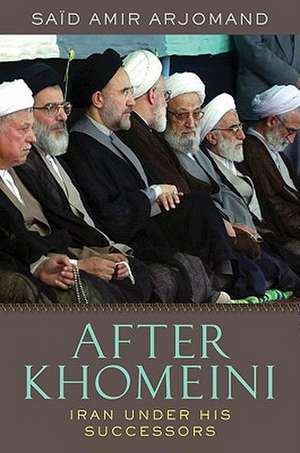
After Khomeini
Autor Said Amir Arjomanden Limba Engleză Hardback – 20 noi 2009
In After Khomeini, Said Amir Arjomand paints a subtle and perceptive portrait of contemporary Iran. This work, a sequel to Arjomand's acclaimed The Turban for the Crown, examines Iran under the successors of Ayatollah Khomeini up to the present day. He begins, as the Islamic Republic did, with Khomeini, offering a brilliant capsule biography of the man who masterminded the revolution that overthrew the Shah. Arjomand draws clear distinctions between the moderates of the initial phrase of the revolution, radicals, pragmatists, and hardliners, the latter best exemplified by Mahmud Ahmadinejad. Taking a chronological and thematic approach, he traces the emergence and consolidation of the present system of collective rule by clerical councils and the peaceful transition to dual leadership by the ayatollah as the supreme guide and the subordinate president of the Islamic Republic of Iran. He explains the internal political quarrels among Khomeini's heirs as a struggle over his revolutionary legacy. And he outlines how the ruling clerical elite and the nation's security forces are interdependent politically and economically, speculating on the potential future role of the Revolutionary Guards. Bringing the work up to current political events, Arjomand analyzes Iran's foreign policy as well, including the impact of the fall of Communism on Iran and Ahmadinejad's nuclear policy.
Few countries loom larger in American foreign relations than Iran. In this rich and insightful account, an expert on Iranian society and politics untangles the complexities of a nation still riding the turbulent wake of one of history's great revolutions.
"
Preț: 115.44 lei
Preț vechi: 140.71 lei
-18%
Puncte Express: 173
Carte tipărită la comandă
Livrare economică 04-15 decembrie
Livrare prin curier în România Termenul estimat este afișat lângă disponibilitate.
Transport gratuit de la 400.00 lei Plată online sau ramburs, în funcție de opțiunile comenzii.
Retur gratuit în 14 zile Comandă securizată și suport în română.
Specificații
ISBN-13: 9780195391794
ISBN-10: 0195391799
Pagini: 280
Dimensiuni: 164 x 244 x 29 mm
Greutate: 0.52 kg
Editura: Oxford University Press
Locul publicării:New York, United States
ISBN-10: 0195391799
Pagini: 280
Dimensiuni: 164 x 244 x 29 mm
Greutate: 0.52 kg
Editura: Oxford University Press
Locul publicării:New York, United States
V-ar putea interesa
-
 Return of the DambustersJohn NicholPreț: 92.23 lei
 -
 The House by the LakeThomas Harding-29%Preț: 67.11 lei94.63 lei
 -
 The Crime and the SilenceAnna BikontPreț: 129.27 lei
 -
 The Gorbachev FactorArchie Brown-19%Preț: 488.12 lei602.62 lei
 -
 The Unfinished Bombing: Oklahoma City in American MemoryEdward T. Linenthal-14%Preț: 166.26 lei193.75 lei
 -
 The Turks in World HistoryCarter V. Findley-22%Preț: 220.63 lei281.65 lei
 -
 The Ancient Mesopotamian CityMarc Van De Mieroop-30%Preț: 554.48 lei792.42 lei
 -
 War and Law since 1945Geoffrey Best-27%Preț: 410.31 lei559.93 lei
 -
 -27%Preț: 371.64 lei509.99 lei
 -
 Born in the GDR: Living in the Shadow of the WallHester Vaizey-18%Preț: 94.22 lei114.93 lei
 -
 -17%Preț: 380.03 lei457.53 lei
 -
 -17%Preț: 367.98 lei445.81 lei
 -
 -17%Preț: 280.80 lei336.69 lei
 -
 -19%Preț: 57.68 lei71.12 lei
 -
 Ancient Syria: A Three Thousand Year HistoryTrevor Bryce-18%Preț: 199.18 lei243.77 lei
 -
 Samuel and the Shaping of TraditionMark Leuchter-12%Preț: 255.32 lei290.72 lei
 -
 Turkey: What Everyone Needs to Know®Andrew Finkel-18%Preț: 64.92 lei79.22 lei
 -
 The Throne of Adulis: Red Sea Wars on the Eve of IslamG.W. Bowersock-13%Preț: 305.95 lei351.59 lei
 -
 Being NixonEvan ThomasPreț: 167.63 lei
 -
 Babylon: Legend, History and the Ancient CityMichael Seymour-20%Preț: 200.09 lei251.15 lei
 -
 Eichmann before JerusalemBettina Stangneth-27%Preț: 80.13 lei109.82 lei
 -
 Africa: A Modern HistoryGuy Arnold-13%Preț: 287.25 lei329.96 lei
Descriere
Iran has not ceased to surprise the world since the American ambassador's famous "thinking the unthinkable" 1978 cable about the imminent fall of the Shah and the coming of Islamic revolution. The apparent sequence of moderate government of President Hashemi-Rafsanjani (1989-97) and democratic reform under President Khatami (1997-2005) was followed by the return of the hardliners and revolutionary populism coupled with an aggressive foreign policy, including anuclear program. Iran's political regime has proved remarkably resilient through all these changes, despite the disaffection of the younger half of the population, and become all the stronger, partly as a result of the Bush administration's ill-advised bluff about regime change. The death of Imam Khomeini as its charismatic leader in 1989 did not mean the end of the Islamic revolution, but only the beginning of a prolonged struggle among the children of the revolution over Khomeini's heritage. The integrative social revolution begun in 1979 has continued quietly, while the raucous/noisy struggle to define, structure and control the new Islamic political order set up by Khomeini among different factions of his followers has produced a unique political regime whichdefies understanding. Arjomand draws on the sociology of revolution to offer a general explanation of political developments in Iran in the last two decades while seeking to understand its unique features in terms of constitutional politics of the creation of the post-revolutionary order. Not only Iran'sdomestic politics but also its foreign policy are shown to follow a pattern typical of the great revolutions. Surprising as it may seem, the parameters for Iran's constitutional politics in the last two decades are those set by Khomeini's mixture of theocratic, republican and populist elements in the ideology of the Islamic revolution.
Notă biografică
Saïd Amir Arjomand was born in Tehran and is the founder and president (1996-2002, 2006-2009) of the Association for the Study of Persianate Societies and the Editor of the Journal of Persianate Studies.
Recenzii
A clear analysis of Iran's political and ideological transformation in the post-Khomeini period. Dealing with a broad range of issues from political development and constitutional politics to Islamic reformism and the rise of new conservatives, this book is a valuable addition to Iranian studies and current debates in the sociology of revolution.
Cuprins
- Introduction
- 1. Khomeini and the Islamic Revolution
- 2. Dual Leadership and Constitutional Developments after Khomeini
- 3. Thermidor at Last: Hashemi-Rajsanjani's Presidency and the Economy
- 4. Revolutionary Ideology and Its Transformation into Islamic Reformism
- 5. The Rise and Fall of President Khatami and the Reform Movement
- 6. Social and Political Consequences of the Integrative Revolution
- 7. Iran's Foreign Policy from the Export of Revolution to Pragmatism
- 8. Iran's New Political Class and the Ahmadinejad Presidency
- 9. Khomeini's Successor: Ayatollah Khamenei as the Leader of the Islamic Republic of Iran
- 10. The Hardliners, Foreign Policy and Nuclear Development
- Conclusion
- Appendix: Two Models of Revolution
- Notes
- References
- Index