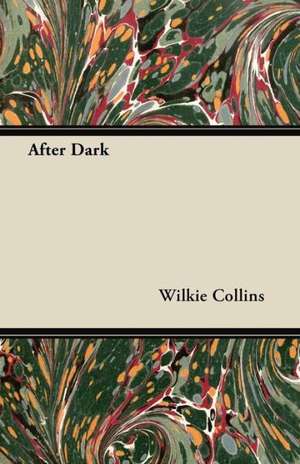
After Dark
Autor Wilkie Collinsen Limba Engleză Paperback – 14 dec 2012
Preț: 206.35 lei
Puncte Express: 310
Carte tipărită la comandă
Livrare economică 26 noiembrie-10 decembrie
Livrare prin curier în România Termenul estimat este afișat lângă disponibilitate.
Transport gratuit de la 400.00 lei Plată online sau ramburs, în funcție de opțiunile comenzii.
Retur gratuit în 14 zile Comandă securizată și suport în română.
Specificații
ISBN-13: 9781447470632
ISBN-10: 144747063X
Pagini: 524
Dimensiuni: 140 x 216 x 31 mm
Greutate: 0.73 kg
Editura: Goldberg Press
ISBN-10: 144747063X
Pagini: 524
Dimensiuni: 140 x 216 x 31 mm
Greutate: 0.73 kg
Editura: Goldberg Press
V-ar putea interesa
-
 Yonnondio: From the ThirtiesTillie OlsenPreț: 108.86 lei
 -
 Orange As MarmaladeFran StewartPreț: 111.91 lei
 -
 LeilaAntonio FogazzaroPreț: 115.76 lei
 -
 OblomovIvan Aleksandrovich GoncharovPreț: 67.24 lei
 -
 Herbert WestHoward Philli LovecraftPreț: 41.41 lei
 -
 Basil and CleopatraFitzgerald Francis ScottPreț: 49.18 lei
 -
 The Perfect LifeFitzgerald Francis ScottPreț: 37.96 lei
 -
 The Man Who Was ThursdayChesterton Gilbert KeithPreț: 59.75 lei
 -
 The AvengerWallace EdgarPreț: 64.97 lei
 -
 Mr. Justice MaxellWallace EdgarPreț: 56.69 lei
 -
 The Third BulletLindsay O'ConnorPreț: 89.57 lei
 -
 Chronicles Heartfelt Poetry Dreams Blossoming to RealityJeffery WilliamsPreț: 72.92 lei
Notă biografică
William Wilkie Collins (8 January 1824 - 23 September 1889) was an English novelist, playwright and short story writer best known for The Woman in White (1859) and The Moonstone (1868). Born to the family of a painter, William Collins, in London, he grew up in Italy and France, learning French and Italian. He began work as a clerk for a tea merchant. After his first novel, Antonina, appeared in 1850, he met Charles Dickens, who became a close friend and mentor. Some of Collins's works appeared first in Dickens's journals All the Year Round and Household Words and they collaborated on drama and fiction. In May of 1851 Collins acted with Dickens in Edward Bulwer-Lytton's play Not So Bad As We Seem. Among the audience were Queen Victoria and Prince Albert. Collins's story "A Terribly Strange Bed," his first contribution to Household Words, appeared in April, 1852. In May 1852 he went on tour with Dickens's company of amateur actors, again performing Not So Bad As We Seem, but with a more substantial role. Collins achieved financial stability and an international following with his best known works in the 1860s, but began suffering from gout. Taking opium for the pain grew into an addiction. In the 1870s and 1880s his writing quality declined with his health. Collins was critical of the institution of marriage: he split his time between Caroline Graves and his common-law wife Martha Rudd, with whom he had three children.