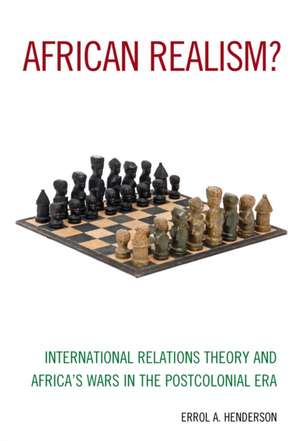
African Realism?: International Relations Theory and Africa's Wars in the Postcolonial Era
Autor Errol A. Hendersonen Limba Engleză Paperback – 14 feb 2017
Preț: 280.74 lei
Preț vechi: 380.42 lei
-26%
Puncte Express: 421
Carte tipărită la comandă
Livrare economică 12-26 noiembrie
Livrare prin curier în România Termenul estimat este afișat lângă disponibilitate.
Transport gratuit de la 400.00 lei Plată online sau ramburs, în funcție de opțiunile comenzii.
Retur gratuit în 14 zile Comandă securizată și suport în română.
Specificații
ISBN-13: 9781538104972
ISBN-10: 1538104970
Pagini: 316
Ilustrații: 6 b/w photos; 9 tables;
Dimensiuni: 151 x 230 x 24 mm
Greutate: 0.48 kg
Editura: Bloomsbury Publishing
Colecția Rowman & Littlefield
Locul publicării:New York, United States
ISBN-10: 1538104970
Pagini: 316
Ilustrații: 6 b/w photos; 9 tables;
Dimensiuni: 151 x 230 x 24 mm
Greutate: 0.48 kg
Editura: Bloomsbury Publishing
Colecția Rowman & Littlefield
Locul publicării:New York, United States
V-ar putea interesa
-
 World OrderKissingerPreț: 92.97 lei
 -
 Preț: 137.63 lei
 -
 Preț: 307.19 lei
 -
 @WarShane Harris-27%Preț: 66.13 lei91.14 lei
 -
 Countdown to Zero DayKim Zetter-20%Preț: 96.71 lei120.37 lei
 -
 Understanding Public Diplomacy in East AsiaJan MelissenPreț: 392.31 lei
 -
 -22%Preț: 114.74 lei146.18 lei
 -
 China and the West: Hope and Fear in the Age of AsiaFokke Obbema-21%Preț: 165.03 lei209.41 lei
 -
 -36%Preț: 44.12 lei69.24 lei
Cuprins
List of Figures and Tables
Map of Africa
Acknowledgments
Introduction
Chapter 1: International Relations and Africa: A Mélange of Metaphors, a
Dearth of Theory
Chapter 2: Africa's Wars as New Wars: Dubious Dichotomies and
Flattening History
Chapter 3: Africa, Racism, and World Politics: Dualism and the Persistence
of Primitivism
Chapter 4: Socialization and the Domestic Sources of Africa's International
Wars
Chapter 5: Africa's International Wars: Inverted Legitimacy and
Neopatrimonial Balancing
Chapter 6: Disturbing the Peace: Africa's International Wars and the
Democratic Peace
Chapter 7: Liberal Trade Theory, Regional Institutionalism, and Africa's
International Wars
Conclusion: Towards African Realism?
References
Index
Map of Africa
Acknowledgments
Introduction
Chapter 1: International Relations and Africa: A Mélange of Metaphors, a
Dearth of Theory
Chapter 2: Africa's Wars as New Wars: Dubious Dichotomies and
Flattening History
Chapter 3: Africa, Racism, and World Politics: Dualism and the Persistence
of Primitivism
Chapter 4: Socialization and the Domestic Sources of Africa's International
Wars
Chapter 5: Africa's International Wars: Inverted Legitimacy and
Neopatrimonial Balancing
Chapter 6: Disturbing the Peace: Africa's International Wars and the
Democratic Peace
Chapter 7: Liberal Trade Theory, Regional Institutionalism, and Africa's
International Wars
Conclusion: Towards African Realism?
References
Index
Recenzii
This important book challenges prevailing theories of international relations and war. Henderson offers an Afrocentric analysis of conflict behavior of African states since independence, including internal and international wars, informed but not bound by existing theoretical paradigms. In the end, he demonstrates the necessity of testing global theories in regional and other contextual settings and of formulating approaches that do justice to their specific historical, cultural, and institutional conditions. Using a combination of qualitative and quantitative analyses, he contends that African states' conflict behavior is best explained by a 'neopatrimonial balancing thesis' that upends or modifies conventional realist, democratic peace and liberal trade theses, at least insofar as they apply to Africa. The research and policy implications of Henderson's findings are only briefly noted at the end; they certainly invite reconsideration of the ways scholars and policy practitioners frame and formulate their respective approaches to addressing contemporary African conflicts. Highly recommended for college and university libraries and collections supporting African and international studies, peace and conflict programs, and larger public library systems. Summing Up: Highly recommended. Upper-division undergraduates and above.
This is a virtual tour de force of the International Relations field while also serving as a critique of much of its treatment of conflicts and wars in Africa. The author does a thorough job in mainstreaming Africa and elevating its relevance to IR theories. He demonstrates that it is realism rather than liberalism or constructivism that best depicts African approaches to international relations in the post-colonial period. Henderson should be congratulated on taking a bold and consistent stand as he wades through the massive literatures on Africa and IR that reflects his mastery of both.
In this well-researched and highly readable book, Errol A. Henderson presents an impressive analysis of the applicability of international relations theory to African interstate conflicts, particularly with respect to the debate concerning the democratic peace thesis (DPT). In challenging some of the established ideas in a field that tends to ignore Africa, African Realism? should appeal to policymakers, as well as to professors and students engaged in graduate seminars in African politics, comparative politics, and international relations.
This is a virtual tour de force of the International Relations field while also serving as a critique of much of its treatment of conflicts and wars in Africa. The author does a thorough job in mainstreaming Africa and elevating its relevance to IR theories. He demonstrates that it is realism rather than liberalism or constructivism that best depicts African approaches to international relations in the post-colonial period. Henderson should be congratulated on taking a bold and consistent stand as he wades through the massive literatures on Africa and IR that reflects his mastery of both.
In this well-researched and highly readable book, Errol A. Henderson presents an impressive analysis of the applicability of international relations theory to African interstate conflicts, particularly with respect to the debate concerning the democratic peace thesis (DPT). In challenging some of the established ideas in a field that tends to ignore Africa, African Realism? should appeal to policymakers, as well as to professors and students engaged in graduate seminars in African politics, comparative politics, and international relations.