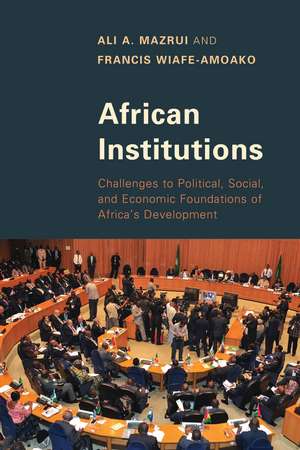
African Institutions: Challenges to Political, Social, and Economic Foundations of Africa's Development
Autor Ali A. Mazrui, Francis Wiafe-Amoakoen Limba Engleză Hardback – 12 noi 2015
This comprehensive text examines three key issue areas in Africa: politics, society, and economy. It demonstrates how the lack of consideration for domestic norms and societal realities explain the weaker institutions and lack of development on the African continent. The chapters examine critical issues such as gender, ethnicity and constitution development, legitimacy and the state, the correlation between abundant resources and instability, the dilemmas of political dynasties, international economic regimes and Africa's economy, and more. Featuring many case studies, including Kenya, South Africa, Senegal, Ghana, Nigeria, Tanzania, Morocco, Togo, DRC, Ethiopia, Rwanda, the book provides some explanation of underdevelopment in Africa, linking the historical and colonial realities that hinder democratic consolidation to contemporary African politics, society and economy.
Preț: 569.66 lei
Preț vechi: 662.39 lei
-14%
Puncte Express: 854
Carte tipărită la comandă
Livrare economică 20 noiembrie-04 decembrie
Livrare prin curier în România Termenul estimat este afișat lângă disponibilitate.
Transport gratuit pentru acest produs Plată online sau ramburs, în funcție de opțiunile comenzii.
Retur gratuit în 14 zile Comandă securizată și suport în română.
Specificații
ISBN-13: 9781442239524
ISBN-10: 1442239522
Pagini: 196
Ilustrații: 3 tables
Dimensiuni: 160 x 238 x 19 mm
Greutate: 0.41 kg
Editura: Bloomsbury Publishing
Colecția Rowman & Littlefield
Locul publicării:New York, United States
ISBN-10: 1442239522
Pagini: 196
Ilustrații: 3 tables
Dimensiuni: 160 x 238 x 19 mm
Greutate: 0.41 kg
Editura: Bloomsbury Publishing
Colecția Rowman & Littlefield
Locul publicării:New York, United States
Cuprins
Chapter One: Institutions: An Introduction
Francis Wiafe-Amoako
Chapter Two: Democracide: Who killed democracy in Africa? Clues of the past, concerns of the future
Ali A. Mazrui
Chapter Three: Political Ideologies and Democratic Consolidation in Africa
Francis Wiafe-Amoako
Chapter Four: Gender Roles in Africa: Traditional versus Contemporary Institutions
Ali A. Mazrui and Francis Wiafe-Amoako
Chapter Five: Legitimacy and Rule: Africa in Search of a Political Order
Francis Wiafe-Amoako
Chapter Six: Democracy and the Politics of Petroleum: Comparative African Perspectives
Ali A. Mazrui
Chapter Seven: Uhuru Bado Kidogo : Africa's condition of "Not Yet Uhuru"
Ali A. Mazrui
Chapter Eight: "Katiba Na Kabila": If African Politics Are Ethnic-Prone, Can African Constitutions Be Ethnic-Proof?
Ali A. Mazrui
Resources
About the Authors
Francis Wiafe-Amoako
Chapter Two: Democracide: Who killed democracy in Africa? Clues of the past, concerns of the future
Ali A. Mazrui
Chapter Three: Political Ideologies and Democratic Consolidation in Africa
Francis Wiafe-Amoako
Chapter Four: Gender Roles in Africa: Traditional versus Contemporary Institutions
Ali A. Mazrui and Francis Wiafe-Amoako
Chapter Five: Legitimacy and Rule: Africa in Search of a Political Order
Francis Wiafe-Amoako
Chapter Six: Democracy and the Politics of Petroleum: Comparative African Perspectives
Ali A. Mazrui
Chapter Seven: Uhuru Bado Kidogo : Africa's condition of "Not Yet Uhuru"
Ali A. Mazrui
Chapter Eight: "Katiba Na Kabila": If African Politics Are Ethnic-Prone, Can African Constitutions Be Ethnic-Proof?
Ali A. Mazrui
Resources
About the Authors
Recenzii
The work by Ali Mazrui and Francis Wiafe-Amoako is an important contribution to our understanding of African institutions, in particular, and the study of institutions as a pivot around which societies hang together in general. . . .The book by Mazrui and Wife-Amoako provides an important frame of reference for understanding Africa's future political paths and how the continent could play its role in the world. On the whole, the authors are hopeful about the prospects of democracy in Africa. Theirs is not banal hope characteristic of the mood swings in much of the analyses that one day see an Africa that is rising and the next see a hopeless continent. Their hope is grounded in analysis of trends over time, including the fact that military coups are receding, democratisation and economic progress are advancing in countries where institutions are solidifying and women are increasingly realising their political and economic roles in the continent. The analytical and argumentative manner in which the book is written makes it a fascinating and informative text on Africa's institutions, their lack of maturity and the conditions that are necessary to ensure that they work optimally.
In 2009 President Barack Obama said, rightly in my view, that Africa didn't need strong men, it needed strong institutions. Professor Ali Mazrui made almost the same point in 1970 in an article aptly titled "The Monarchical Tendency in African Political Culture." He also grappled with the associated challenges. Now Mazrui's numerous writings on the subject conveniently re-appear as multiple chapters in African Institutions, ably updated by Dr. Francis Wiafe-Amoako, the book's co-author. The book is further enriched with Wiafe-Amoako's own chapters. This is a timely book and an invaluable reference, most ideal for comparative politics, African studies and related fields.
Much of what the younger partner to the late Mazrui wrote are contained in our celebrated Mazruian. Yet, it should be stated categorically here that Ali himself was sufficiently impressed by Francis Wiafe-Amoako to break bread with him in their lifetime journey to identify for posterity what must be done to cultivate institutions in modern Africa. In this age of Facebook, CNN, the BBC, and the VOA, the living voice of Mazrui and his colleague Francis will reverberate in the firmaments of African thoughts.
In 2009 President Barack Obama said, rightly in my view, that Africa didn't need strong men, it needed strong institutions. Professor Ali Mazrui made almost the same point in 1970 in an article aptly titled "The Monarchical Tendency in African Political Culture." He also grappled with the associated challenges. Now Mazrui's numerous writings on the subject conveniently re-appear as multiple chapters in African Institutions, ably updated by Dr. Francis Wiafe-Amoako, the book's co-author. The book is further enriched with Wiafe-Amoako's own chapters. This is a timely book and an invaluable reference, most ideal for comparative politics, African studies and related fields.
Much of what the younger partner to the late Mazrui wrote are contained in our celebrated Mazruian. Yet, it should be stated categorically here that Ali himself was sufficiently impressed by Francis Wiafe-Amoako to break bread with him in their lifetime journey to identify for posterity what must be done to cultivate institutions in modern Africa. In this age of Facebook, CNN, the BBC, and the VOA, the living voice of Mazrui and his colleague Francis will reverberate in the firmaments of African thoughts.