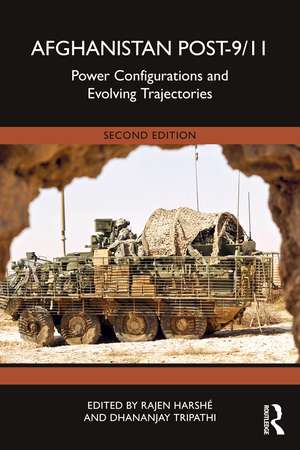
Afghanistan in Transition: From Taliban to Taliban
Editat de Rajen Harshé, Dhananjay Tripathien Limba Engleză Paperback – 4 dec 2024
The essays in this volume:
- Locate Afghanistan under globalisation and reflect on the state and nation-building efforts in Afghanistan by shedding light on the status of citizens, especially women
- Analyse how the Taliban survived in all these years, and how it returned to power
- Examine Afghanistan’s relations with major powers like the USA, China, and India and explore the intricacies of ties between India, Pakistan, and Afghanistan within the Indian subcontinent
Preț: 354.40 lei
Puncte Express: 532
Carte disponibilă
Livrare economică 17 noiembrie-01 decembrie
Livrare express 03-07 noiembrie pentru 29.28 lei
Livrare prin curier în România Termenul estimat este afișat lângă disponibilitate.
Transport gratuit de la 400.00 lei Plată online sau ramburs, în funcție de opțiunile comenzii.
Retur gratuit în 14 zile Comandă securizată și suport în română.
Specificații
ISBN-13: 9780367243135
ISBN-10: 036724313X
Pagini: 172
Dimensiuni: 156 x 234 x 13 mm
Greutate: 0.32 kg
Ediția:2
Editura: Taylor & Francis
Colecția Routledge India
Locul publicării:Oxford, United Kingdom
ISBN-10: 036724313X
Pagini: 172
Dimensiuni: 156 x 234 x 13 mm
Greutate: 0.32 kg
Ediția:2
Editura: Taylor & Francis
Colecția Routledge India
Locul publicării:Oxford, United Kingdom
Public țintă
PostgraduateCuprins
PART I: Engaging with Afghanistan 1. Introduction 2. Situating Afghanistan in a Globalising World 3. ‘Pragmatism’ against ‘Ideology’ in Transnational vs Regional Jihadist Groups: Situating Taliban and Islamic State-Khorasan on a Conflict-Cooperation Continuum. PART II: What about the Taliban? 4. Through the Lens of Belief: Taliban's Worldview and Its Influence 5. Pieced Peace in Afghanistan: Evaluating the Peace Processes for Ending the Conflict in Afghanistan Post-2014 6. State building in Talibanized Afghanistan: Lessons from History PART III: Afghanistan and Major Powers 7. The U.S. Role in Afghanistan: A Critical Overview 8. China’s Engagement with Afghanistan: Quest for Security, Stability and Strategy 9. Is the Past a Prologue? Deciphering India’s North–West Engagement
Notă biografică
Rajen Harshé has taught Political Science and International Relations for more than four decades in places such as University of Hyderabad, Hyderabad, and South Asian University, New Delhi. He is a founding and the former Vice Chancellor of the Central University of Allahabad (2005–10), Prayagraj, India. He also worked as President of the G.B. Pant Social Science Institute (2014–20), Prayagraj. He has written extensively on African and International Affairs. His latest work is Africa in World Affairs: Politics of Imperialism, the Cold War and Globalisation (Oxon, New York, New Delhi, Routledge, 2019).
Dhananjay Tripathi is Associate Professor (Senior Grade) at the Department of International Relations, South Asian University (SAU), New Delhi, India. His recent publications are (ed) Re-imagining Border Studies in South Asia (2020, Routledge), co-edited South Asia: Boundaries, Borders and Beyond (2022, Routledge), and Afghanistan Post-2014: Power Configurations and Evolving Trajectories (2016, Routledge). He has contributed several articles to reputed international academic journals.
Dhananjay Tripathi is Associate Professor (Senior Grade) at the Department of International Relations, South Asian University (SAU), New Delhi, India. His recent publications are (ed) Re-imagining Border Studies in South Asia (2020, Routledge), co-edited South Asia: Boundaries, Borders and Beyond (2022, Routledge), and Afghanistan Post-2014: Power Configurations and Evolving Trajectories (2016, Routledge). He has contributed several articles to reputed international academic journals.
Descriere
Owing to its geo-strategic location and mineral wealth, Afghanistan has acquired significance in the inter-state politics of Asia as well as world politics during the past decades. This book discusses the Taliban’s return which outlines the recent and current developments in contemporary Afghanistan.