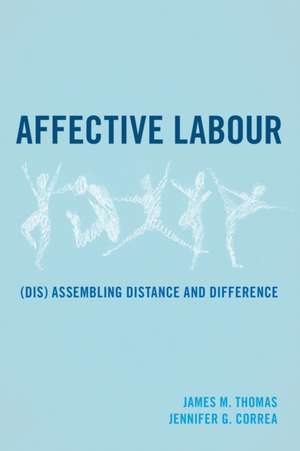
Affective Labour: (Dis) assembling Distance and Difference
Autor James M. Thomas, Jennifer G. Correaen Limba Engleză Paperback – 11 dec 2015
The book demonstrates how the power of affective labour might be harnessed for progressively oriented world-building projects, including what the authors term an 'affective labour from below.' By tying an analysis of affective labour into movements for social justice, the authors aim to produce a critical theory of the world that can be practically applied.
Preț: 342.12 lei
Preț vechi: 482.20 lei
-29%
Puncte Express: 513
Carte tipărită la comandă
Livrare economică 07-21 decembrie
Livrare prin curier în România Termenul estimat este afișat lângă disponibilitate.
Transport gratuit de la 400.00 lei Plată online sau ramburs, în funcție de opțiunile comenzii.
Retur gratuit în 14 zile Comandă securizată și suport în română.
Specificații
ISBN-13: 9781783483907
ISBN-10: 1783483903
Pagini: 240
Ilustrații: 2 Tables
Dimensiuni: 151 x 231 x 17 mm
Greutate: 0.27 kg
Editura: Bloomsbury Publishing
Colecția Rowman & Littlefield
Locul publicării:New York, United States
ISBN-10: 1783483903
Pagini: 240
Ilustrații: 2 Tables
Dimensiuni: 151 x 231 x 17 mm
Greutate: 0.27 kg
Editura: Bloomsbury Publishing
Colecția Rowman & Littlefield
Locul publicării:New York, United States
V-ar putea interesa
-
 -21%Preț: 271.33 lei344.47 lei
 -
 -30%Preț: 896.98 lei1284.28 lei
 -
 Bottlenecks: A New Theory of Equal OpportunityJoseph Fishkin-31%Preț: 393.69 lei567.57 lei
 -
 Social Change and Intersectional ActivismSharon Doetsch-KidderPreț: 406.06 lei
 -
 -15%Preț: 650.15 lei764.88 lei
 -
 Whistling VivaldiClaude M. SteelePreț: 88.90 lei
 -
 Gender and SexualityMomin RahmanPreț: 196.39 lei
 -
 Preț: 249.45 lei
 -
 Preț: 67.45 lei
 -
 Marginality and Exclusion in EgyptKamal Fahmi-27%Preț: 217.15 lei297.89 lei
 -
 DispatcherMark GevisserPreț: 178.20 lei
 -
 Turning the TideAngela V. JohnPreț: 148.45 lei
Cuprins
Introduction: Difference, Distance, and Affective Labour / 1. The Production of Good Times in Urban Nightlife / 2. An Economy of Fear on the U.S. - Mexico Border / 3. Diversity Regimes and Affective Labor in Higher Education / 4. Affective Labour from Above and Below / 5. Affective Labour and World Building: Toward a Theory of Affect for Radical Change / Conclusion / Bibliography / Index
Recenzii
Thomas and Correa offer an important empirical study of affective labor's central role in sustaining two pillars of inequality: racial difference and socio-spatial distance. Noteworthy for its comparative and relational approaches, Affective Labour reveals the entwinements between racism and affect in everyday practices and places.
In this theoretically groundbreaking yet remarkably accessible book, Thomas and Correa establish a strong case for why affect should matter to scholars of race and racism, as well as to activists working for social justice. Affective Labour describes the painstaking work of identification, the crafting of difference, and the production of social distance, in effect asking how forms of violence and exclusion become imaginable or unimaginable. The book takes the reader on an intellectual journey from a college-town bar scene to the US-Mexico border, through the contemporary diversity regimes of predominantly white institutions. The authors then bring the lessons from these case studies to bear on the emergent affective politics of Black Lives Matter and similar radical democratic social movements. In spite of the grimly neoliberal landscapes of difference and inequality it explores, Affective Labour remains optimistic in its evocation of coming into being and the potential for an affect of liberation in progressive politics. ?
Bringing together critical social, cultural and political analysis, phenomenology and original ethnographic research, this book is a must read for anyone interested in the politics of affect. Thomas and Correa provide an imaginative and incisive account of how the manufacturing of gendered, racialised, sexualised, and classed relations of distance and difference is a matter of affective labour. Through a diverse range of in depth examples - from American nightlife cultures, to University diversity-initiatives, to the #BlackLivesMatter movement - the book offers a refreshing and distinctive examination of the affective work of everyday life and its wider critical implications. The analysis offered is at once productively troubling and optimistic: Contemporary forms of affective labour frequently work to reproduce relations of domination, but they also fuel solidarity, resistance and 'a sense of hope for what can be, despite the reality of what is'.
Thomas and Correa's expansive research into distance and difference takes us on an immersive journey into configurations of affective subjectivity - from above and below. Carefully crafted case studies of urban nightlife in Columbia, Missouri, 'War on Terror' at the US-Mexico border, diversity regimes in higher education, and the #BlackLivesMatter Movement, underline why affect should be of critical concern to social, cultural and political theorists. Affective Labour is an original and timely contribution that will have implications for how we approach the politics of difference in the classroom, the polity and on the street.
In this theoretically groundbreaking yet remarkably accessible book, Thomas and Correa establish a strong case for why affect should matter to scholars of race and racism, as well as to activists working for social justice. Affective Labour describes the painstaking work of identification, the crafting of difference, and the production of social distance, in effect asking how forms of violence and exclusion become imaginable or unimaginable. The book takes the reader on an intellectual journey from a college-town bar scene to the US-Mexico border, through the contemporary diversity regimes of predominantly white institutions. The authors then bring the lessons from these case studies to bear on the emergent affective politics of Black Lives Matter and similar radical democratic social movements. In spite of the grimly neoliberal landscapes of difference and inequality it explores, Affective Labour remains optimistic in its evocation of coming into being and the potential for an affect of liberation in progressive politics. ?
Bringing together critical social, cultural and political analysis, phenomenology and original ethnographic research, this book is a must read for anyone interested in the politics of affect. Thomas and Correa provide an imaginative and incisive account of how the manufacturing of gendered, racialised, sexualised, and classed relations of distance and difference is a matter of affective labour. Through a diverse range of in depth examples - from American nightlife cultures, to University diversity-initiatives, to the #BlackLivesMatter movement - the book offers a refreshing and distinctive examination of the affective work of everyday life and its wider critical implications. The analysis offered is at once productively troubling and optimistic: Contemporary forms of affective labour frequently work to reproduce relations of domination, but they also fuel solidarity, resistance and 'a sense of hope for what can be, despite the reality of what is'.
Thomas and Correa's expansive research into distance and difference takes us on an immersive journey into configurations of affective subjectivity - from above and below. Carefully crafted case studies of urban nightlife in Columbia, Missouri, 'War on Terror' at the US-Mexico border, diversity regimes in higher education, and the #BlackLivesMatter Movement, underline why affect should be of critical concern to social, cultural and political theorists. Affective Labour is an original and timely contribution that will have implications for how we approach the politics of difference in the classroom, the polity and on the street.