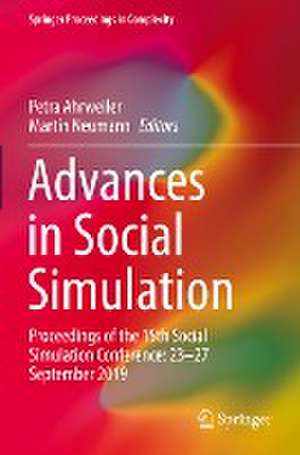
Advances in Social Simulation: Springer Proceedings in Complexity
Editat de Petra Ahrweiler, Martin Neumannen Limba Engleză Paperback – 28 apr 2022
This book presents the state of the art in social simulation as presented at the Social Simulation Conference 2019 in Mainz, Germany. It covers the developments in applications and methods of social simulation, addressing societal issues such as socio-ecological systems and policymaking. Methodological issues discussed include large-scale empirical calibration, model sharing and interdisciplinary research, as well as decision-making models, validation and the use of qualitative data in simulation modeling. Research areas covered include archaeology, cognitive science, economics, organization science and social simulation education.
This book gives readers insight into the increasing use of social simulation in both its theoretical development and in practical applications such as policymaking whereby modeling and the behavior of complex systems is key. The book appeals to students, researchers and professionals in the various fields.
Din seria Springer Proceedings in Complexity
- 18%
 Preț: 1249.73 lei
 - 20%
 Preț: 1202.39 lei
 - 18%
 Preț: 1313.51 lei
 - 18%
 Preț: 1224.81 lei
 - 18%
 Preț: 1232.88 lei
 - 18%
 Preț: 1172.35 lei
 - 18%
 Preț: 1397.91 lei
 - 18%
 Preț: 924.22 lei
 - 18%
 Preț: 924.52 lei
 - 20%
 Preț: 949.61 lei
 - 20%
 Preț: 669.62 lei
 - 15%
 Preț: 671.36 lei
 - 18%
 Preț: 987.39 lei
 - 18%
 Preț: 1497.91 lei
 - 20%
 Preț: 668.71 lei
 - 15%
 Preț: 619.75 lei
 - 24%
 Preț: 1207.56 lei
 - 18%
 Preț: 981.05 lei
 - 24%
 Preț: 921.42 lei
 - 18%
 Preț: 1310.62 lei
 - 18%
 Preț: 930.00 lei
 - 18%
 Preț: 1175.66 lei
 - 18%
 Preț: 1282.29 lei
 - 15%
 Preț: 645.82 lei
 -
 Preț: 413.54 lei
 - 18%
 Preț: 1269.81 lei
 - 18%
 Preț: 1201.59 lei
 - 18%
 Preț: 1287.56 lei
 - 18%
 Preț: 917.39 lei
 - 15%
 Preț: 616.95 lei
 - 20%
 Preț: 647.19 lei
 - 18%
 Preț: 992.26 lei
 -
 Preț: 407.68 lei
 - 18%
 Preț: 1169.07 lei
 - 20%
 Preț: 1295.18 lei
 - 15%
 Preț: 668.50 lei
 - 18%
 Preț: 1282.51 lei
 - 20%
 Preț: 1248.84 lei
 - 24%
 Preț: 1221.21 lei
Preț: 1636.77 lei
Preț vechi: 2045.96 lei
-20%
Puncte Express: 2455
Carte tipărită la comandă
Livrare economică 23 noiembrie-07 decembrie
Livrare prin curier în România Termenul estimat este afișat lângă disponibilitate.
Transport gratuit pentru acest produs Plată online sau ramburs, în funcție de opțiunile comenzii.
Retur gratuit în 14 zile Comandă securizată și suport în română.
Specificații
ISBN-13: 9783030615055
ISBN-10: 3030615057
Pagini: 628
Ilustrații: XXII, 603 p. 140 illus., 108 illus. in color.
Dimensiuni: 155 x 235 x 34 mm
Greutate: 0.94 kg
Ediția:1st ed. 2021
Editura: Springer
Colecția Springer Proceedings in Complexity
Seria Springer Proceedings in Complexity
Locul publicării:Cham, Switzerland
ISBN-10: 3030615057
Pagini: 628
Ilustrații: XXII, 603 p. 140 illus., 108 illus. in color.
Dimensiuni: 155 x 235 x 34 mm
Greutate: 0.94 kg
Ediția:1st ed. 2021
Editura: Springer
Colecția Springer Proceedings in Complexity
Seria Springer Proceedings in Complexity
Locul publicării:Cham, Switzerland
Cuprins
Part 1: Computational Organisation Theory.- Chapter 1. Simulation Model of Financial Flows of an Industrial Enterprise.- Chapter 2. Drug Trafficking as Illegal Supply Chain - A Social Simulation.- Chapter 3. Influences of Faultlines on Organizational Performance.- Chapter 4. Agent-based Model and Empirical Data Integration in Architectural Design Methodology for Corporate Offices.- Part 2: Norms, Values and Salience: Modelling Socio-Economic Behaviour.- Chapter 5. Agent Based Model of Cross Media Reach of Advertising.- Chapter 6. Social Identity in Agent-based Models – Exploring the State of the Art.- Part 3: Artificial Sociality.- Chapter 7. Towards Fundamental Models of Radicalization.- Chapter 8. InCREDulity in Artificial Societies.- Chapter 9. How Does Social status In The Classroom Influence Classroom Community Formation? -Verification Using Multi-agent Simulation.- Chapter 10. Agent-based Simulation of Policies to Reconnect a City and the Countryside.
Textul de pe ultima copertă
This book presents the state of the art in social simulation as presented at the Social Simulation Conference 2019 in Mainz, Germany. It covers the developments in applications and methods of social simulation, addressing societal issues such as socio-ecological systems and policymaking. Methodological issues discussed include large-scale empirical calibration, model sharing and interdisciplinary research, as well as decision-making models, validation and the use of qualitative data in simulation modeling. Research areas covered include archaeology, cognitive science, economics, organization science and social simulation education.
This book gives readers insight into the increasing use of social simulation in both its theoretical development and in practical applications such as policymaking whereby modeling and the behavior of complex systems is key. The book appeals to students, researchers and professionals in the various fields.
This book gives readers insight into the increasing use of social simulation in both its theoretical development and in practical applications such as policymaking whereby modeling and the behavior of complex systems is key. The book appeals to students, researchers and professionals in the various fields.