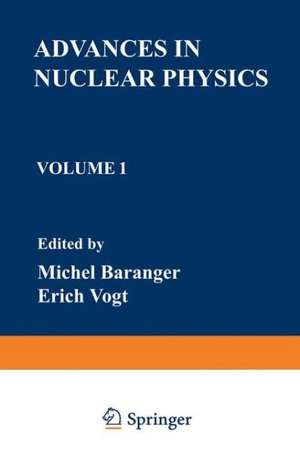
Advances in Nuclear Physics: Volume 1: Advances in Nuclear Physics, cartea 1
Autor Michel Baranger, Erich Vogten Limba Engleză Paperback – 12 dec 2012
Preț: 621.17 lei
Preț vechi: 730.79 lei
-15%
Puncte Express: 932
Carte tipărită la comandă
Livrare economică 10-24 octombrie
Livrare prin curier în România Termenul estimat este afișat lângă disponibilitate.
Transport gratuit pentru acest produs Plată online sau ramburs, în funcție de opțiunile comenzii.
Retur gratuit în 14 zile Comandă securizată și suport în română.
Specificații
ISBN-13: 9781475701050
ISBN-10: 1475701055
Pagini: 432
Ilustrații: XIV, 418 p. 13 illus.
Dimensiuni: 152 x 229 x 23 mm
Greutate: 0.58 kg
Ediția:Softcover reprint of the original 1st ed. 1968
Editura: Springer Us
Colecția Springer
Seria Advances in Nuclear Physics
Locul publicării:New York, NY, United States
ISBN-10: 1475701055
Pagini: 432
Ilustrații: XIV, 418 p. 13 illus.
Dimensiuni: 152 x 229 x 23 mm
Greutate: 0.58 kg
Ediția:Softcover reprint of the original 1st ed. 1968
Editura: Springer Us
Colecția Springer
Seria Advances in Nuclear Physics
Locul publicării:New York, NY, United States
V-ar putea interesa
-
 -17%Preț: 205.01 lei247.09 lei
 -
 -29%Preț: 461.83 lei647.95 lei
 -
 Atomic PhysicsC.J. Foot-11%Preț: 373.20 lei417.52 lei
 -
 The Properties of NucleiG. A. Jones-22%Preț: 134.59 lei173.29 lei
 -
 Nuclear Power: A Very Short IntroductionMaxwell Irvine-20%Preț: 55.70 lei69.82 lei
 -
 Deep Inelastic ScatteringRobin Devenish-22%Preț: 462.60 lei594.92 lei
 -
 -31%Preț: 550.79 lei792.82 lei
 -
 ColliderPaul HalpernPreț: 89.50 lei
 -
 The Experimental Foundations of Particle PhysicsRobert N. Cahn-14%Preț: 729.24 lei847.95 lei
 -
 Modern Quantum Field TheoryTom Banks-19%Preț: 461.92 lei570.26 lei
 -
 Nuclear Reactions for AstrophysicsIan J. Thompson-14%Preț: 703.02 lei817.46 lei
 -
 -18%Preț: 732.79 lei893.64 lei
 -
 Exploring Fundamental ParticlesLincoln Wolfenstein-15%Preț: 480.63 lei565.45 lei
 -
 -8%Preț: 436.41 lei474.36 lei
Public țintă
ResearchCuprins
1 The Reorientation Effect.- 1. Introduction.- 2. Classical Estimates of Effects.- 3. Theory of Coulomb Excitation.- 4. Theory of the Reorientation Effect.- 5. Excitation via the Giant Dipole Resonance.- 6. Experimental Methods.- 7. Reorientation Experiments.- Acknowledgments.- Appendix I. Numerical Expressions.- Appendix II. Tables of Orbital Integrals.- Appendix III. Approximate Formula for the Reorientation Effect.- References.- 2 The Nuclear SU3 Model.- 1. Introduction.- 2. Basic Shell Model.- 3. Symmetry of Oscillator Quanta — The Groups U3 and SU3.- 4. The Effective Interaction.- 5. Application of the SU3-Coupling Scheme to Light Nuclei.- 6. Summary and Developments.- Acknowledgments.- References.- Appendix A. Harmonic Oscillator.- Appendix B. Use of Groups in Quantum Mechanics.- Appendix C. The Symmetric and Unitary Groups.- Appendix D. Generating Operators of Us.- Appendix E. Classification According to SU3 without the Harmonic Oscillator.- Appendix F. Raising and Lowering Operators of the Group SU3.- Appendix G. Calculation of Matrix Elements.- Appendix H. The Normalization Coefficients and Overlaps.- Appendix I. Use of the Group SU3 in the Classification of Elementary Particles.- 3 The Hartree-Fock Theory of Deformed Light Nuclei.- 1. Introduction.- 2. The Hartree-Fock Equations.- 3. Symmetries of the Hartree-Fock Hamiltonian.- 4. The Choice of an Expansion for the Orbits.- 5. Single Major Shell Hartree-Fock Calculations.- 6. Solutions of the Single Major-Shell Hartree-Fock Calculations for Even-Even N = Z Nuclei.- 7. Deformed Excited Equilibrium States of Spherical Nuclei.- 8. A Soluble Model—The Effect of the Exchange Components of the Interaction.- 9. The Deformation of the Hartree-Fock Field—The Quadrupole-Quadrupole Interaction.- 10. The Effect ofthe Spin-Orbit Splitting.- 11. The Multiplicity of Hartree-Fock Solutions.- 12. Hartree-Fock Solutions of Other Nuclei.- 13. Magnetic Moments of Odd-A Nuclei.- 14. Angular Momentum Projection.- 15. Major-Shell-Mixing Hartree-Fock Calculations—Quadrupole Polarization of Closed Shells.- 16. Conclusion.- Acknowledgments.- References.- 4 The Statistical Theory of Nuclear Reactions.- 1. Introduction.- 2. The Model for Average Cross Sections.- 3. Application of the Evaporation Model.- 4. Basis of the Evaporation Model in Reaction Theory.- 5. Conclusions.- Acknowledgments.- Appendix A. Absorption Cross Section of a Complex Square Well.- Appendix B. Effect of Finite Averaging Interval.- References.- 5 Three-Particle Scattering—A Review of Recent Work on the Nonrelativistic Theory.- 1. Introduction.- 2. The Amado Model.- 3. The Faddeév Equations.- 4. Application of the Faddeév Equations.- 5. Concluding Remarks.- Acknowledgments.- References.- Appendix A.- Appendix B.- Appendix C.- Appendix D.- Appendix E.