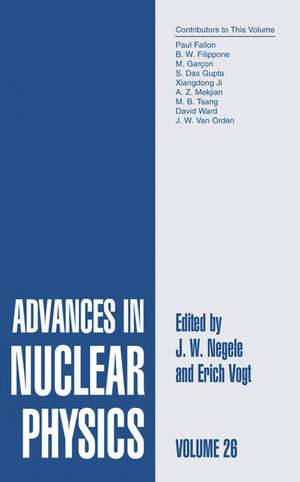
Advances in Nuclear Physics: Volume 26: Advances in Nuclear Physics, cartea 26
Editat de J.W. Negele, Erich W. Vogten Limba Engleză Hardback – 31 aug 2001
Preț: 919.07 lei
Preț vechi: 1120.81 lei
-18%
Puncte Express: 1379
Carte tipărită la comandă
Livrare economică 23 noiembrie-07 decembrie
Livrare prin curier în România Termenul estimat este afișat lângă disponibilitate.
Transport gratuit pentru acest produs Plată online sau ramburs, în funcție de opțiunile comenzii.
Retur gratuit în 14 zile Comandă securizată și suport în română.
Specificații
ISBN-13: 9780306466854
ISBN-10: 0306466856
Pagini: 386
Ilustrații: XX, 386 p.
Dimensiuni: 155 x 235 x 24 mm
Greutate: 0.75 kg
Ediția:2001
Editura: Springer Us
Colecția Springer
Seria Advances in Nuclear Physics
Locul publicării:New York, NY, United States
ISBN-10: 0306466856
Pagini: 386
Ilustrații: XX, 386 p.
Dimensiuni: 155 x 235 x 24 mm
Greutate: 0.75 kg
Ediția:2001
Editura: Springer Us
Colecția Springer
Seria Advances in Nuclear Physics
Locul publicării:New York, NY, United States
Public țintă
ResearchCuprins
The Spin Structure of the Nucleon.- Liquid-Gas Phase Transition in Nuclear Multifragmentation.- High Spin Properties of Atomic Nuclei.- The Deuteron: Structure and Form Factors.