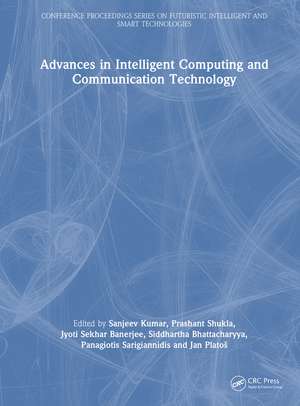
Advances in Intelligent Computing and Communication Technology: Conference Proceedings Series on Futuristic Intelligent and Smart Technologies
Editat de Sanjeev Kumar, Prashant Shukla, Jyoti Sekhar Banerjee, Siddhartha Bhattacharyya, Panagiotis Sarigiannidis, Jan Platošen Limba Engleză Hardback – 19 noi 2026
The book covers a broad spectrum of emerging areas, including Artificial Intelligence, Machine Learning, Data Science, Intelligent Systems, Communication Technologies, Computer Science and Engineering, Information Technology, and other interdisciplinary engineering domains. Each contribution reflects rigorous peer review and emphasizes both theoretical advancements and real-world applications. Designed as a valuable multidisciplinary reference, this book bridges the gap between academia and industry by offering practical insights, real-time problem-solving approaches, and future research directions.
It will be an essential resource for researchers, educators, practitioners, and postgraduate students seeking to stay abreast of recent developments and innovations in engineering and technology.


Preț: 958.54 lei
Preț vechi: 1355.59 lei
-29% Precomandă
Puncte Express: 1438
Carte nepublicată încă
Livrare prin curier în România Precomanda se expediază când titlul devine disponibil.
Transport gratuit pentru acest produs Plată online sau ramburs, în funcție de opțiunile comenzii.
Retur gratuit în 14 zile Comandă securizată și suport în română.
Doresc să fiu notificat când acest titlu va fi disponibil:
Se trimite...
Specificații
ISBN-13: 9781041334088
ISBN-10: 1041334087
Pagini: 222
Dimensiuni: 210 x 280 mm
Ediția:1
Editura: CRC Press
Colecția CRC Press
Seria Conference Proceedings Series on Futuristic Intelligent and Smart Technologies
ISBN-10: 1041334087
Pagini: 222
Dimensiuni: 210 x 280 mm
Ediția:1
Editura: CRC Press
Colecția CRC Press
Seria Conference Proceedings Series on Futuristic Intelligent and Smart Technologies
Public țintă
Academic and Undergraduate CoreNotă biografică
Sanjeev Kumar received his Master’s degree in Software Engineering from MNNIT Allahabad in 2015 and earned his Ph.D. from the same institute in 2020. With nearly 12 years of professional experience, he is currently serving as an Associate Professor in the Department of Computer Science at United University, Prayagraj.
Prashant Shukla is an Associate Professor and Head of the Department in the Department of Computer Science and Engineering at United University, Prayagraj, India. He received his M.Tech. and Ph.D. degrees from the prestigious Indian Institute of Information Technology (IIIT) Allahabad. Dr. Shukla has been extensively involved in teaching, research, and departmental leadership for several years. His research interests span across Deep Learning, Machine Learning, Natural Language Processing, Artificial Intelligence, and emerging computational technologies.
Jyoti Sekhar Banerjee is currently serving as the Associate Professor & Head of the Department in the Computer Science and Engineering (AI & ML) Department at the Bengal Institute of Technology, Kolkata, India. He is also the Professor-in-Charge, R & D and Consultancy Cell & Nodal Officer of the IPR Cell of BIT. Since 2024, he also works as a Remote Researcher in the Internet of THings & AppliCAtions Lab (ITHACA) at the Department of Electrical and Computer Engineering, University of Western Macedonia, Greece. Dr. Banerjee is also working as the Adjunct Research Faculty under the Lincoln Global Postdoctoral Researcher (LGPR) Programme at Lincoln University College, Malaysia.
Siddhartha Bhattacharyya [FIET(UK), FIEI, FIETE, LFOSI, FSCRS, SMIEEE, SMACM, SMAAIA, SMIETI, LMCSI, LMISTE] is currently serving as a Senior Researcher in the Faculty of Electrical Engineering and Computer Science of VSB Technical University of Ostrava, Czech Republic. He also serves as the Scientific Advisor of Algebra University College, Zagreb, Croatia.
Panagiotis Sarigiannidis is the Director of the ITHACA lab, co-founder of the 1st spin-off of the University of Western Macedonia: MetaMind Innovations P.C., and Full Professor in the Department of Electrical and Computer Engineering in the University of Western Macedonia, Kozani, Greece. He received the B.Sc. and Ph.D. degrees in computer science from the Aristotle University of Thessaloniki, Thessaloniki, Greece, in 2001 and 2007, respectively.
Jan Platoš is a professor at the Department of Computer Science and the Dean of the Faculty of Electrical Engineering and Computer Science, VSB-TUO, Czech Republic. He has co-authored more than 240 scientific articles published in proceedings and journals. His primary fields of interest are machine learning, artificial intelligence, industrial data processing, text processing, data compression, bioinspired algorithms, information retrieval, data mining, data structures, and data prediction.
Prashant Shukla is an Associate Professor and Head of the Department in the Department of Computer Science and Engineering at United University, Prayagraj, India. He received his M.Tech. and Ph.D. degrees from the prestigious Indian Institute of Information Technology (IIIT) Allahabad. Dr. Shukla has been extensively involved in teaching, research, and departmental leadership for several years. His research interests span across Deep Learning, Machine Learning, Natural Language Processing, Artificial Intelligence, and emerging computational technologies.
Jyoti Sekhar Banerjee is currently serving as the Associate Professor & Head of the Department in the Computer Science and Engineering (AI & ML) Department at the Bengal Institute of Technology, Kolkata, India. He is also the Professor-in-Charge, R & D and Consultancy Cell & Nodal Officer of the IPR Cell of BIT. Since 2024, he also works as a Remote Researcher in the Internet of THings & AppliCAtions Lab (ITHACA) at the Department of Electrical and Computer Engineering, University of Western Macedonia, Greece. Dr. Banerjee is also working as the Adjunct Research Faculty under the Lincoln Global Postdoctoral Researcher (LGPR) Programme at Lincoln University College, Malaysia.
Siddhartha Bhattacharyya [FIET(UK), FIEI, FIETE, LFOSI, FSCRS, SMIEEE, SMACM, SMAAIA, SMIETI, LMCSI, LMISTE] is currently serving as a Senior Researcher in the Faculty of Electrical Engineering and Computer Science of VSB Technical University of Ostrava, Czech Republic. He also serves as the Scientific Advisor of Algebra University College, Zagreb, Croatia.
Panagiotis Sarigiannidis is the Director of the ITHACA lab, co-founder of the 1st spin-off of the University of Western Macedonia: MetaMind Innovations P.C., and Full Professor in the Department of Electrical and Computer Engineering in the University of Western Macedonia, Kozani, Greece. He received the B.Sc. and Ph.D. degrees in computer science from the Aristotle University of Thessaloniki, Thessaloniki, Greece, in 2001 and 2007, respectively.
Jan Platoš is a professor at the Department of Computer Science and the Dean of the Faculty of Electrical Engineering and Computer Science, VSB-TUO, Czech Republic. He has co-authored more than 240 scientific articles published in proceedings and journals. His primary fields of interest are machine learning, artificial intelligence, industrial data processing, text processing, data compression, bioinspired algorithms, information retrieval, data mining, data structures, and data prediction.
Cuprins
VTRWC-Net: An Intelligent Pharmaceutical and Biomedical Residual Waste Management Framework: Integrating Vision Transformer with Recommendation System. Innovations, Interdisciplinary Challenges and Future Directions in Harnessing AI for Criminal Justice System. Satellite-Based Anomaly Detection for Agricultural Monitoring Using Autoencoder. Support Vector Machine-Based Land Cover Classification Using Fused Hyperspectral and LiDAR Data. Anomaly Detection in Cloud Storage: A Systematic Survey of Models, Datasets, and Metrics for DDoS Precursor and Insider Threat Identification. Smart Computational Framework for Hand Gesture Recognition Using MediaPipe in Therapeutic and Training Applications. Adaptive Edge Offloading Framework for Efficient Congestion Management in mMTC Systems. Harmonizing Human and Machine: A Verification Loop for Enterprise Safety Systems. Value-Weighted Graph Embeddings: A Hybrid Framework for High-Precision Ethereum Phishing Detection. Attention-Enhanced ResNet for Fire, Smoke, and Normal Image Multi-Class Classification. An Explainable Voting Ensemble Framework for Robust Diabetes Prediction Using SHAP and LIME-Based Interpretability. Designing Scalable and Resilient Software Architectures for Juice Production in the Age of Industry 4.0. Artificial Intelligence Trends for Automatically Identifying Hate Speech on Social Media Networks. Machine Learning-Based Prediction of Typhoid Incidence Using Clinical and Environmental Characteristics. Explainable AI in Diabetic Retinopathy Diagnosis: CNN-Based Detection with Gradient-Weighted Class Activation Mapping. A Novel Framework for LGB Model-Based Approach for Malware Detection by Analyzing the Ember Dataset. Multi-Omics Integration in Leukemia Detection Using Multimodal Deep Learning Architectures. Unsupervised Deep Learning for Granular Strategic Insight: The Autoencoder Approach. Yolov8 Detection of Deviant Behavior in the Crowded Campus. AI-Powered Regression Approaches for Early Prediction of Blood Glucose and Blood Pressure. Explainable Prognostic Modelling for Glioma Using Interpretable Machine Learning Techniques. Automating Precision Agriculture with Deep Learning and Image Analysis. Hybrid Feature Selection Using Nature-Inspired Algorithms for Accurate Lower Back Pain Diagnosis. Comparative Study of Chatbots for College Campus Applications: Evaluating Knowledge Base Quality and Platform Performance. Multi-Class Anomaly Detection in Network Traffic Using Supervised Learning. Machine Learning-Driven Personalization in E-Commerce: Enhancing Recommendation Systems for Optimal User Engagement. Predictive Analysis of Cardiovascular Disease: A Future Direction. Comparative Analysis and Implementation of Malware Detection in Android Using Machine Learning. Student Grade Prediction Using Moth-Flame Optimization and Machine Learning. Exploring Instance Segmentation and Defect Detection Across Varied Textured Surfaces: A Comprehensive Study. GAN-Driven Data Augmentation for Enhanced Diabetic Retinopathy Classification Using Deep Learning Frameworks. Use of AIoT Approaches in Precision Agriculture. Minimising Outage Probability in MIMO-UWOC Systems Using Alternating Metaheuristic Power Allocation. Intelligent Stroke Risk Assessment System (ISRAS). Evaluating the Influence of Intelligent Personalization on Consumer Buying Patterns in Digital Commerce. A Stacked Learning Approach to Intrusion Detection for Robust Network Protection. A Scalable RPA-Enabled Incremental Learning Framework for Course-Specific Student Performance Prediction. Transformer-Multi Model-Guided Generative Adversarial Network for Face Occlusion Removal. Comparative Study of Diffusion Models and GANs for Synthetic Retinal Image Generation. Role of Healthcare 5.0 in Society 5.0. Blockchain Security: Review, Research Challenges and Future Prospects. Impact of Online Credible Review and Customer Purchase Intention: A Case Study of Cambodia. Improved Spam Identification Using a Hybrid Neural-Fuzzy-Wrapper Architecture with Statistical Superiority and Programmatic Noise Alleviation. UniBlend: A Hybrid Machine Learning Ensemble for Accurate and Robust Breast Cancer Diagnosis. GreenEdge: Leveraging Edge-Enabled Big Data Pipelines and Cloud Orchestration for Real-Time Environmental Monitoring
Descriere
This book discusses innovative ideas and cutting-edge research in intelligent computing and communication technologies.