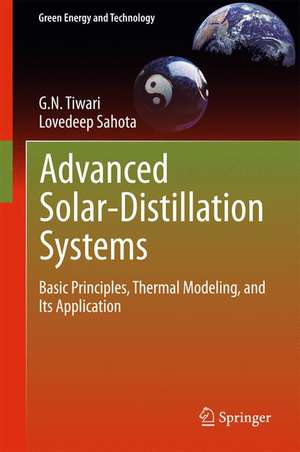
Advanced Solar-Distillation Systems
Autor G. N. Tiwari, Lovedeep Sahotaen Limba Engleză Hardback – 14 aug 2017
Preț: 577.36 lei
Preț vechi: 712.79 lei
-19%
Puncte Express: 866
Carte tipărită la comandă
Livrare economică 27 noiembrie-03 decembrie
Livrare prin curier în România Termenul estimat este afișat lângă disponibilitate.
Transport gratuit pentru acest produs Plată online sau ramburs, în funcție de opțiunile comenzii.
Retur gratuit în 14 zile Comandă securizată și suport în română.
Specificații
ISBN-13: 9789811046711
ISBN-10: 9811046719
Pagini: 496
Ilustrații: XXVII, 468 p. 141 illus., 95 illus. in color.
Dimensiuni: 160 x 241 x 31 mm
Greutate: 0.94 kg
Ediția:1st edition 2017
Editura: Springer
Locul publicării:Singapore, Singapore
ISBN-10: 9811046719
Pagini: 496
Ilustrații: XXVII, 468 p. 141 illus., 95 illus. in color.
Dimensiuni: 160 x 241 x 31 mm
Greutate: 0.94 kg
Ediția:1st edition 2017
Editura: Springer
Locul publicării:Singapore, Singapore
V-ar putea interesa
-
 Portable Hydrogen Energy Systems: Fuel Cells and Storage Fundamentals and ApplicationsPaloma Ferreira-Aparicio-26%Preț: 839.70 lei1132.33 lei
-
 -18%Preț: 918.04 lei1119.56 lei
-
 Injury Prevention and ControlDinesh Mohan-18%Preț: 1012.62 lei1234.90 lei
-
 -18%Preț: 1752.38 lei2137.05 lei
-
 Sustainable Indoor LightingPaola Sansoni-15%Preț: 622.93 lei732.86 lei
-
 -18%Preț: 780.90 lei952.31 lei
-
 Building-Integrated Solar Energy SystemsRobert E. Parkin-18%Preț: 1381.26 lei1684.47 lei
-
 Chemical Energy from Natural and Synthetic GasYatish T. Shah-18%Preț: 1161.56 lei1416.54 lei
-
 Introduction to Sustainability AnalyticsRaghavan (Ram) Ramanan-18%Preț: 1015.13 lei1237.96 lei
-
 -27%Preț: 888.31 lei1210.21 lei
-
 Renewable Energy in ChinaJiahai Yuan-27%Preț: 1219.88 lei1661.07 lei
-
 Energy Efficient Passive BuildingG. N. TiwariPreț: 380.09 lei
-
 Fundamentals of Photovoltaic Modules and Their ApplicationsGopal Nath Tiwari-14%Preț: 1135.40 lei1320.22 lei
-
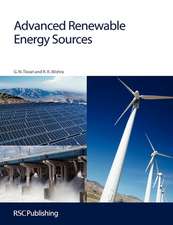 Advanced Renewable Energy SourcesGopal Nath TiwariPreț: 398.52 lei
-
 Handbook of Transitions to Energy and Climate SecurityRobert LooneyPreț: 478.45 lei
-
 The Energy Mix for Sustaining Our FutureAhmad Vasel-15%Preț: 663.90 lei781.06 lei
-
 High Temperature ElectrolysisMiguel Angel Laguna-Bercero-18%Preț: 1051.13 lei1281.86 lei
-
 CO2 Refrigeration Cycle and SystemsXin-Rong Zhang-18%Preț: 1044.71 lei1274.04 lei
-
 -18%Preț: 977.03 lei1191.51 lei
-
 Women in PowerJill S. Tietjen-18%Preț: 883.33 lei1077.22 lei
-
 Microgrids Design and ImplementationMiguel Castilla-18%Preț: 1167.85 lei1424.21 lei
-
 Climate Change, Energy, Sustainability and PavementsKasthurirangan Gopalakrishnan-18%Preț: 1088.33 lei1327.24 lei
-
 Handbook of Solar EnergyG. N. Tiwari-24%Preț: 2045.46 lei2691.39 lei
Cuprins
General Introduction.- Solar Radiation and Heat Transfer.- History of Passive Solar Distillation Systems. Solar Collectors.- Thermal Modeling of Active Solar Distillation.- Parametric Study of Solar Distillation and Its Application.- Energy and Exergy Analysis of Solar Distillation.- Energy Matrix of Solar Distillation.- Exergoeconomic.- Economic Analysis of Solar Distillation.
Notă biografică
Professor Gopal Nath Tiwari, received postgraduate and doctoral degrees in 1972 and 1976, respectively, from the Banaras Hindu University, India. Since 1977, he has been actively involved in the teaching program at Centre for Energy Studies, IIT Delhi. His research interests in the field of Solar Energy Applications are solar distillation, water/air heating system, greenhouse technology for agriculture and aquaculture, earth-to-air heat exchangers, passive building design, hybrid photovoltaic thermal (HPVT) systems, climate change, energy security, etc. He has guided about 75 PhD students and published over 550 research papers in journals of repute. He has authored twenty books associated with reputed publishers.He is a co-recipient of the 'Hariom Ashram Prerit S.S. Bhatnagar' Award in 1982. He had been to the University of Papua, New Guinea in 1987-1989 as an Energy and Environment Expert. He was also named European Fellow in 1997, and has been nominated for the IDEA award. He is responsible for development of "Solar Energy Park" at IIT Delhi and Energy Laboratory at University of Papua, New Guinea, Port Moresby. Dr. Tiwari has successfully coordinated various research projects funded by the Government of India. Dr. Tiwari was Editor of International Journal of Agricultural Engineering for the duration of three years (2006-2008). He is Associate Editor for Solar Energy Journal (SEJ) in the area of Solar Distillation and editor of the International Journal of Energy Research since 2007. He is also the Chief-Editor of Fundamental of Renewable Energy Applications and servers as a reviewer for many international journals. He was conferred the title of "Vigyan Ratna" by the State of Uttar Pradesh, India on March 26, 2008. He is also founder president of the Bag Energy Research Society that is responsible for energy education in rural India.
Dr. Arvind Tiwari holds a Bachelor's degree in Physics, a Master of Science in Material Science from Jamia Millia Islamia, and a Master of Technology in Microelectronics from Punjab University (2002). He completed his PhD in 2006 from IIT DElhi(Hybrid Photovoltaic Thermal System). He is a post-doctoral fellow from University of Twente, Netherland. Besides, several other teaching engagements throughout his career, Dr Tiwari has worked as an Indian Expert in the capacity of senior lecturer in Manmohan Memorial Polytechnic, Morang, Nepal on deputation by the Government of India from January 2010 to January 2012. At present, he is working as Professor in Qassim University, Kingdom of Saudi Arabia.
To his credit he has more than 20 research papers in international journals of repute. He has co-supervised 3 PhD students at IIT Delhi and is currently supervising an additional 4 PhD students. He is also reviewer of many international journals including Solar Energy, Energy Research, and Journal of Open Access.
Mr. Shyam holds a Bachelor of Science degree (BSc) majoring in Mathematics, Physics and Chemistry and Master of Science degree (MSc.) in Physics from the University of Allahabad. He also holds a Master of Technology degree (MTech) in Cryogenic Engineering from Indian Institute of Technology, Kharagpur, India. During his MTech programme he worked on Giant Magnetoimpedance (GMI) effect in manganites and developed a magnetic position sensor based on GMI effect. He worked as an Assistant Professor at Marathwada Institute of Technology, Bulandshahr from August 2008 to October 2012 and taught Engineering Physics at the undergraduate level.
Presently, he is pursuing a PhD under the supervision of Prof. G. N. Tiwari at the Centre for Energy Studies, Indian Institute of Technology Delhi. His areas of research interest are solar thermal collectors (modelling and experiments), photovoltaics, heat and mass transfer, exergy, CO2 mitigation, climate change and carbon trading, and exergoeconomic and enviroeconomic analyses. &
Textul de pe ultima copertă
This book is primarily intended to serve as a textbook and reference work for graduate and professional training coursework on solar desalination of water. The book begins with an introduction to the increasing demand for potable water, various types of water pollution and its impacts on human health, and goes on to cover basics of desalination technologies. It covers all aspects of solar-energy based distillation and desalination for producing potable water resources, including radiation and heat transfer concepts, a history of solar distillation systems, and background on solar collectors. The contents include thermal modeling and parametric study of solar distillation. Energy and exergy aspects are analyzed in detail, including energy matrices of solar distillation. A special chapter on exeroeconomics introduces fundamental equations which include the general balance equation, thermodynamic balance equations, and economic balance equations. A chapter on Economic Analysis of Solar Distillation completes the coverage. The book includes solved examples and end-of-chapter exercises in the form of both problems and objective-type questions. The contents of this book are useful to students, researchers, professionals, and policymakers looking for a comprehensive resource on solar desalination.
Caracteristici
Covers all aspects of solar distillation to produce potable water Introduces a sustainable, environmentally friendly method for water distillation Includes applications, examples, and pedagogy to ensure well-rounded coverage Includes supplementary material: sn.pub/extras Includes supplementary material: sn.pub/extras