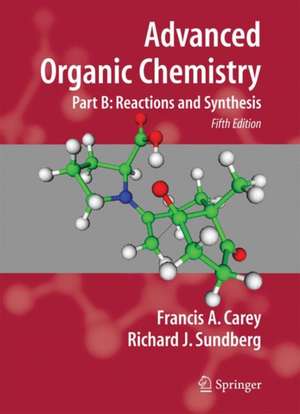
Advanced Organic Chemistry
Autor Francis A. Carey, Richard J Sundbergen Limba Engleză Paperback – 6 sep 2007
Structura și metodologia lucrării Advanced Organic Chemistry sunt concepute pentru a ghida studentul de la fundamentele teoretice către aplicațiile complexe de cercetare. Organizat în două volume complementare, acest curs avansat își bazează progresia pe o ierarhie logică: Partea A se concentrează pe conceptele structurale — stereochimie, conformație și aromaticitate — în timp ce Partea B, detaliată în acest volum, explorează mecanismele de reacție și sinteza. Descoperim aici o metodologie riguroasă care nu se limitează la prezentarea reacțiilor, ci oferă o documentare vastă prin referințe la literatura primară și de specialitate, facilitând tranziția către munca de laborator. Această a cincea ediție aduce o revizuire substanțială față de versiunea din 2001, integrând progresele majore din domeniul chimiei computaționale. Reținem că materialul este calibrat pentru nivelul graduate, presupunând cunoașterea chimiei organice introductive, dar oferind în același timp recapitulări necesare pentru fiecare temă nouă. Cuprinsul relevă o acoperire exhaustivă, de la alchilarea enolaților și utilizarea compușilor organometalici (Grupul I și II), până la reacții care implică metale de tranziție și sinteze în mai mulți pași. Acoperă aceeași arie ca Organic Synthesis de Michael Smith, dar cu o abordare mai profund ancorată în fundamentele mecanice și structurale, spre deosebire de orientarea strict bazată pe reacții a textului lui Smith. Totodată, se distinge de Computational Organic Chemistry prin faptul că menține un echilibru între metodele de calcul și chimia sintetică tradițională, oferind prin site-ul partener modele digitale ce ajută la vizualizarea selectivității reacțiilor. Este, în esență, un instrument de lucru care transformă teoria în capacitate de cercetare aplicată.
Preț: 433.52 lei
Preț vechi: 522.32 lei
-17%
Carte disponibilă
Livrare economică 07-21 noiembrie
Livrare express 24-30 octombrie pentru 111.83 lei
Specificații
ISBN-10: 0387683542
Pagini: 1321
Ilustrații: XXX, 1321 p.
Dimensiuni: 255 x 187 x 50 mm
Greutate: 2.35 kg
Ediția:5th edition
Editura: Springer Us
Locul publicării:New York, NY, United States
V-ar putea interesa
-
 Foundations of Organic Chemistry: Worked ExamplesJosephine Peach-15%Preț: 244.10 lei286.40 lei
 -
 Problems in Structural Inorganic ChemistryWai-Kee Li-20%Preț: 403.92 lei505.48 lei
 -
 Inorganic ChemistryMark Weller-17%Preț: 540.88 lei653.75 lei
 -
 Organic Chemistry: Chimie organicăJonathan Clayden-18%Preț: 570.15 lei694.33 lei
 -
 Solutions Manual to accompany Organic ChemistryJonathan Clayden-20%Preț: 424.61 lei530.15 lei
 -
 Organic ChemistryL. G. Wade-23%Preț: 1967.19 lei2554.79 lei
 -
 Organic SynthesisMichael Smith-32%Preț: 826.51 lei1208.85 lei
 -
 -23%Preț: 427.97 lei555.81 lei
 -
 Guidebook to Mechanism in Organic ChemistryPeter Sykes-15%Preț: 528.99 lei622.34 lei
 -
 Schaum's Outline of Organic Chemistry, Sixth EditionHerbert Meislich-31%Preț: 176.83 lei257.72 lei
 -
 Organic Chemistry ISEFrancis Carey-8%Preț: 492.19 lei534.99 lei
 -
 Organic Chemistry ISEJanice Smith-8%Preț: 488.51 lei530.99 lei
 -
 -11%Preț: 644.82 lei724.52 lei
 -
 -13%Preț: 594.09 lei682.87 lei
 -
 Greene's Protective Groups in Organic Synthesis, 2 Volume SetPeter G. M. Wuts-23%Preț: 1328.77 lei1725.67 lei
 -
 March's Advanced Organic ChemistryMichael B. Smith-23%Preț: 1366.29 lei1774.40 lei
 -
 Organic Reactions, Volume 117Kevin H Shaughnessy-23%Preț: 2239.82 lei2908.87 lei
 -
 Preț: 216.58 lei
 -
 -18%Preț: 1000.25 lei1219.82 lei
 -
 -18%Preț: 944.25 lei1151.53 lei
Public țintă
GraduateDe ce să citești această carte
Pentru studenții la masterat sau doctorat în chimie, această lucrare este standardul de referință care face legătura între cursurile de licență și literatura de cercetare. Cititorul câștigă o înțelegere profundă a mecanismelor de reacție și a metodelor moderne de sinteză, beneficiind de resurse digitale pentru vizualizarea structurilor complexe. Este manualul esențial pentru oricine dorește să stăpânească sinteza organică avansată și chimia metalelor de tranziție.
Despre autor
Francis A. Carey este un reputat profesor emerit la University of Virginia, cu o carieră dedicată predării chimiei organice și cercetării în domeniul mecanismelor sintetice. Educat la Drexel University și Penn State, cu stagii postdoctorale la Harvard, Carey a publicat peste patruzeci de lucrări de cercetare. Expertiza sa didactică este reflectată în claritatea cu care Advanced Organic Chemistry prezintă subiecte complexe, autorul fiind recunoscut pentru capacitatea de a sintetiza literatura de specialitate în formate accesibile studenților avansați.
Cuprins
Alkylation of Enolates and Other Carbon Nucleophiles.- Reactions of Carbon Nucleophiles with Carbonyl Compounds.- Functional Group Interconversion by Substitution, Including Protection and Deprotection.- Electrophilic Additions to Carbon-Carbon Multiple Bonds.- Reduction of Carbon-Carbon Multiple Bonds, Carbonyl Groups, and Other Functional Groups.- Concerted Cycloadditions, Unimolecular Rearrangements, and Thermal Eliminations.- Organometallic Compounds of Group I and II Metals.- Reactions Involving Transition Metals.- Carbon-Carbon Bond-Forming Reactions of Compounds of Boron, Silicon, and Tin.- Reactions Involving Carbocations, Carbenes, and Radicals as Reactive Intermediates.- Aromatic Substitution Reactions.- Oxidations.- Multistep Syntheses.
Recenzii
"Advanced Organic Chemistry … the well-known textbook for graduate students – has now appeared in a 5th edition. … Carey & Sundberg will be interesting to all students who seek a detailed understanding of organic chemistry, and who wish to refresh and embellish their existing knowledge. On the strength of the scope and quality of the explanations, this pair of texts is recommended for use as the resource of first resort for specific research questions in one’s later career." (www.organische-chemie.ch, January, 2008)
Notă biografică
Francis A. Carey is a native of Pennsylvania, educated in the public schools of Philadelphia, at Drexel University (B.S. in chemistry, 1959), and at Penn State (Ph.D. 1963). Following postdoctoral work at Harvard and military service, he was appointed to the chemistry faculty of the University of Virginia in 1966. Prior to retiring in 2000, he regularly taught the two-semester lecture courses in general chemistry and organic chemistry. With his students, Professor Carey has published over forty research papers in synthetic and mechanistic organic chemistry.
Caracteristici
Descriere
Since its original appearance in 1977, Advanced Organic Chemistry has maintained its place as the premier textbook in the field, offering broad coverage of the structure, reactivity and synthesis of organic compounds. As in the earlier editions, the text contains extensive references to both the primary and review literature and provides examples of data and reactions that illustrate and document the generalizations. While the text assumes completion of an introductory course in organic chemistry, it reviews the fundamental concepts for each topic that is discussed.
The two-part fifth edition has been substantially revised and reorganized for greater clarity. Among the changes: Updated material reflecting advances in the field since 2001’s Fourth Edition, especially in computational chemistry; A companion Web site provides digital models for study of structure, reaction and selectivity; Solutions to the exercises provided to instructors online.
The control of reactivity to achieve specific syntheses is one of the overarching goals of organic chemistry. Part B describes the most general and useful synthetic reactions, organized on the basis of reaction type. Together with Part A: Structure and Mechanisms, the two volumes are intended to provide the advanced undergraduate or beginning graduate student in chemistry with a sufficient foundation to comprehend and use the research literature in organic chemistry.