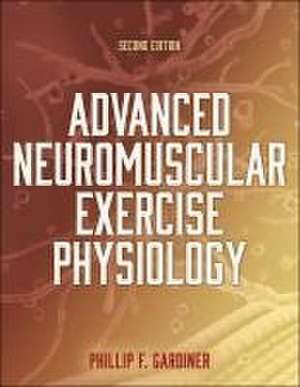
Advanced Neuromuscular Exercise Physiology
Autor Phillip Gardineren Limba Engleză Paperback – 25 mar 2024
În lucrarea Advanced Neuromuscular Exercise Physiology, autorul Phillip Gardiner propune o analiză clinică riguroasă a interacțiunii dintre sistemul nervos și cel muscular în contextul efortului fizic. Notăm cu interes modul în care această a doua ediție sintetizează progresele recente din biochimie și biologia moleculară pentru a explica adaptările fiziologice acute și cronice. Considerăm că volumul reprezintă un manual de referință comparabil cu Fatigue: Neural and Muscular Mechanisms, însă Advanced Neuromuscular Exercise Physiology aduce un plus de actualitate prin integrarea ghidurilor de cercetare din ultimii ani și a noilor tehnologii de monitorizare. Structura cărții facilitează o progresie logică, pornind de la eterogenitatea fibrelor musculare și excitabilitatea motoneuronilor în primele capitole, către aspecte complexe ale controlului metabolic. Reținem introducerea capitolului de considerații clinice, care face trecerea necesară de la fiziologia teoretică la patologia mișcării, oferind o perspectivă valoroasă asupra modului în care afecțiunile neuromusculare alterează capacitatea de exercițiu. Față de abordarea mai generală din Skeletal Muscle Physiology, lucrarea de față se concentrează specific pe sinapsa dintre semnalul neural și răspunsul mecanic. Din punct de vedere al experienței de învățare, textul utilizează obiective de capitol și întrebări de recapitulare pentru a consolida conceptele dificile, cum ar fi pattern-ul „onion skin” în recrutarea unităților motorii. Ilustrațiile actualizate și graficele noi sprijină înțelegerea mecanismelor de oboseală centrală și periferică, oferind totodată exemple practice care ancorează teoria în realitatea antrenamentului de forță și rezistență.
Preț: 741.34 lei
Preț vechi: 780.35 lei
-5%
Carte disponibilă
Livrare economică 07-21 noiembrie
Livrare express 24-30 octombrie pentru 45.61 lei
Specificații
ISBN-10: 1718215568
Pagini: 264
Dimensiuni: 280 x 215 x 20 mm
Greutate: 0.74 kg
Ediția:Second Edition
Editura: HUMAN KINETICS
V-ar putea interesa
-
 Cellular Physiology and Neurophysiology: Mosby Physiology SeriesMordecai P. Blaustein-31%Preț: 232.01 lei333.87 lei
 -
 Boron & Boulpaep Concise Medical PhysiologyWalter F. Boron-28%Preț: 523.42 lei725.39 lei
 -
 Neumann's Kinesiology of the Musculoskeletal SystemDonald A. Neumann-28%Preț: 716.42 lei992.48 lei
 -
 Neuromuscular and Electrodiagnostic Medicine Board ReviewThananan Thammongkolchai-28%Preț: 526.05 lei735.43 lei
 -
 Aminoff's Diagnosis of Neuromuscular DisordersMichael J. Aminoff-28%Preț: 1024.23 lei1413.92 lei
 -
 Guyton and Hall Textbook of Medical PhysiologyJohn E. Hall-27%Preț: 724.83 lei997.48 leiRecomandat
 -
 -29%Preț: 317.87 lei445.03 lei
 -
 NSCA's Guide to Tests and AssessmentsNsca -National Strength & Conditioning Association-5%Preț: 392.00 lei412.63 lei
 -
 ACSM's Advanced Exercise PhysiologyAmerican College of Sports Medicine-20%Preț: 843.59 lei1057.53 lei
 -
 Preț: 140.57 lei
 -
 -27%Preț: 380.60 lei521.97 lei
 -
 Human PhysiologyDee Silverthorn-5%Preț: 592.75 lei623.95 lei
 -
 -5%Preț: 364.31 lei383.48 lei
 -
 Science and Development of Muscle HypertrophyBrad J. Schoenfeld-8%Preț: 452.48 lei491.83 lei
 -
 Strength Training: Methods, Health Benefits & DopingCleber Ferraresi-27%Preț: 1520.32 lei2073.95 lei
 -
 -5%Preț: 383.85 lei404.05 leiRecomandat
 -
 Neurophysiological Basis of Motor ControlMark L. Latash-23%Preț: 724.39 lei940.76 lei
 -
 Physiology of Sport and ExerciseW. Larry Kenney-5%Preț: 1117.19 lei1175.99 lei
 -
 Concurrent Aerobic and Strength TrainingMoritz Schumann-5%Preț: 992.74 lei1044.99 lei
De ce să citești această carte
Recomandăm această ediție specialiștilor în kinetoterapie și fiziologia efortului care doresc să înțeleagă fundamentul molecular al mișcării. Cititorul câștigă o perspectivă clară asupra celor mai noi descoperiri, precum rolul exerkine-lor în adaptare, beneficiind de un suport vizual îmbunătățit. Este o resursă esențială pentru a trece de la simpla observare a performanței la înțelegerea mecanismelor neurofiziologice care o generează.
Cuprins
Muscle Heterogeneity
Orderly Motor Unit Recruitment
Smaller Motoneurons Are More Excitable
Membrane Resistivity and Motoneuron Size
Other Factors Determining Action Potential Generation
Minimal Firing Rates and Afterhyperpolarization Durations
Motoneuron Current–Frequency Relationship and Excitability
Spike Frequency Adaptation
Motoneuron Persistent Inward Currents (PICs)
Summary
Chapter 2. Motor Unit Recruitment During Different Types of Movements
Measuring Human Motor Unit Recruitment
Influence of Task
Synergists
Influence of Pain on Motor Unit Recruitment
Slow-Ramp Isometric Contractions
Maintained Isometric Contractions
Isometric Contractions in Various Directions
Isometric Contractions Versus Movements
Ballistic Contractions
Lengthening Contractions
Cocontraction of Agonists and Antagonists
Unilateral Versus Bilateral Contractions
Maximal Voluntary Contractions
Muscle Histochemistry to Investigate Rhythmic Complex Contractions
Summary
Chapter 3. Muscle Blood Flow and Metabolism
Muscle Blood Flow
Muscle Metabolism
Summary
Chapter 4. Peripheral Factors in Neuromuscular Fatigue
Fatigue as Interference With the Contractile Machinery
Failure of Impulse Propagation Along the Muscle Fiber Membrane
Peripheral Fatigue Sites Other Than Muscle Membrane and Contractile Machinery
Research From Animal Experiments
Summary
Chapter 5. Central Factors in Neuromuscular Fatigue
Motoneuron Activity During Sustained Contractions
Isometric Versus Anisometric Tasks
Rotation of Motor Units?
Summary
Chapter 6. Muscular Mechanisms in Aerobic Endurance Training
Chronic Muscle Stimulation
Coordination of Muscle Protein Systems
Pretranslational Control
Translational Control
Posttranslational Modifications
Mitochondrial Responses
Simultaneous Expression of Isoforms
Adaptations Can Occur Ex Vivo
Adaptations Appear in a Specific Sequence
Thresholds of Activity for Adaptation
Chronic Stimulation and Atrophy
Metabolic Signals and the Adaptive Response
Degenerative and Regenerative Processes
Summary
Chapter 7. Neural Mechanisms in Aerobic Endurance Training
Adaptation of the Neuromuscular Junction
Responses of Motoneurons
Adaptations of Spinal Cord Circuits
Summary
Chapter 8. Muscle Molecular Mechanisms in Strength Training
Acute Responses in Protein Synthesis and Degradation
Connective Tissue Responses
Role of Muscle Damage
Role of Dietary Supplements
Summary
Chapter 9. Muscle Property Changes in Strength Training
Increased Muscle Fiber Cross-Sectional Area
Fiber Type Composition
Muscle Fiber Number
Muscle Composition
Muscle Architecture
Muscle Fiber Ultrastructure
Tendons
Evoked Isometric Contractile Properties
Changes in Muscle Force, Velocity, and Power
Fatigue Resistance
Role of Eccentric Contractions
Concurrent Resistance and Aerobic Training
Summary
Chapter 10. Neural Mechanisms in Strength Training
Gains in Strength Versus Muscle Girth
Strength Gains Show Task Specificity
Surface EMG Response During MVC
Imaginary Strength Training
Reflex Adaptations
Cross Education
Decreased Activation of Antagonists
Changes in Motor Unit Recruitment
Changes in Motor Cortex
Summary
Chapter 11. Clinical Considerations Concerning Neuromuscular Exercise and Training
Effects of Exercise on Neuromuscular Aging
Effects of Exercise Training in Stroke Patients
Physical Activity and Fibromyalgia
Exercise and Dementia
Amyotrophic Lateral Sclerosis
Summary
Descriere
Notă biografică
Author of the Human Kinetics books Neuromuscular Aspects of Physical Activity (2001) and Skeletal Muscle: Form and Function (coauthor, 2006), Gardiner has also published over 150 research articles on neuromuscular system adaptability.
Gardiner served as the president of the Canadian Society for Exercise Physiology (CSEP) and as coeditor in chief of the Canadian Journal of Applied Physiology. In 2007, he received the highest award bestowed by the Canadian Society for Exercise Physiology: the CSEP Honour Award. He served as a Tier I Canada Research Chair in physical activity and health studies at the University of Manitoba from 2002 to 2016 and was chair of the Scientific Committee of Muscular Dystrophy Canada from 2015 to 2018. He has also served the Canadian Institutes of Health Research as chair of the board and as scientific director of the Institute of Musculoskeletal Health and Arthritis (IMHA).