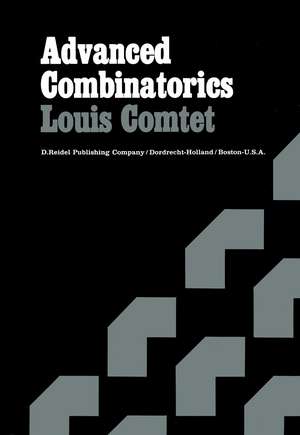
Advanced Combinatorics
Autor Louis Comteten Limba Engleză Paperback – 6 noi 2011
Preț: 797.77 lei
Preț vechi: 972.88 lei
-18%
Puncte Express: 1197
Carte tipărită la comandă
Livrare economică 08-22 decembrie
Livrare prin curier în România Termenul estimat este afișat lângă disponibilitate.
Transport gratuit pentru acest produs Plată online sau ramburs, în funcție de opțiunile comenzii.
Retur gratuit în 14 zile Comandă securizată și suport în română.
Specificații
ISBN-13: 9789401021982
ISBN-10: 9401021988
Pagini: 360
Ilustrații: XI, 343 p.
Dimensiuni: 155 x 235 x 20 mm
Greutate: 0.55 kg
Ediția:1974
Editura: Springer
Locul publicării:Dordrecht, Netherlands
ISBN-10: 9401021988
Pagini: 360
Ilustrații: XI, 343 p.
Dimensiuni: 155 x 235 x 20 mm
Greutate: 0.55 kg
Ediția:1974
Editura: Springer
Locul publicării:Dordrecht, Netherlands
V-ar putea interesa
-
 Combinatorics, Complexity, and Chance: A Tribute to Dominic WelshGeoffrey Grimmett-32%Preț: 800.75 lei1169.62 lei
 -
 Introduction to Graph TheoryRobin J. WilsonPreț: 372.11 lei
 -
 Modern Graph TheoryBela BollobásPreț: 464.54 lei
 -
 Random GraphsSvante Janson-9%Preț: 1124.51 lei1235.72 lei
 -
 Graph TheoryRussell Merris-9%Preț: 1225.07 lei1346.23 lei
 -
 More Games of No ChanceRichard NowakowskiPreț: 478.02 lei
 -
 Combinatorial Methods in Discrete MathematicsVladimir N. Sachkov-11%Preț: 417.93 lei469.57 lei
 -
 Probabilistic Methods in Combinatorial AnalysisSachkov Vladimir N.Preț: 437.58 lei
 -
 CombinatoricsBela Bollobás-19%Preț: 533.08 lei658.12 lei
 -
 Computational Oriented MatroidsJuergen G Bokowski-20%Preț: 585.35 lei731.68 lei
 -
 Combinatorial Algorithms: Generation, Enumeration, and SearchDonald L. Kreher-18%Preț: 1065.09 lei1298.89 lei
 -
 Elliptic Curves: Number Theory and Cryptography, Second EditionLawrence C. Washington-18%Preț: 1491.38 lei1818.76 lei
 -
 -15%Preț: 724.43 lei852.27 lei
 -
 Principia Mathematica - Volume ThreeAlfred North WhiteheadPreț: 201.27 lei
 -
 Graph TheoryAdrian BondyPreț: 414.96 lei
 -
 Graph PartitioningCharles-Edmond Bichot-23%Preț: 993.37 lei1290.10 lei
 -
 Looking at NumbersTom Johnson-15%Preț: 667.23 lei784.98 lei
Public țintă
ResearchCuprins
I. Vocabulary of Combinatorial Analysis.- 1.1. Subsets of a Set; Operations.- 1.2. Product Sets.- 1.3. Maps.- 1.4. Arrangements, Permutations.- 1.5. Combinations (without repetitions) or Blocks.- 1.6. Binomial Identity.- 1.7. Combinations with Repetitions.- 1.8. Subsets of [n], Random Walk.- 1.9. Subsets of Z/nZ.- 1.10. Divisions and Partitions of a Set; Multinomial Identity.- 1.11. Bound Variables.- 1.12. Formal Series.- 1.13. Generating Functions.- 1.14. List of the Principal Generating Functions.- 1.15. Bracketing Problems.- 1.16. Relations.- 1.17. Graphs.- 1.18. Digraphs; Functions from a Finite Set into Itself.- Supplement and Exercises.- II. Partitions of Integers.- 2.1. Definitions of Partitions of an Integer [n].- 2.2. Generating Functions of p(n) and P(n, m).- 2.3. Conditional Partitions.- 2.4. Ferrers Diagrams.- 2.5. Special Identities; ‘Formal’ and ‘Combinatorial’ Proofs.- 2.6. Partitions with Forbidden Summands; Denumerants.- Supplement and Exercises.- III. Identities and Expansions.- 3.1. Expansion of a Product of Sums; Abel Identity.- 3.2. Product of Formal Series; Leibniz Formula.- 3.3. Bell Polynomials.- 3.4. Substitution of One Formal Series into Another; Formula of Faà di Bruno.- 3.5. Logarithmic and Potential Polynomials.- 3.6. Inversion Formulas and Matrix Calculus.- 3.7. Fractionary Iterates of Formal Series.- 3.8. Inversion Formula of Lagrange.- 3.9. Finite Summation Formulas.- Supplement and Exercises.- IV. Sieve Formulas.- 4.1. Number of Elements of a Union or Intersection.- 4.2. The ‘problème des rencontres’.- 4.3. The ‘problème des ménages’.- 4.4. Boolean Algebra Generated by a System of Subsets.- 4.5. The Method of Rényi for Linear Inequalities.- 4.6. Poincaré Formula.- 4.7. Bonferroni Inequalities.- 4.8. Formulas of Ch.Jordan.- 4.9. Permanents.- Supplement and Exercises.- V. Stirling Numbers.- 5.1. Stirling Numbers of the Second Kind S(n, k) and Partitions of Sets.- 5.2. Generating Functions for S(n, k).- 5.3. Recurrence Relations between the S(n, k).- 5.4. The Number ?(n) of Partitions or Equivalence Relations of a Set with n Elements.- 5.5. Stirling Numbers of the First Kind s(n, k) and their Generating Functions.- 5.6. Recurrence Relations between the s(n, k).- 5.7. The Values of s(n, k).- 5.8. Congruence Problems.- Supplement and Exercises.- VI. Permutations.- 6.1. The Symmetric Group.- 6.2. Counting Problems Related to Decomposition in Cycles; Return to Stirling Numbers of the First Kind.- 6.3. Multipermutations.- 6.4. Inversions of a Permutation of [n].- 6.5. Permutations by Number of Rises; Eulerian Numbers.- 6.6. Groups of Permutations; Cycle Indicator Polynomial; Burnside Theorem.- 6.7. Theorem of Pólya.- Supplement and Exercises.- VII. Examples of Inequalities and Estimates.- 7.1. Convexity and Unimodality of Combinatorial Sequences.- 7.2. Sperner Systems.- 7.3. Asymptotic Study of the Number of Regular Graphs of Order Two on N.- 7.4. Random Permutations.- 7.5. Theorem of Ramsey.- 7.6. Binary (Bicolour) Ramsey Numbers.- 7.7. Squares in Relations.- Supplement and Exercises.- Fundamental Numerical Tables.- Factorials with Their Prime Factor Decomposition.- Binomial Coefficients.- Partitions of Integers.- Bell Polynomials.- Logarithmic Polynomials.- Partially Ordinary Bell polynomials.- Multinomial Coefficients.- Stirling Numbers of the First Kind.- Stirling Numbers of the Second Kind and Exponential Numbers.