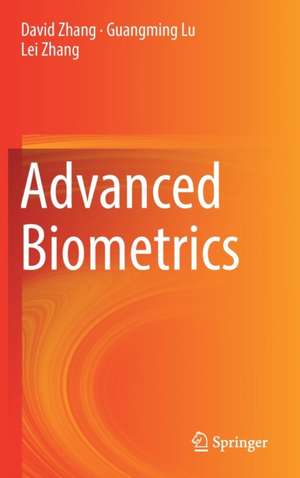
Advanced Biometrics
Autor David Zhang, Guangming Lu, Lei Zhangen Limba Engleză Hardback – 16 aug 2017
Traditional biometric technologies, such as fingerprint, face, iris, and palmprint, have been extensively studied and addressed in many research books. However, all of these technologies have their own advantages and disadvantages, and there is no single type of biometric technology that can be used for all applications. Many new biometric technologies have been developed in recent years, especia
lly in response to new applications. The contributions gathered here focus on how to develop a new biometric technology based on the requirements of essential applications, and how to design efficient algorithms that yield better performance.
Preț: 672.68 lei
Preț vechi: 791.40 lei
-15%
Puncte Express: 1009
Carte tipărită la comandă
Livrare economică 28 noiembrie-12 decembrie
Livrare prin curier în România Termenul estimat este afișat lângă disponibilitate.
Transport gratuit pentru acest produs Plată online sau ramburs, în funcție de opțiunile comenzii.
Retur gratuit în 14 zile Comandă securizată și suport în română.
Specificații
ISBN-13: 9783319615448
ISBN-10: 3319615440
Pagini: 352
Ilustrații: XIII, 335 p. 30 illus.
Dimensiuni: 160 x 241 x 25 mm
Greutate: 0.64 kg
Ediția:1st edition 2018
Editura: Springer
Locul publicării:Cham, Switzerland
ISBN-10: 3319615440
Pagini: 352
Ilustrații: XIII, 335 p. 30 illus.
Dimensiuni: 160 x 241 x 25 mm
Greutate: 0.64 kg
Ediția:1st edition 2018
Editura: Springer
Locul publicării:Cham, Switzerland
V-ar putea interesa
-
 Electromagnetic Induction ImagingLulu Wang-19%Preț: 583.08 lei719.86 lei
 -
 -18%Preț: 1203.11 lei1467.21 lei
 -
 -18%Preț: 1018.90 lei1242.57 lei
 -
 Energy Technology 2019Tao Wang-18%Preț: 982.51 lei1198.18 lei
 -
 Introduction to Audio ProcessingMads G. Christensen-15%Preț: 550.34 lei647.45 lei
 -
 Adaptive FilteringPaulo S. R. Diniz-23%Preț: 778.85 lei1011.50 lei
 -
 Filter Banks and Audio CodingGerald Schuller-15%Preț: 528.48 lei621.74 lei
 -
 Digital Filter Design using Python for Power Engineering ApplicationsShivkumar Venkatraman Iyer-15%Preț: 723.33 lei850.98 lei
 -
 Energy Technology 2018Ziqi Sun-18%Preț: 1899.09 lei2315.96 lei
 -
 -15%Preț: 623.34 lei733.34 lei
 -
 Next Generation Intelligent EnvironmentsStefan Ultes-15%Preț: 622.93 lei732.86 lei
 -
 Dental Image Processing for Human IdentificationDeven N. Trivedi-15%Preț: 600.07 lei705.96 lei
 -
 Advances in Multimedia ModelingSusanne Boll-20%Preț: 677.08 lei846.34 lei
 -
 Intelligent Video Event Analysis and UnderstandingJianguo Zhang-20%Preț: 674.56 lei843.20 lei
 -
 The Semantic Web - ISWC 2010Peter F. Patel-Schneider-20%Preț: 340.13 lei425.16 lei
 -
 Preț: 396.81 lei
 -
 -18%Preț: 751.34 lei916.26 lei
 -
 Preț: 378.80 lei
 -
 Acoustical Analysis of the TanpuraAsoke Kumar Datta-15%Preț: 660.09 lei776.58 lei
 -
 -18%Preț: 1284.83 lei1566.85 lei
 -
 -24%Preț: 772.50 lei1016.46 lei
 -
 -18%Preț: 1007.97 lei1229.23 lei
 -
 -15%Preț: 670.93 lei789.33 lei
 -
 -20%Preț: 672.48 lei840.60 lei
 -
 High Performance Vision IntelligenceAparajita Nanda-15%Preț: 670.88 lei789.28 lei
Cuprins
OVERVIEW.- High Resolution Partial Fingerprint Alignment using Pore-Valley Descriptors.- Adaptive Fingerprint Pore Modeling and Extraction.- A Reference High Resolution using Minutiae and Pores.- Online Finger-Knuckle-Print Verification for Personal Authentication.- Phase Congruency Induced Local Features for FKP Verification.- Ensemble of Local and Global Information for Finger-Knuckle-Print Verification.- Reconstruction based FKP Verification with Score Level Adaptive Binary Fusion.- 3D Fingerprint Reconstruction and Recognition.- Multi-Spectral Backhand Authentication.
Notă biografică
David Zhang graduated in Computer Science from Peking University. He received his MSc in 1982 and his PhD in 1985 in Computer Science from the Harbin Institute of Technology (HIT), respectively. From 1986 to 1988 he was a Postdoctoral Fellow at Tsinghua University and then an Associate Professor at the Academia Sinica, Beijing. In 1994 he received his second PhD in Electrical and Computer Engineering from the University of Waterloo, Ontario, Canada. He is a Chair Professor since 2005 at the Hong Kong Polytechnic University where he is the Founding Director of the Biometrics Research Centre (UGC/CRC) supported by the Hong Kong SAR Government in 1998. He is Founder and Editor-in-Chief, International Journal of Image and Graphics (IJIG); Founder and Series Editor, Springer International Series on Biometrics (KISB); Organizer, the 1st International Conference on Biometrics Authentication (ICBA); Associate Editor of more than ten international journals including IEEE Transactions and so on. He was selected as a Highly Cited Researcher in Engineering by Thomson Reuters in 2014, 2015 and 2016, respectively. Professor Zhang is a Croucher Senior Research Fellow, Distinguished Speaker of the IEEE Computer Society, and a Fellow of both IEEE and IAPR.
Dongmin Guo received her B.S. and M.S. degrees at School of Automation, Northwestern Polytechnical University Xi'an, China in 2003 and 2006, respectively and received her Ph.D. degree at the Hong Kong Polytechnic University, Hong Kong, in 2011. She is currently working as a research associate in Radiology Department, Wake Forest University Health Sciences. Her research interests include bioinformatics and machine learning.
Ke Yan received his B.S. and Ph.D. degrees both from the Department of Electronic Engineering, Tsinghua University, Beijing, China. He was the winner of the 2016 Tsinghua University Excellent Doctoral Dissertation Award. He iscurrently a postdoctoral fellow in the Lab of Diagnostic Radiology Research, National Institutes of Health, USA. He is studying deep learning methods to analyze medical images. His research interests include computer vision, machine learning, and their biomedical applications.
Textul de pe ultima copertă
This book describes a range of new biometric technologies, such as high-resolution fingerprint, finger-knuckle-print, multi-spectral backhand, 3D fingerprint, tongueprint, 3D ear, and multi-spectral iris technologies. Further, it introduces readers to efficient feature extraction, matching and fusion algorithms, in addition to developing potential systems of its own. These advanced biometric technologies and methods are divided as follows: 1. High-Resolution Fingerprint Recognition; 2. Finger-Knuckle-Print Verification; 3. Other Hand-Based Biometrics; and 4. New Head-Based Biometrics.
Traditional biometric technologies, such as fingerprint, face, iris, and palmprint, have been extensively studied and addressed in many research books. However, all of these technologies have their own advantages and disadvantages, and there is no single type of biometric technology that can be used for all applications. Many new biometric technologies have been developed in r
ecent years, especially in response to new applications. The contributions gathered here focus on how to develop a new biometric technology based on the requirements of essential applications, and how to design efficient algorithms that yield better performance.Traditional biometric technologies, such as fingerprint, face, iris, and palmprint, have been extensively studied and addressed in many research books. However, all of these technologies have their own advantages and disadvantages, and there is no single type of biometric technology that can be used for all applications. Many new biometric technologies have been developed in r
Caracteristici
Introduces some new technologies into the biometric family Introduces a range of efficient feature extraction, matching, and fusion algorithms Presents techniques that are strongly supported by experimental results and developed systems