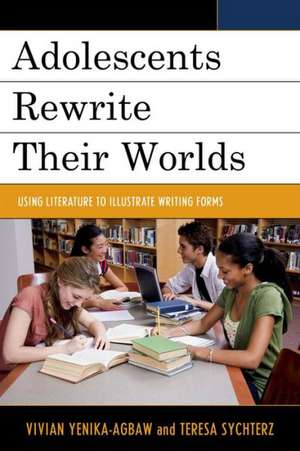
Adolescents Rewrite their Worlds: Using Literature to Illustrate Writing Forms
Editat de Vivian Yenika-Agbaw, Teresa Sychterz Contribuţii de Donna-Marie Cole-Malott, Jason Griffith, Jason Moser, Mary Napolien Limba Engleză Paperback – 8 feb 2015
Authors/Contributors' professional experiences of teaching writing using literaturePractical pedagogical practices that may transform the way teachers teach writing and use literatureInterviews with authors that give insight into their writing processWriting practices for twenty-first-century adolescents using new literacies
Preț: 254.91 lei
Preț vechi: 333.83 lei
-24%
Puncte Express: 382
Carte tipărită la comandă
Livrare economică 16-30 noiembrie
Livrare prin curier în România Termenul estimat este afișat lângă disponibilitate.
Transport gratuit de la 400.00 lei Plată online sau ramburs, în funcție de opțiunile comenzii.
Retur gratuit în 14 zile Comandă securizată și suport în română.
Specificații
ISBN-13: 9781475813234
ISBN-10: 1475813236
Pagini: 182
Ilustrații: 30 BW Illustrations, 5 Tables
Dimensiuni: 152 x 227 x 13 mm
Greutate: 0.27 kg
Editura: Bloomsbury Publishing
Colecția Rowman & Littlefield
Locul publicării:New York, United States
ISBN-10: 1475813236
Pagini: 182
Ilustrații: 30 BW Illustrations, 5 Tables
Dimensiuni: 152 x 227 x 13 mm
Greutate: 0.27 kg
Editura: Bloomsbury Publishing
Colecția Rowman & Littlefield
Locul publicării:New York, United States
V-ar putea interesa
-
 From Beginning to EndMike RoystonPreț: 76.83 lei
 -
 FrankensteinRosie DickinsPreț: 47.73 lei
 -
 Nelson Thornes Framework English Skills in Fiction 1GEOFF REILLY-31%Preț: 164.05 lei236.11 lei
 -
 Preț: 45.83 lei
Cuprins
Contents
List of Tables
Acknowledgments
Foreword:Patrick Shannon
Chapter 1: Literature: Art, Tool and More
Vivian Yenika-Agbaw
Chapter 2:The Transformative Power of Children's Literature in the Classroom
Teresa Sychterz
Chapter 3:Writing Public Service Announcements and Genre Jabs
Jason Griffith
Chapter 4:Using Photo Story to Rewrite the Classics
Jason Griffith
Chapter 5:Multi-genre Projects and the Urban Classroom: An Examination of Language and Critical Literacy
Donna-Marie Cole-Malott
Chapter 6:Digital Literacy: Writing Biographies
Jason Moser
Chapter 7:Literature Responses and Academic Writing
Vivian Yenika-Agbaw
Chapter 8:Chatting with Artists
Mary Napoli & Sychterz
Chapter 9:Graphic Novels Comes Alive in a Sixth Grade Classroom
Mary Napoli & Teresa Sychterz
Appendix A:Transformative Teaching Practices
Appendix B:Teaching Resources
Contributor's Biography
List of Tables
Acknowledgments
Foreword:Patrick Shannon
Chapter 1: Literature: Art, Tool and More
Vivian Yenika-Agbaw
Chapter 2:The Transformative Power of Children's Literature in the Classroom
Teresa Sychterz
Chapter 3:Writing Public Service Announcements and Genre Jabs
Jason Griffith
Chapter 4:Using Photo Story to Rewrite the Classics
Jason Griffith
Chapter 5:Multi-genre Projects and the Urban Classroom: An Examination of Language and Critical Literacy
Donna-Marie Cole-Malott
Chapter 6:Digital Literacy: Writing Biographies
Jason Moser
Chapter 7:Literature Responses and Academic Writing
Vivian Yenika-Agbaw
Chapter 8:Chatting with Artists
Mary Napoli & Sychterz
Chapter 9:Graphic Novels Comes Alive in a Sixth Grade Classroom
Mary Napoli & Teresa Sychterz
Appendix A:Transformative Teaching Practices
Appendix B:Teaching Resources
Contributor's Biography
Recenzii
Adolescents Rewrite their Worlds: Using Literature to Illustrate Writing Forms is definitely every middle school teacher's "go-to book" for reading and writing instruction. The contributors respect and understand that integrating digital literacies and multimodal projects into the language arts curriculum motivates and engages adolescents to read and write culturally authentic texts. Student choice and collaboration bring the meaning and social interactions that adolescents crave to projects such as writing graphic novels, creating film adaptations of texts, using Photo Story, and illustrator studies that marry technology with traditional writing tasks, always keeping the learner at the center. A book for the 21st century and beyond, the authors tap into what's important to students and suggest teaching and learning projects that can prepare students for the critical thinking and problem solving they need to be productive participants in our ever-changing global society. This is truly a must-have professional book for every middle school teacher!
Provide time, offer choice, and empower students! Adolescents Rewrite their Worlds: Using Literature to Illustrate Writing Forms is an inspiring collection of theoretical and engaging ideas that supports a teaching of literacy that goes beyond the simple mandate of skills. The authors share numerous classroom strategies on how to use children's literature and meaningful writing pieces to transform and empower students' cultural and democratic thinking. The book validates the importance of pleasure reading, and provides a refreshing look at multimodal compositions, digital biographies, multigenre projects, graphic novels, and visual literacy that will motivate all ELA teachers to try something new! During a time when it might be easy for teachers to be sucked into standards and prescribed methodologies, this book is a vital reminder that adolescents are more likely to choose to read, write, and think critically when classroom environments provide "space" for such practices.
Provide time, offer choice, and empower students! Adolescents Rewrite their Worlds: Using Literature to Illustrate Writing Forms is an inspiring collection of theoretical and engaging ideas that supports a teaching of literacy that goes beyond the simple mandate of skills. The authors share numerous classroom strategies on how to use children's literature and meaningful writing pieces to transform and empower students' cultural and democratic thinking. The book validates the importance of pleasure reading, and provides a refreshing look at multimodal compositions, digital biographies, multigenre projects, graphic novels, and visual literacy that will motivate all ELA teachers to try something new! During a time when it might be easy for teachers to be sucked into standards and prescribed methodologies, this book is a vital reminder that adolescents are more likely to choose to read, write, and think critically when classroom environments provide "space" for such practices.