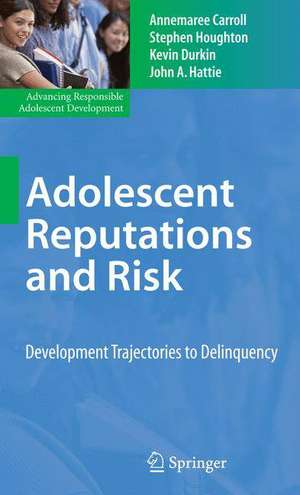
Adolescent Reputations and Risk: Advancing Responsible Adolescent Development
Autor Annemaree Carroll, Stephen Houghton, Kevin Durkin, John A. Hattieen Limba Engleză Hardback – 18 dec 2008
Synthesizing 15 years of research with delinquent youth, this volume describes the volatile dynamic of child and adolescent social worlds, emphasizing reputation enhancement and goal-setting as bases underlying deviant behavior. In innovative and accessible terms, "Adolescent Reputations and Risk" addresses delinquency throughout the course of childhood and adolescence, offers the first detailed explanation of delinquency by integrating goal-setting and reputation enhancement theories, provides evidence analyzing deviant trends in goal-setting and reputation enhancement terms among primary and high school students, answers key questions on topics such as impulsivity, drug and inhalant use, early-childhood psychopathy, links between ADHD and aggression, and the psychology of loners and includes current data on interventions for at-risk youth, including family and school methods, cognitive-behavioral therapy, wilderness and boot camp programs, and interactive multimedia strategies.
This volume is an essential resource for clinical child, school, and counseling psychologists; social workers; and allied education and community mental health professionals and practitioners.
Din seria Advancing Responsible Adolescent Development
- 18%
 Preț: 983.79 lei
- 30%
 Preț: 585.68 lei
- 25%
 Preț: 714.76 lei
- 18%
 Preț: 701.28 lei
-
 Preț: 370.30 lei
- 27%
 Preț: 570.84 lei
- 5%
 Preț: 996.07 lei
- 28%
 Preț: 564.19 lei
-
 Preț: 402.24 lei
- 18%
 Preț: 922.89 lei
-
 Preț: 401.98 lei
-
 Preț: 387.27 lei
- 15%
 Preț: 669.81 lei
- 24%
 Preț: 906.93 lei
- 15%
 Preț: 726.41 lei
-
 Preț: 407.65 lei
- 15%
 Preț: 669.16 lei
-
 Preț: 405.09 lei
- 15%
 Preț: 665.89 lei
- 15%
 Preț: 689.10 lei
-
 Preț: 409.18 lei
-
 Preț: 384.16 lei
-
 Preț: 370.78 lei
- 24%
 Preț: 695.99 lei
- 18%
 Preț: 1443.07 lei
Preț: 665.89 lei
Preț vechi: 783.39 lei
-15%
Puncte Express: 999
Carte tipărită la comandă
Livrare economică 05-19 decembrie
Livrare prin curier în România Termenul estimat este afișat lângă disponibilitate.
Transport gratuit pentru acest produs Plată online sau ramburs, în funcție de opțiunile comenzii.
Retur gratuit în 14 zile Comandă securizată și suport în română.
Specificații
ISBN-13: 9780387799872
ISBN-10: 0387799877
Pagini: 228
Ilustrații: XVII, 208 p.
Dimensiuni: 160 x 241 x 18 mm
Greutate: 0.46 kg
Ediția:2009
Editura: Springer
Colecția Advancing Responsible Adolescent Development
Seria Advancing Responsible Adolescent Development
Locul publicării:New York, NY, United States
ISBN-10: 0387799877
Pagini: 228
Ilustrații: XVII, 208 p.
Dimensiuni: 160 x 241 x 18 mm
Greutate: 0.46 kg
Ediția:2009
Editura: Springer
Colecția Advancing Responsible Adolescent Development
Seria Advancing Responsible Adolescent Development
Locul publicării:New York, NY, United States
V-ar putea interesa
-
 Preț: 120.12 lei
-
 -31%Preț: 656.66 lei957.32 lei
-
 Preț: 91.54 lei
-
 -27%Preț: 72.74 lei99.22 lei
-
 Jerry Thomas' Bartenders GuideJerry Thomas-19%Preț: 57.93 lei71.38 lei
-
 Developmental-Systemic Family Therapy with AdolescentsTerry S. Trepper-5%Preț: 387.69 lei408.09 lei
-
 Understanding 12-14-Year-OldsJonathan Bradley-21%Preț: 106.59 lei134.95 lei
-
 Seven KingsFran Abrams-17%Preț: 59.80 lei72.05 lei
-
 -21%Preț: 107.70 lei136.21 lei
Public țintă
Professional/practitionerCuprins
At-Risk Youth: Identifying, Charting, and Explaining the Course of Early Involvement with Crime.- Reputation-Enhancing Goals: The Theory of Deliberate Choice.- Measuring Delinquency, Goals, and Reputational Orientations in Young Persons.- Children at Risk: Initiating Goals and Reputations.- Adolescents at Risk: Establishing Goals and Reputations.- Establishing and Maintaining Reputations Through Risk-Taking Behavior.- Early-Onset Life-Course Persistent and Late-Onset Adolescent-Limited Offenders: Impulsivity, Peers, and Social Reputations.- Psychopathy in Children and Adolescents and the Fledgling Psychopath Hypothesis.- Treatment and Interventions for Young Persons at Risk.- Developmental Trajectories of Deviancy: Looking Back, Moving Forward.
Recenzii
From the reviews:
"Adolescent Reputations and Risk takes a close look at a fascinating developmental topic. … Organized in a format that is friendly to students, academics, and practitioners, the book is a nice addition to the library of anyone interested in adolescence as a developmental period. Even those interested in ‘normal’ adolescent behavior might find that Adolescent Reputations and Risk complements their understanding of the inner workings of the mysterious adolescent psyche." (Beniamin K. Barton, PsycCRITIQUES, Vol. 54 (26), 2009)
"Adolescent Reputations and Risk takes a close look at a fascinating developmental topic. … Organized in a format that is friendly to students, academics, and practitioners, the book is a nice addition to the library of anyone interested in adolescence as a developmental period. Even those interested in ‘normal’ adolescent behavior might find that Adolescent Reputations and Risk complements their understanding of the inner workings of the mysterious adolescent psyche." (Beniamin K. Barton, PsycCRITIQUES, Vol. 54 (26), 2009)
Notă biografică
Dr Linda-Dianne (Linda) Willis is Program Director, Bachelor of Education, and Senior Lecturer, in the School of Education and Professional Studies at Griffith University in Brisbane, Queensland, Australia. She is an experienced classroom and tertiary teacher, having taught extensively in the primary and middle years in schools and primary, middle years and senior secondary courses in universities. Linda has held leadership roles in government and independent schools and was the Program Director of the Master of Teaching (Primary) program at The University of Queensland for four years (2014-2018). Linda completed her PhD on parent-teacher engagement in 2013 and has since led significant research projects across Queensland in Catholic and state schools which examine parent engagement in inquiry curriculum using social media and the role of principals in leading parent engagement. She uses dialogic approaches throughout the design and implementation of her research projects as she worksalongside students, parents, teachers, principals, preservice teachers, researchers and industry stakeholders to generate authentic partnerships for enhancing student learning and wellbeing and the success of schools. Her work focuses on how usually marginalised individuals such as parents in schools may be enabled to play more participatory roles as co-educators in their child's learning and wellbeing. Linda was the Lead Chief Investigator (2016-2020) on the project, Principal Leadership for Parent-School-Community Engagement. This research was supported by the Queensland Department of Education's Education Horizon Grant scheme in partnership with Parents and Citizens' Associations Queensland. Linda has published widely in the area of parent engagement and presented on this topic at national and international conferences. Her other research interests include literacy, preservice teacher education, inquiry curriculum, dialogic pedagogies, and Humanities and Social Sciences education. Linda is the National Publications Director of the Australian Literacy Educators' Association (ALEA) and a member of the ALEA Executive and National Council.
Assoc Professor Jenny Povey is a Research Group Leader at the Institute for Social Science Research and an Associate Investigator in the Australian Research Council (ARC) Centre of Excellence on Families and Children over the Life Course (the Life Course Centre) at The University of Queensland, Australia. Jenny's research group focuses on the utilisation of research by policy-makers and practitioners to address educational disadvantage. Jenny also has considerable experience and expertise in complex policy and program evaluations. Jenny's research interests include research utilisation, research translation, education effectiveness, school leadership, school culture, parent engagement and improving student learning and wellbeing. She has extensive experience in mixed methods research using administrative data together with survey and qualitative data. Jenny's work has attracted over $11 million in research funding from the ARC, the Australian Government, the Queensland Government, the Tasmanian Government, the New South Wales Government, The University of Queensland, and not for profit organisations. Jenny has published in leading education, sociology and psychology journals and produced over 40 reports for various stakeholders. As a Chief Investigator on the Principal Leadership for Parent-School-Community Engagement (2016-2020) research, Jenny contributed to the development of a parent engagement course and led the development of a Parent Engagement Toolkit.
Dr Julie Hodges is a Research Fellow at the Parenting and Family Support Centre, the School of Psychology, at The University of Queensland, Australia. Her research activities draw on her background as a clinical psychologist, a teacher and a parenting educator. She has conducted research focused on the wellbeing an
Textul de pe ultima copertă
The news of teenagers and even younger children committing ever more serious and violent crimes continues to shock and baffle. The escalating psychological and social toll of youth crime is being paid by all – from victims to offenders to parents and siblings to teachers and to the community as a whole. Adolescent Reputations and Risk looks beyond traditional theories to examine, from a solid empirical basis, the motivation and values that make some young people choose antisocial over positive behavior, resulting in potent new insights and possible solutions to this ongoing problem.
Synthesizing 15 years of research with delinquent youth, this volume describes the volatile dynamic of child and adolescent social worlds, emphasizing reputation enhancement and goal-setting as bases underlying deviant behavior. In innovative and accessible terms, Adolescent Reputations and Risk:
Synthesizing 15 years of research with delinquent youth, this volume describes the volatile dynamic of child and adolescent social worlds, emphasizing reputation enhancement and goal-setting as bases underlying deviant behavior. In innovative and accessible terms, Adolescent Reputations and Risk:
- Addresses delinquency throughout the course of childhood and adolescence.
- Offers the first detailed explanation of delinquency by integrating goal-setting and reputation enhancement theories.
- Provides evidence analyzing deviant trends in goal-setting and reputation enhancement terms among primary and high school students.
- Answers key questions on topics such as impulsivity, drug and inhalant use, early-childhood psychopathy, links between ADHD and aggression, and the psychology of loners.
- Includes current data on interventions for at-risk youth, including family and school methods, cognitive-behavioral therapy, wilderness and boot camp programs, and interactive multimedia strategies.
Caracteristici
Provides access to more than a decade of empirical based research that examines delinquency from a different perspective Offers the first detailed, alternative explanation that integrates goal-setting and reputation enhancement theories Provides evidence that examines the developmental trends in goal setting and reputation enhancement among primary and high school aged students