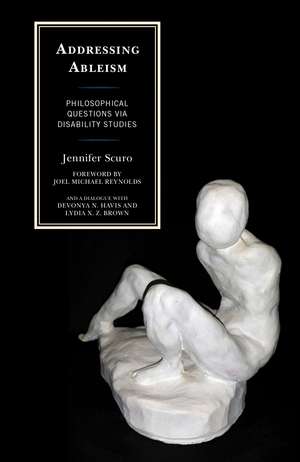
Addressing Ableism: Philosophical Questions via Disability Studies
Autor Jennifer Scuro Cu Devonya N. Havis, Lydia X. Z. Brown Cuvânt înainte de Joel Michael Reynoldsen Limba Engleză Paperback – 31 mai 2019
Preț: 286.46 lei
Preț vechi: 389.14 lei
-26%
Puncte Express: 430
Carte tipărită la comandă
Livrare economică 02-16 decembrie
Livrare prin curier în România Termenul estimat este afișat lângă disponibilitate.
Transport gratuit de la 400.00 lei Plată online sau ramburs, în funcție de opțiunile comenzii.
Retur gratuit în 14 zile Comandă securizată și suport în română.
Specificații
ISBN-13: 9781498540766
ISBN-10: 1498540767
Pagini: 276
Ilustrații: 9 b/w photos;
Dimensiuni: 150 x 228 x 20 mm
Greutate: 0.41 kg
Editura: Bloomsbury Publishing
Colecția Lexington Books
Locul publicării:New York, United States
ISBN-10: 1498540767
Pagini: 276
Ilustrații: 9 b/w photos;
Dimensiuni: 150 x 228 x 20 mm
Greutate: 0.41 kg
Editura: Bloomsbury Publishing
Colecția Lexington Books
Locul publicării:New York, United States
Cuprins
Foreword by Joel Michael Reynolds
Prologue: the scale and scope of ableism
One: experience
Two: diagnosis
Three: intersectionality - a dialogue with Devonya N. Havis and Lydia X. Z. Brown
Four: precariousness
Five: prosthesis
Epilogue: parts and wholes
Prologue: the scale and scope of ableism
One: experience
Two: diagnosis
Three: intersectionality - a dialogue with Devonya N. Havis and Lydia X. Z. Brown
Four: precariousness
Five: prosthesis
Epilogue: parts and wholes
Recenzii
Addressing Ableism is a transformative work. The book provides a detailed and rigorous archaeology of contemporary ableism, and compellingly argues for the ethical imperative to resist it. It provides a powerful framework for such resistance in not only in its content but also its form. Its fusion of philosophical analysis with memoir and social critique make it both intellectually and emotionally affecting, and Scuro's dialogue with Lydia Brown and Devonya Havis models the kinds of conversations she hopes to provoke. This book is a major contribution to disability studies, and its insights expand the customary boundaries of the field.
Addressing Ableism: Philosophical Questions via Disability Studies, by Jennifer Scuro in collaboration with Devonya Havis and Lydia X. Brown, is a vital new contribution to the annals of philosophy of disability and to philosophical discourse more generally. . . The book spans a wide spectrum of issues and concerns that the disability studies community has introduced into academic discourse, considers the political character of the ontological and ethical claims of other philosophers of disability, incorporates Scuro's personal reflections on her own social and institutional position as a white, nondisabled philosopher of disability with a disabled child, and highlights a fascinating and provocative dialogue that Scuro engages in with Havis, a Black disabled woman, and Brown, a disabled queer of color. Indeed, the attention that Scuro gives to the details of oft-overlooked conflicts and controversies that surround critical work on disability, the diversity and volume of research that she uses throughout the book, and the centrality to the aims and design of the book of the dialogue among Scuro and her interlocutors are among the book's most notable strengths. Taken together, these elements of Addressing Ableism combine to make it a unique philosophical journey.
Addressing Ableism: Philosophical Questions via Disability Studies, by Jennifer Scuro in collaboration with Devonya Havis and Lydia X. Brown, is a vital new contribution to the annals of philosophy of disability and to philosophical discourse more generally. . . The book spans a wide spectrum of issues and concerns that the disability studies community has introduced into academic discourse, considers the political character of the ontological and ethical claims of other philosophers of disability, incorporates Scuro's personal reflections on her own social and institutional position as a white, nondisabled philosopher of disability with a disabled child, and highlights a fascinating and provocative dialogue that Scuro engages in with Havis, a Black disabled woman, and Brown, a disabled queer of color. Indeed, the attention that Scuro gives to the details of oft-overlooked conflicts and controversies that surround critical work on disability, the diversity and volume of research that she uses throughout the book, and the centrality to the aims and design of the book of the dialogue among Scuro and her interlocutors are among the book's most notable strengths. Taken together, these elements of Addressing Ableism combine to make it a unique philosophical journey.