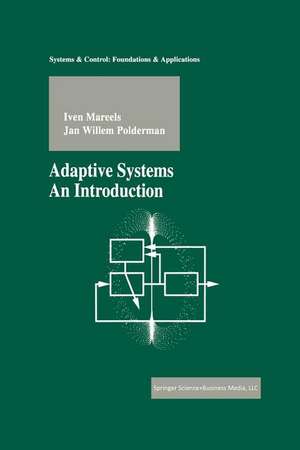
Adaptive Systems: Systems & Control: Foundations & Applications
Autor Iven Mareels, Jan Willem Poldermanen Limba Engleză Paperback – 7 sep 2012
Din seria Systems & Control: Foundations & Applications
- 15%
 Preț: 611.27 lei
 -
 Preț: 374.54 lei
 - 18%
 Preț: 823.65 lei
 - 15%
 Preț: 661.83 lei
 -
 Preț: 408.64 lei
 - 15%
 Preț: 674.70 lei
 - 15%
 Preț: 670.12 lei
 - 15%
 Preț: 584.73 lei
 -
 Preț: 397.95 lei
 - 15%
 Preț: 651.27 lei
 - 15%
 Preț: 668.04 lei
 - 15%
 Preț: 675.82 lei
 - 15%
 Preț: 664.88 lei
 - 15%
 Preț: 657.71 lei
 -
 Preț: 399.93 lei
 - 15%
 Preț: 546.55 lei
 -
 Preț: 381.55 lei
 -
 Preț: 411.78 lei
 - 18%
 Preț: 1383.74 lei
 - 18%
 Preț: 995.59 lei
 -
 Preț: 411.23 lei
 -
 Preț: 395.19 lei
 - 18%
 Preț: 995.63 lei
 - 18%
 Preț: 966.51 lei
 - 18%
 Preț: 950.43 lei
 - 15%
 Preț: 643.87 lei
 - 18%
 Preț: 973.69 lei
 - 15%
 Preț: 653.16 lei
 - 18%
 Preț: 915.89 lei
 - 15%
 Preț: 646.70 lei
 -
 Preț: 399.46 lei
 - 15%
 Preț: 669.86 lei
 -
 Preț: 396.88 lei
 - 18%
 Preț: 1014.46 lei
 - 15%
 Preț: 669.16 lei
Preț: 395.23 lei
Puncte Express: 593
Carte tipărită la comandă
Livrare economică 23 noiembrie-07 decembrie
Livrare prin curier în România Termenul estimat este afișat lângă disponibilitate.
Transport gratuit de la 400.00 lei Plată online sau ramburs, în funcție de opțiunile comenzii.
Retur gratuit în 14 zile Comandă securizată și suport în română.
Specificații
ISBN-13: 9781461264149
ISBN-10: 1461264146
Pagini: 364
Ilustrații: XVII, 342 p.
Dimensiuni: 155 x 235 x 20 mm
Greutate: 0.55 kg
Ediția:Softcover reprint of the original 1st ed. 1996
Editura: birkhäuser
Colecția Systems & Control: Foundations & Applications
Seria Systems & Control: Foundations & Applications
Locul publicării:Boston, MA, United States
ISBN-10: 1461264146
Pagini: 364
Ilustrații: XVII, 342 p.
Dimensiuni: 155 x 235 x 20 mm
Greutate: 0.55 kg
Ediția:Softcover reprint of the original 1st ed. 1996
Editura: birkhäuser
Colecția Systems & Control: Foundations & Applications
Seria Systems & Control: Foundations & Applications
Locul publicării:Boston, MA, United States
V-ar putea interesa
-
 Adventures in the AnthropoceneGaia Vince-18%Preț: 75.94 lei93.05 lei
 -
 Birth of a TheoremCedric Villani-32%Preț: 62.17 lei91.64 lei
 -
 -19%Preț: 73.10 lei90.43 lei
 -
 Star Trek: The Official Guide to Our UniverseAndrew FazekasPreț: 170.74 lei
 -
 StartalkNeil De Grasse TysonPreț: 216.65 lei
 -
 Suspicious Minds: Why We Believe Conspiracy TheoriesRob Brotherton-26%Preț: 63.30 lei85.40 lei
 -
 -27%Preț: 66.57 lei91.55 lei
 -
 50 Science Ideas You Really Need to KnowGail Dixon-23%Preț: 73.27 lei95.39 lei
Public țintă
ResearchCuprins
1 Adaptive Systems.- 1.1 Introduction.- 1.2 Adaptive systems: examples.- 1.3 General structure of adaptive control systems.- 1.4 Illustrating the concepts.- 1.5 Summary of chapter.- 1.6 Notes and references.- 1.7 Exercises.- 2 Systems And Their Representations.- 2.1 Introduction.- 2.2 Notation.- 2.3 The behavior.- 2.4 Latent variables.- 2.5 Equivalent representations.- 2.6 Controllability.- 2.7 Observability.- 2.8 Stability.- 2.9 Elimination of Latent variables.- 2.10 The ring ?[?,??1].- 2.11 An example.- 2.12 A word about the notation.- 2.13 Summary of chapter.- 2.14 Notes and references.- 3 Adaptive systems : principles of identification.- 3.1 Introduction.- 3.2 Object of interest and model class.- 3.3 Identification criterion and algorithms.- 3.4 Data model assumptions.- 3.5 Analysis of identification algorithms.- 3.6 Persistency of excitation.- 3.7 Summary of chapter.- 3.8 Notes and references.- 3.9 Exercises.- 4 Adaptive Pole Assignment.- 4.1 Introduction.- 4.2 Preliminaries.- 4.3 The system and its representations.- 4.4 Equilibrium analysis.- 4.5 An algorithm for adaptive pole assignment.- 4.6 Analysis of the algorithm.- 4.7 Filtered signals.- 4.8 Modification of the projection algorithm.- 4.9 Summary of chapter.- 4.10 Notes and references.- 4.11 Exercises.- 5 Direct Adaptive Model Reference Control.- 5.1 Introduction.- 5.2 Basic problem definition.- 5.3 Model reference control: nonadaptive solution.- 5.4 Error model construction.- 5.5 Equilibrium analysis.- 5.6 Adaptive algorithm.- 5.7 Analysis of the adaptive system.- 5.8 Adaptive model reference control with disturbance rejection.- 5.9 Summary of chapter.- 5.10 Notes and references.- 5.11 Exercises.- 6 Universal Controllers.- 6.1 Introduction.- 6.2 Existence of solutions.- 6.3 The first order case.- 6.4Higher order systems.- 6.5 Mårtensson’s algorithm.- 6.6 Summary of chapter.- 6.7 Notes and references.- 6.8 Exercises.- 7 The pole/zero cancellation problem.- 7.1 Introduction.- 7.2 The pole/zero cancellation problem in adaptive control.- 7.3 Combining direct and indirect adaptive control.- 7.4 Adaptive Excitation.- 7.5 A more fundamental viewpoint.- 7.6 Conclusions.- 7.7 Summary of chapter.- 7.8 Notes and references.- 7.9 Exercises.- 8 Averaging Analysis For Adaptive Systems.- 8.1 Introduction.- 8.2 Averaging.- 8.3 Transforming an adaptive system into standard form.- 8.4 Averaging approximation.- 8.5 Application: the MIT rule for adaptive control.- 8.6 Application: echo cancellation in telephony.- 8.7 Summary of chapter.- 8.8 Notes and references.- 8.9 Exercises.- 9 Dynamics of adaptive systems: A case study.- 9.1 Introduction.- 9.2 The example.- 9.3 Global analysis and bifurcations.- 9.4 Adaptive system behavior: ideal case.- 9.5 Adaptive system behavior: undermodelled case.- 9.6 Discussion.- 9.7 Summary of chapter.- 9.8 Notes and References.- 9.9 Exercises.- Epilogue.- A Background material.- A.1 A contraction result.- A.2 The Comparison Principle.- A.2.1 Bellman-Gronwall Lemma.- A.2.2 Perturbed linear stable systems.- A.3 Miscellaneous stability results.- A.3.1 Stability Definitions.- A.3.2 Some Lyapunov stability results.- A.4 Detectability.- A.5 An inequality for linear systems.- A.6 Finite horizon averaging result.- A.7 Maple code for solving Lyapunov equations.- A.8 Maple code for fixed points and two periodic solutions.
Recenzii
From the reviews:
"This book is intended to be a first introduction to the theory of adaptive systems for graduate students. It treats exclusively deterministic adaptive control in a discrete-time formulation…. The basic course material contained in Chapters 1, 2, 3, 4, 5, and 6 is supplemented with the presentation of more advanced problems and tools such as well-posedness of the control problem during adaptation (Chapter 7), averaging techniques for analysis of adaptive systems (Chapter 8), and global dynamical analysis of adaptive systems operating in a plant-model mismatch situation (Chapter 9)." —Mathematical Reviews
"The book is based on graduate courses taught by both authors and is intended as a text-book. Therefore it is self contained and only basic knowledge of linear algebra and ordinary differential equations is needed. … cover the basic theory of adaptive systems and can be used for a one trimester course. … The book is accompanied by many solved and unsolved exercises, two Maple procedures and a large bibliography." (EMS Newsletter, Issue 27, March, 1998)
"This book is intended to be a first introduction to the theory of adaptive systems for graduate students. It treats exclusively deterministic adaptive control in a discrete-time formulation…. The basic course material contained in Chapters 1, 2, 3, 4, 5, and 6 is supplemented with the presentation of more advanced problems and tools such as well-posedness of the control problem during adaptation (Chapter 7), averaging techniques for analysis of adaptive systems (Chapter 8), and global dynamical analysis of adaptive systems operating in a plant-model mismatch situation (Chapter 9)." —Mathematical Reviews
"The book is based on graduate courses taught by both authors and is intended as a text-book. Therefore it is self contained and only basic knowledge of linear algebra and ordinary differential equations is needed. … cover the basic theory of adaptive systems and can be used for a one trimester course. … The book is accompanied by many solved and unsolved exercises, two Maple procedures and a large bibliography." (EMS Newsletter, Issue 27, March, 1998)