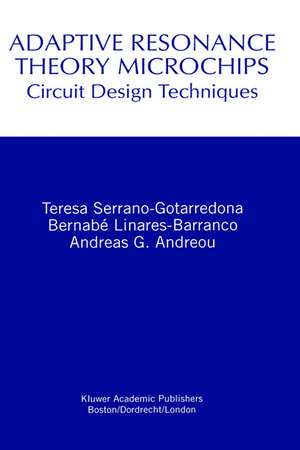
Adaptive Resonance Theory Microchips
Autor Teresa Serrano-Gotarredona, Bernabé Linares-Barranco, Andreas G Andreouen Limba Engleză Hardback – 31 aug 1998
Preț: 978.90 lei
Preț vechi: 1193.78 lei
-18%
Puncte Express: 1468
Carte tipărită la comandă
Livrare economică 27 noiembrie-11 decembrie
Livrare prin curier în România Termenul estimat este afișat lângă disponibilitate.
Transport gratuit pentru acest produs Plată online sau ramburs, în funcție de opțiunile comenzii.
Retur gratuit în 14 zile Comandă securizată și suport în română.
Specificații
ISBN-13: 9780792382317
ISBN-10: 0792382315
Pagini: 234
Ilustrații: XXIII, 234 p.
Dimensiuni: 160 x 241 x 19 mm
Greutate: 0.56 kg
Ediția:1998 edition
Editura: Springer Us
Locul publicării:New York, NY, United States
ISBN-10: 0792382315
Pagini: 234
Ilustrații: XXIII, 234 p.
Dimensiuni: 160 x 241 x 19 mm
Greutate: 0.56 kg
Ediția:1998 edition
Editura: Springer Us
Locul publicării:New York, NY, United States
V-ar putea interesa
-
 Using Artificial Intelligence Absolute Beginner's GuideMichael Miller-20%Preț: 201.24 lei251.56 lei
 -
 ARM System-on-Chip ArchitectureSteve Furber-23%Preț: 591.53 lei768.22 lei
 -
 Computer Architecture: A Quantitative ApproachJohn L. Hennessy-39%Preț: 534.37 lei882.55 lei
 -
 -40%Preț: 622.22 lei1028.93 lei
 -
 The Art of ElectronicsPaul Horowitz-9%Preț: 706.10 lei775.93 lei
 -
 Learning the Art of ElectronicsThomas C. Hayes-11%Preț: 605.89 lei680.79 lei
 -
 -23%Preț: 906.97 lei1177.89 lei
 -
 Artificial Intelligence Hardware DesignAlbert Chun-Chen Liu-20%Preț: 716.17 lei895.22 lei
 -
 Machine Learning For DummiesLuca Massaron-20%Preț: 149.88 lei187.36 lei
 -
 Agentic AI For DummiesPam Baker-20%Preț: 145.95 lei182.44 lei
 -
 The Essential Book of AIAnne Rooney-20%Preț: 76.61 lei95.77 lei
 -
 Foundations of Analog and Digital Electronic CircuitsAnant Agarwal-28%Preț: 546.19 lei754.30 lei
 -
 Advanced Topics in Electric CircuitsZdzislaw Trzaska-18%Preț: 968.35 lei1180.92 lei
 -
 Preț: 390.45 lei
 -
 -20%Preț: 531.38 lei664.22 lei
 -
 AAD Algorithms-Aided DesignArturo TedeschiPreț: 356.48 lei
 -
 Recent Advances in Artificial Intelligence and Smart ApplicationsJyotsna K. Mandal-18%Preț: 1017.19 lei1240.48 lei
 -
 Neural Network Modelling of Microstrip AntennasVenkata A P Chavali-18%Preț: 853.71 lei1041.11 lei
 -
 AI and MicroservicesDileep Kumar Pandiya-20%Preț: 263.90 lei329.88 lei
Public țintă
ResearchCuprins
1. Adaptive Resonance Theory Algorithms.- 1.1 Introduction.- 1.2 ART1.- 1.3 ARTMAP.- 1.4 Fuzzy-ART.- 1.5 Fuzzy-ARTMAP.- 2. A Vlsi-Friendly ART1 Algorithm.- 2.1 The Modified ART1 Algorithm.- 2.2 Functional Differences between Original and Modified Model.- 3. ART1 And ARTMAP Vlsi Circuit Implementation.- 3.1 Introduction.- 3.2 Hardware-Oriented Attractive Properties of the ART1 Algorithm.- 3.3 Circuit Description.- 3.4 Modular System Expansivity.- 3.5 Implementation of Synaptic Current Sources.- 3.6 Experimental Results of First Prototype.- 3.7 Experimental Results of Second Prototype.- 4. A Current-Mode Multi-Chip WTA-MAX Circuit.- 4.1 Introduction.- 4.2 Operation Principle.- 4.3 Circuit Implementation.- 4.4 System Stability Coarse Analysis.- 4.5 System Stability Fine Analysis.- 4.6 Experimental Results.- 5. An ART1/ARTMAP/Fuzzy-ART/Fuzzy-ARTMAP Chip.- 5.1 The Synaptic Cell.- 5.2 Peripheral Cells.- 5.3 Concluding Remarks.- 6. Analog Learning Fuzzy Art Chips.- 6.1 Introduction.- 6.2 Summary of the Fuzzy-ART Algorithm.- 6.3 Current-Mode Fuzzy-ART Chip.- 6.4 Fuzzy-ART/VQ Chip.- 6.5 Conclusions.- 7. Some Potential Applications For Art Microchips.- 7.1 Portable Non-invasive Device for Determination of Concentrations of Biological Substances.- 7.2 Cardiac Arrhythmia Classifier for Implantable Pacemaker.- 7.3 Vehicle Interior Monitoring Device for Auto Alarm.- 7.4 Concluding Remarks.- Appendices.- A- MATLAB Codes for Adaptive Resonance Theory Algorithms.- A.1 MATLAB Code Example for ART1.- A.2 MATLAB Code Example for ARTMAP.- A.3 MATLAB Code Example for Fuzzy-ART.- A.4 MATLAB Code Example for Fuzzy-ARTMAP.- A. 5 Auxiliary Functions.- B- Computational Equivalence of the Original ART1 and the Modified ART1m Models.- B. l Direct Access to Subset and Superset Patterns.- B. 2 DirectAccess by Perfectly Learned Patterns (Theorem 1 of original ART1).- B. 3 Stable Choices in STM (Theorem 2 of original ART1).- B. 4 Initial Filter Values determine Search Order (Theorem 3 of original ART1).- B. 5 Learning on a Single Trial (Theorem 4 of original ART1.- B. 6 Stable Category Learning (Theorem 5 of original ART1.- B. 7 Direct Access after Learning Self-Stabilizes (Theorem 6 of original ART1).- B.8 Search Order(Theorem 7 of original ART1).- B.9 Biasing the Network towards Uncommitted Nodes.- B.10 Expanding Proofs to Fuzzy-ART.- B. 11 Remarks.- C- Systematic Width-and-Length Dependent CMOS Transistor Mismatch Characterization.- C.1 Mismatch Characterization Chip.- C.2 Mismatch Parameter Extraction and Statistical Characterization.- C.3 Characterization Results.- References.