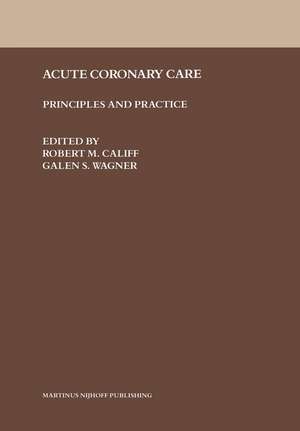
Acute Coronary Care: Principles and Practice
Editat de Robert M. Califf, G.S. Wagneren Limba Engleză Paperback – 3 noi 2011
Preț: 377.03 lei
Preț vechi: 396.88 lei
-5%
Puncte Express: 566
Carte tipărită la comandă
Livrare economică 23 noiembrie-07 decembrie
Livrare prin curier în România Termenul estimat este afișat lângă disponibilitate.
Transport gratuit de la 400.00 lei Plată online sau ramburs, în funcție de opțiunile comenzii.
Retur gratuit în 14 zile Comandă securizată și suport în română.
Specificații
ISBN-13: 9781461338307
ISBN-10: 1461338301
Pagini: 580
Ilustrații: 576 p.
Dimensiuni: 178 x 254 x 30 mm
Greutate: 0.99 kg
Ediția:1985
Editura: Springer Us
Colecția Springer
Locul publicării:New York, NY, United States
ISBN-10: 1461338301
Pagini: 580
Ilustrații: 576 p.
Dimensiuni: 178 x 254 x 30 mm
Greutate: 0.99 kg
Ediția:1985
Editura: Springer Us
Colecția Springer
Locul publicării:New York, NY, United States
V-ar putea interesa
-
 Vascular AnaesthesiaJonathan Thompson-22%Preț: 515.47 lei663.07 lei
 -
 ABC of HypertensionD Gareth Beevers-5%Preț: 256.78 lei270.30 lei
 -
 -5%Preț: 291.60 lei306.95 lei
 -
 -24%Preț: 569.56 lei747.88 lei
 -
 -24%Preț: 573.45 lei750.33 lei
 -
 -5%Preț: 2413.08 lei2540.09 lei
 -
 Horizons in World Cardiovascular Research: Volume 3Eleanor H Bennington-23%Preț: 1306.16 lei1703.63 lei
 -
 Horizons in World Cardiovascular Research: Volume 4Eleanor H Bennington-23%Preț: 928.39 lei1210.87 lei
 -
 -23%Preț: 1391.01 lei1814.20 lei
 -
 The Hemiplegia HandbookLiz Barnes-5%Preț: 262.06 lei275.86 lei
Public țintă
ResearchCuprins
I. Pathophysiology of Ischemic Heart Disease.- 1. Factors that Regulate Transmural Myocardial Blood Flow Distribution.- 2. The Relationship between Coronary Blood Flow and Reversible and Irreversible Ischemic Injury.- 3. Energy Metabolism and Transport in the ischemic and Postischemic Myocardium.- 4. The Pathophysiology of Atherosclerosis of the Coronary Arteries and Changes that Predispose to Ischemic Heart Disease.- 5. The Role of Coronary Artery Spasm in Acute Ischemic Syndromes.- 6. The Role of Thrombosis in Acute Myocardial Ischemic Syndromes.- 7. The Biochemistry of Thrombolytic Agents.- 8. Clinical Pharmacology of Streptokinase.- 9. Terminology for Location of Acute Myocardial Infarcts.- 10. Subendocardial versus Transmural Infarction: Anatomic and Electrocardiographic Considerations.- 11. Hemodynamic Abnormalities in Acute Myocardial Infarction.- 12. Autonomic Imbalance during Acute Myocardial Ischemia and Infarction.- II. The Prediction and Prevention of Acute Myocardial Ischemia and Infarction.- 13. The Changing Prognosis of Patients with Unstable Angina and Acute Myocardial Infarction.- 14. Risk Factors that Predict Fatal and Nonfatal Cardiac Events.- 15. The Role of Nutrition in Atherogenesis and Acute Myocardial Infarction.- 16. The Role of Antithrombotic Therapy in the Acute Ischemic Syndromes.- 17. Clinical Trials of Modification of Mortality during Acute Myocardial Infarction.- III. Methods for Diagnosing and Sizing Myocardial Infarctions.- 18. Serum CK-MB in Diagnosis and Assessment of Acute Myocardial Infarction.- 19. The Ability of the QRS Complex to Determine the Location and Size of Myocardial Infarcts.- 20. Radionuclide Techniques for Diagnosing and Sizing of Myocardial Infarction.- 21. The Clinical Diagnosis of Right Ventricular Infarction.- IV. Methods for Monitoring the Patient with Acute Myocardial Ischemia.- 22. Hemodynamic Monitoring in Acute Myocardial Infarction.- 23. The Use of Echocardiographic Techniques for Determining Cardiac Function during Acute Myocardial Infarction.- 24. The Potential Usefulness of Doppler Ultrasound in Myocardial Infarction.- 25. The Use of Serial Radionuclide Angiography for Monitoring Function during Acute Myocardial Infarction.- 26. Tachyarrhythmias during Acute Myocardial Infarction and Options for Their Electrical Management.- V. Coronary Care: The Prehospital Phase.- 27. The Tiered Response Mobile Intensive Care System in the Management of Out-of-hospital Cardiac Arrest.- 28. The First Hour of Acute Myocardial Infarction Observed during Mobile Intensive Care.- 29. Cost Effectiveness of Mobile Intensive Care Unit for an Entire Community.- VI. Coronary Care : The Postadmission Phase.- 30. Optimal Identification of the Patient with Acute Myocardial Ischemia in the Emergency Room.- 31. Achieving Pain Relief with Physiologic Management and Analgesic Agents during Acute Myocardial Infarction.- 32. The Use of Intravenous Antiventricular Arrhythmic Agents during Acute Myocardial Infarction.- 33. The Clinical Use of Thrombolytic Agents.- 34. Methods for Detecting Salvage of Jeopardized Myocardium following Intracoronary Thrombolysis in Acute Myocardial Infarction.- 35. The Role of Surgery in Unstable Angina Pectoris and Acute Myocardial Infarction.- VII. Coronary Care: The Coronary Care Unit.- 36. The Evolution of Care of Patients with Unstable Angina and Myocardial Infarction.- 37. Organization and Administration of the Cardiac Care Unit.- 38. The Cost-effectiveness of Coronary Care Units.- VIII. Coronary Care: The Coronary Care Unit Phase.- 39. The Optimal Use of Temporary Pacingduring Acute Myocardial Infarction.- 40. Drug Interactions in Coronary Care.- 41. The Use of ?-adrenergic and Calcium-blocking Drugs during Acute Myocardial Ischemia and Infarction.- 42. Respiratory Care for Patients with Acute Myocardial Ischemia.- 43. Optimal Regulation of Preload and Afterload during Acute Myocardial Infarction.- 44. The Medical Management of Cardiogenic Shock due to Myocardial Necrosis.- 45. Surgical Treatment of Cardiogenic Shock following Acute Myocardial Infarction.- 46. Myocardial Infarct Expansion and Extension.- 47. Pericarditis following Myocardial Infarction.- 48. Preparation of the Patient, Family, and Staff for Imminent Death on a Coronary Care Unit.- IX. Coronary Care: The Predischarge Phase.- 49. Determination of the Optimal Time for Patient Mobilization and Hospital Discharge following Acute Myocardial Infarction.- 50. Identification and Prophylactic Treatment of Patients at High Risk of Late Postinfarction Sudden Death.- 51. The Quantification of Residual Ischemia in Patients Recovering from Acute Myocardial Infarction by Exercise Thallium-201 Scintigraphy.- 52. The Value of Radionuclide Angiography for Risk Assessment of Patients following Acute Myocardial Infarction.- 53. Optimal Use of Ambulatory Monitoring prior to Hospital Discharge following Acute Myocardial Infarction.- 54. Electrophysiologic Testing to Identify High-risk Patients after Acute Myocardial Infarction.- 55. Strategies for Assessing the Risk Status of Patients following Acute Myocardial Infarction or Unstable Angina.- X. Coronary Care: The Convalescent Phase.- 56. The Role of Outpatient Transtelephonic ECG Monitoring and Self-medication following Acute Myocardial Infarction.- 57. Minimizing Psychological Stress for Patients and Family following Acute MyocardialInfarction.- 58. Minimizing Disability and Optimizing Return to Work following Acute Myocardial Infarction.