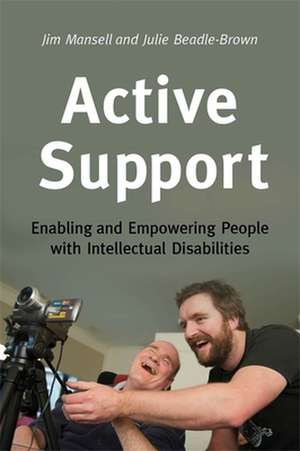
Active Support: Enabling and Empowering People with Intellectual Disabilities
Autor Jim Mansell, Julie Beadle-Brownen Limba Engleză Paperback – 15 mai 2012
The authors provide a comprehensive overview of Active Support and how it can be used in practice, based on the theory and research underpinning the methods involved. They describe how to engage people with intellectual disabilities in meaningful activity as active participants, and look at the communication style needed to foster positive relationships between carers and the people they are supporting. Highlighting the main issues for those trying to put Active Support into practice, they explain what is needed on a day-to-day basis to support the implementation, improvement and maintenance of the approach, along with possible solutions for the difficulties they may encounter. Finally, they look at how to integrate Active Support with other person-centred approaches, drawing on examples from various organisations and individual case studies.
The definitive text on Active Support, this book will be essential reading for anyone professionally concerned with the quality of life of people with intellectual disabilities, including psychologists, behaviour specialists, social workers, care managers, occupational therapists and inspectors and regulators of services, as well as families.
Preț: 205.55 lei
Preț vechi: 274.15 lei
-25%
Puncte Express: 308
Carte disponibilă
Livrare economică 03-17 noiembrie
Livrare prin curier în România Termenul estimat este afișat lângă disponibilitate.
Transport gratuit de la 400.00 lei Plată online sau ramburs, în funcție de opțiunile comenzii.
Retur gratuit în 14 zile Comandă securizată și suport în română.
Specificații
ISBN-13: 9781849051118
ISBN-10: 1849051119
Pagini: 224
Ilustrații: Illustrations
Dimensiuni: 152 x 228 x 18 mm
Greutate: 0.38 kg
Editura: JESSICA KINGSLEY PUBLISHERS
Colecția Jessica Kingsley Publishers
Locul publicării:London, United Kingdom
ISBN-10: 1849051119
Pagini: 224
Ilustrații: Illustrations
Dimensiuni: 152 x 228 x 18 mm
Greutate: 0.38 kg
Editura: JESSICA KINGSLEY PUBLISHERS
Colecția Jessica Kingsley Publishers
Locul publicării:London, United Kingdom
V-ar putea interesa
-
 Disability DiscourseMairian Corker-28%Preț: 218.43 lei305.45 lei
 -
 Controversial Issues In A Disabling SocietyJohn Swain-29%Preț: 212.28 lei296.91 lei
 -
 DisabilityMark PriestleyPreț: 225.49 lei
 -
 -20%Preț: 116.71 lei145.75 lei
 -
 -26%Preț: 199.03 lei268.29 lei
 -
 -24%Preț: 262.91 lei347.09 lei
 -
 Joey Goes to the DentistCandace Vittorini-19%Preț: 97.44 lei119.76 lei
 -
 -20%Preț: 354.96 lei443.29 lei
 -
 -21%Preț: 93.88 lei118.41 lei
 -
 Asperger's Syndrome: A Guide for Parents and ProfessionalsDr Anthony Attwood-20%Preț: 118.28 lei147.66 lei
 -
 Preț: 82.03 lei
 -
 Asperger Syndrome in the Family: Redefining NormalLiane Holliday Willey-20%Preț: 143.97 lei181.05 lei
Recenzii
Mansell and Beadle-Brown have created a thorough handbook of AS and how to implement it successfully. Readers of this book will also obtain different perspectives of challenges faced with AS, and how to resolve these. The book is a stimulating read, with a strong evidence base referenced to research and government papers. The authors explain their material clearly, and offer ideas for future research. This is a book to buy for any student or practitioner in a relevant field.
excellent and accessible book... It provides a concise explanation of active support - meaningful, engaging and fulfilling daily activities by carers providing intensive support - and how to set about providing this.
The book is comprehensive and essentially provides a value base and structure to support service users positively. It will be useful for families, care providers and health and social care practitioners who work or care for people with intellectual disabilities.
This book is drawn from international sources and sits within social policy and social work values of social inclusion, choice, participation, respect and dignity. Its great value is that by drawing on research as to what works in practice then it is both a key source of evidence and a call of action to effect change at different levels... Each chapter manages to discuss and analyse issues and challenges with which we are all familiar. The evidence is used to highlight what works and to recommend best practice at different levels. This is an important book that deserves to be read by students, social workers, team leaders, senior managers, policy makers and inspectorate staff and its recommendations acted upon.
This landmark book is an authoritative text on the organisation of support and methods of direct practice with people with severe intellectual disability. Written by two outstanding academic leaders, it draws together the significant body of research that forms the evidence base for person centred active support. Its unique contribution and thus immense value is the clarity with which this knowledge is translated into a comprehensive guide to every day practice for staff, front line leaders and senior managers. This book is a key source of theory and evidence for students, researchers and policy makers, as well providing practitioners and organisations with a blueprint for action.
Mansell and Beadle-Brown have pulled together, in one place, a readable, practical yet research-based guide to improving supports for people with significant intellectual disabilities. I recommend this concise volume for any service provider or policymaker who supports this population. It is well worth the read.
This is a really helpful book for anyone wishing not only to understand the place of person centred active support in enabling people with complex support needs to exercise control over their own lives, but to implement it effectively. It is meticulously researched and distils experience gained from implementation really well.
In my 35 years of working with people with a disability I have not come across anything as important as Person-Centred Active Support. It is now at the core of almost all the work that I do.
Person Centred Active Support has been an essential core element of what we do for more than 10 years; it takes energy and tenacity to implement and maintain but the difference it makes in people's lives makes it very worthwhile.
excellent and accessible book... It provides a concise explanation of active support - meaningful, engaging and fulfilling daily activities by carers providing intensive support - and how to set about providing this.
The book is comprehensive and essentially provides a value base and structure to support service users positively. It will be useful for families, care providers and health and social care practitioners who work or care for people with intellectual disabilities.
This book is drawn from international sources and sits within social policy and social work values of social inclusion, choice, participation, respect and dignity. Its great value is that by drawing on research as to what works in practice then it is both a key source of evidence and a call of action to effect change at different levels... Each chapter manages to discuss and analyse issues and challenges with which we are all familiar. The evidence is used to highlight what works and to recommend best practice at different levels. This is an important book that deserves to be read by students, social workers, team leaders, senior managers, policy makers and inspectorate staff and its recommendations acted upon.
This landmark book is an authoritative text on the organisation of support and methods of direct practice with people with severe intellectual disability. Written by two outstanding academic leaders, it draws together the significant body of research that forms the evidence base for person centred active support. Its unique contribution and thus immense value is the clarity with which this knowledge is translated into a comprehensive guide to every day practice for staff, front line leaders and senior managers. This book is a key source of theory and evidence for students, researchers and policy makers, as well providing practitioners and organisations with a blueprint for action.
Mansell and Beadle-Brown have pulled together, in one place, a readable, practical yet research-based guide to improving supports for people with significant intellectual disabilities. I recommend this concise volume for any service provider or policymaker who supports this population. It is well worth the read.
This is a really helpful book for anyone wishing not only to understand the place of person centred active support in enabling people with complex support needs to exercise control over their own lives, but to implement it effectively. It is meticulously researched and distils experience gained from implementation really well.
In my 35 years of working with people with a disability I have not come across anything as important as Person-Centred Active Support. It is now at the core of almost all the work that I do.
Person Centred Active Support has been an essential core element of what we do for more than 10 years; it takes energy and tenacity to implement and maintain but the difference it makes in people's lives makes it very worthwhile.
Cuprins
Acknowledgements. Preface. Introduction. 1. Engagement in Meaningful Activity and Relationships. 2. The Enabling Relationship. 3. Organising Staff Support. 4. Practice Leadership. 5. The Organisational Context. 6. Integrating Active Support with Other Person-centred Approaches. Conclusion. Appendix I: Summary of the Levels of Engagement Reported in Available Studies and Additional Analysis of Available Data, with Adaptive Behaviour Scale Part 1 (ABS) Score Where Available. Appendix II: Summary of Data on Engagement and Support from Staff Following Implementation of Active Support. References. Index.