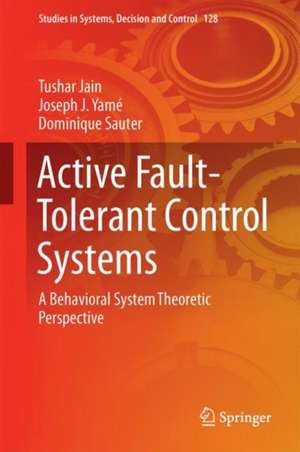
Active Fault-Tolerant Control Systems: Studies in Systems, Decision and Control, cartea 128
Autor Tushar Jain, Joseph J. Yamé, Dominique Sauteren Limba Engleză Hardback – 27 oct 2017
Din seria Studies in Systems, Decision and Control
- 18%
 Preț: 1379.43 lei
 - 20%
 Preț: 1005.92 lei
 - 18%
 Preț: 968.46 lei
 - 15%
 Preț: 622.78 lei
 - 18%
 Preț: 904.85 lei
 - 18%
 Preț: 1391.60 lei
 - 18%
 Preț: 973.48 lei
 - 15%
 Preț: 653.27 lei
 - 18%
 Preț: 1039.63 lei
 - 18%
 Preț: 971.22 lei
 - 20%
 Preț: 950.72 lei
 - 18%
 Preț: 962.48 lei
 - 18%
 Preț: 756.41 lei
 - 18%
 Preț: 1020.97 lei
 - 18%
 Preț: 1123.96 lei
 - 18%
 Preț: 1581.46 lei
 - 20%
 Preț: 1167.61 lei
 - 18%
 Preț: 1067.63 lei
 - 18%
 Preț: 956.01 lei
 - 20%
 Preț: 1415.14 lei
 - 18%
 Preț: 1338.22 lei
 - 20%
 Preț: 1184.15 lei
 - 18%
 Preț: 1681.44 lei
 - 20%
 Preț: 994.22 lei
 - 20%
 Preț: 371.12 lei
 - 20%
 Preț: 1231.28 lei
 - 18%
 Preț: 1588.13 lei
 - 18%
 Preț: 1124.43 lei
 - 20%
 Preț: 1174.31 lei
 - 18%
 Preț: 1411.23 lei
 - 18%
 Preț: 965.20 lei
 - 20%
 Preț: 1171.92 lei
 - 20%
 Preț: 1037.42 lei
 - 18%
 Preț: 1202.77 lei
 - 18%
 Preț: 1569.06 lei
 - 18%
 Preț: 959.85 lei
 - 18%
 Preț: 1230.18 lei
 - 18%
 Preț: 1178.23 lei
 - 18%
 Preț: 855.99 lei
 - 18%
 Preț: 1292.05 lei
 - 20%
 Preț: 1966.68 lei
 - 20%
 Preț: 1006.96 lei
 - 18%
 Preț: 864.08 lei
 - 20%
 Preț: 1676.22 lei
 - 18%
 Preț: 762.47 lei
 - 18%
 Preț: 1233.64 lei
 - 18%
 Preț: 1075.51 lei
 - 18%
 Preț: 1076.15 lei
 - 18%
 Preț: 1189.82 lei
Preț: 662.58 lei
Preț vechi: 779.51 lei
-15%
Puncte Express: 994
Carte tipărită la comandă
Livrare economică 24 noiembrie-08 decembrie
Livrare prin curier în România Termenul estimat este afișat lângă disponibilitate.
Transport gratuit pentru acest produs Plată online sau ramburs, în funcție de opțiunile comenzii.
Retur gratuit în 14 zile Comandă securizată și suport în română.
Specificații
ISBN-13: 9783319688275
ISBN-10: 3319688278
Pagini: 168
Ilustrații: XV, 152 p. 56 illus., 31 illus. in color.
Dimensiuni: 160 x 241 x 15 mm
Greutate: 0.37 kg
Ediția:1st ed. 2018
Editura: Springer
Colecția Studies in Systems, Decision and Control
Seria Studies in Systems, Decision and Control
Locul publicării:Cham, Switzerland
ISBN-10: 3319688278
Pagini: 168
Ilustrații: XV, 152 p. 56 illus., 31 illus. in color.
Dimensiuni: 160 x 241 x 15 mm
Greutate: 0.37 kg
Ediția:1st ed. 2018
Editura: Springer
Colecția Studies in Systems, Decision and Control
Seria Studies in Systems, Decision and Control
Locul publicării:Cham, Switzerland
Cuprins
Introduction.- Active Fault Tolerant Control: Current and Past.- The Behavioral Paradigm.- Benchmark Examples.- Applications
Textul de pe ultima copertă
The book introduces novel algorithms for designing fault-tolerant control (FTC) systems using the behavioral system theoretic approach, and presents a demonstration of successful novel FTC mechanisms on several benchmark examples. The authors also discuss a new transient management scheme, which is an essential requirement for the implementation of active FTC systems, and two data-driven methodologies that are broadly classified as active FTC systems: the projection-based approach and the online-redesign approach. These algorithms do not require much a priori information about the plant in real-time, and in addition this novel implementation of active FTC systems circumvents various weaknesses induced by using a diagnostic module in real-time. The book provides graduate students taking masters and doctoral courses in mathematics, control, and electrical engineering an excellent stepping-stone for their research. It also appeals to practitioners interested to apply innovative fail-safecontrol techniques.
Caracteristici
Focuses on fault-tolerant control (FTC) systems from the behavioral system theoretic perspective Presents a successful demonstration of novel FTC mechanisms on benchmark examples Develops a sophisticated FTC tool for wind turbine systems and proposes two data-driven approaches without using an explicit fault diagnosis module