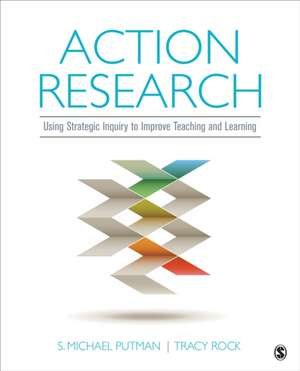
Action Research: Using Strategic Inquiry to Improve Teaching and Learning
Autor S. Michael Putman, Tracy C. Rocken Limba Engleză Paperback – 27 mar 2017
Bazându-ne pe metodologiile riguroase promovate de SAGE Publications, descoperim în Action Research: Using Strategic Inquiry to Improve Teaching and Learning un ghid procedural esențial pentru cadrele didactice care doresc să măsoare impactul intervențiilor pedagogice asupra rezultatelor elevilor. Lucrarea semnată de S. Michael Putman și Tracy C. Rock se distinge printr-o organizare logică, derivată din psihologia autoreglării, împărțind procesul de cercetare în faze clare: definirea sarcinii, planificarea, execuția și adaptarea. Putem afirma că această structură transformă conceptul adesea intimidant de „cercetare” într-o serie de pași acționabili, ancorați în realitatea zilnică a clasei.
Textul integrează elemente distinctive precum secțiunile „TECH Connections”, care facilitează utilizarea instrumentelor digitale în colectarea datelor, și „Note-able Thoughts”, menite să stimuleze reflecția asupra experienței anterioare. Din analiza cuprinsului, observăm o progresie riguroasă de la stabilirea contextului în „epoca responsabilității” (Age of Accountability) până la sinteza literaturii de specialitate. Această abordare completează perspectiva oferită de Action Research - International Student Edition de Craig A. Mertler, adăugând un accent pronunțat pe modelul CAPES și pe utilizarea jurnalelor de cercetare ca instrument de monitorizare continuă.
Poziționată în contextul operei lui S. Michael Putman, cartea extinde temele explorate în Handbook of Research on Professional Development for Quality Teaching and Learning. Dacă lucrarea anterioară se concentra pe standardele de dezvoltare profesională la nivel macro, volumul de față oferă instrumentele micro necesare profesorului pentru a deveni un cercetător autonom în propriul spațiu de instruire. Ritmul este unul aplicat, prioritizând exemplele de tip „Case in Point” și vocile din teren, ceea ce face din această ediție în limba engleză o resursă academică de o înaltă utilitate practică.
Preț: 539.85 lei
Preț vechi: 666.48 lei
-19%
Carte disponibilă
Livrare economică 16-30 noiembrie
Specificații
ISBN-10: 1506307981
Pagini: 288
Dimensiuni: 187 x 232 x 15 mm
Greutate: 0.61 kg
Ediția:1
Editura: SAGE Publications
Colecția Sage Publications, Inc
Locul publicării:Thousand Oaks, United States
V-ar putea interesa
-
 -26%Preț: 198.12 lei269.26 lei
 -
 Preț: 321.42 lei
 -
 Preț: 212.45 lei
 -
 Narrative Inquiry - Experience and Story in Qualitative ResearchD. Jean ClandininPreț: 252.27 lei
 -
 Classroom ConfidentialLouisa Leaman-42%Preț: 72.14 lei125.25 lei
 -
 Managing Your Classroom 2nd EditionGerard DixiePreț: 74.56 lei
 -
 100 Ideas for Surviving Your First Year in TeachingLaura-Jane FisherPreț: 74.70 lei
 -
 Cooperative Learning in the ClassroomWendy JolliffePreț: 373.96 lei
 -
 Preț: 396.73 lei
 -
 Preț: 290.11 lei
De ce să citești această carte
Această carte este ideală pentru educatorii care doresc să își fundamenteze deciziile pedagogice pe date concrete, nu doar pe intuiție. Cititorul câștigă un set complet de instrumente — de la formulare de propuneri la strategii de cercetare colaborativă — care demistifică procesul științific. Este o recomandare esențială pentru cei care vor să transforme provocările de la clasă în oportunități de dezvoltare profesională riguroasă și documentată.
Descriere scurtă
- a chapter focused on collaborative action research for larger groups
- Case in Point examples from the perspective of two teachers
- Voices from the Field convey teachers' experiences conducting action research
- “Note”-able Thoughts represent a way to encourage the reader to stop and think about how the content relates to prior knowledge or experience.
- TECH Connections highlight ways that technology can be used to facilitate the research process.
Cuprins
Acknowledgments
ABOUT THE AUTHORS
PHASE I—TASK DEFINITION
CHAPTER 1: WHAT IS ACTION RESEARCH?
Guiding Questions
Chapter Aims and Goals
Setting the Context: Research in the Age of Accountability
Taking Action: Using the CAPES Framework
Summary
Key Terms
Case in Point: Introducing the Research Log
Activities and Additional Resources
PHASE II—GOAL SETTING AND PLANNING
CHAPTER 2: IDENTIFYING A RESEARCH TOPIC
Guiding Questions
Chapter Aims and Goals
Setting the Context: Choosing a Research Topic
Taking Action: Developing the Research Topic
Developing a Plan or a Product: Completing a Topic Proposal Form
Evaluating Against the Standards: Are You Ready to Move On?
Summary
Key Terms
Case in Point: Developing a Topic
Activities and Additional Resources
CHAPTER 3: CREATING A REVIEW OF LITERATURE
Guiding Questions
Chapter Aims and Goals
Setting the Context: Sources of Information
Taking Action: Locating and Synthesizing Information
Developing a Plan or a Product: Writing the Synthesis of Literature
Evaluating Against the Standards: Are You Ready to Move On?
Summary
Key Terms
Case in Point: Annotated Bibliography Entries
Activities and Additional Resources
CHAPTER 4: CREATING A RESEARCH PLAN
Guiding Questions
Chapter Aims and Goals
Setting the Context: Examining Characteristics and Components of Research Methods
Taking Action: Developing a Preliminary Research Plan
Developing a Plan or a Product: Initiating the Research Plan Proposal Form
Evaluating Against the Standards: Are You Ready to Move On?
Summary
Key Terms
Case in Point: Research Plan (Pre-implementation)
Activities and Additional Resources
CHAPTER 5: METHODS OF DATA COLLECTION
Guiding Questions
Chapter Aims and Goals
Setting the Context: Choosing Data Collection Methods
Validity and Reliability
Sources of Data
Taking Action: Selecting Data Collection Methods
Developing a Plan or a Product: Revising the Research Plan Proposal Form and Creating a Timeline
Evaluating Against the Standards: Are You Ready to Move On?
Summary
Key Terms
Case in Point: Revising the Research Plan and Timeline
Activities and Additional Resources
PHASE III—ENACTING
CHAPTER 6: ANALYZING THE DATA
Guiding Questions
Chapter Aims and Goals
Setting the Context: Analyzing Your Data
Taking Action: Selecting the Method of Data Analysis
Developing a Plan or a Product: Completing the Research Plan Proposal Form and Timeline
Evaluating Against the Standards: Are You Ready to Move On?
Summary
Key Terms
Case in Point: Final Research Plan and Timeline
Activities and Additional Resources
PHASE IV—ADAPTATION
CHAPTER 7: REFLECTING ON RESULTS AND PLANNING FOR ACTION
Guiding Questions
Chapter Aims and Goals
Setting the Context: Reflecting on the Results of Action Research
Taking Action: Creating a Plan for Action
Developing a Plan or a Product: Completing a Plan of Action
Evaluating Against the Standards: Are You Ready to Move On?
Summary
Key Terms
Case in Point: Reflecting on Results
Activities and Additional Resources
CHAPTER 8: THE ACTION RESEARCH REPORT: SHARING RESULTS
Guiding Questions
Chapter Aims and Goals
Setting the Context: Determining the Audience, Format, and Outlet
Taking Action: Crafting the Abstract and Policy Implication Statements
Developing a Product: Creating the Action Research Report Outline, Presentation, and Summary
Evaluating Against the Standards: Are You Ready to Move On?
Moving Forward: Potential Challenges
Summary
Key Terms
Case in Point: Action Research Summary
Activities and Additional Resources
CHAPTER 9: LEADING A COLLABORATIVE ACTION RESEARCH TEAM
Guiding Questions
Chapter Aims and Goals
Setting the Context: Organizing for Collaborative Action Research
Taking Action: Collaborative Action Research
Developing the Product: Forming the Collaborative Action Research Team
Summary
Key Terms
Case in Point: Developing a Collaborative Action Research Study
Activities and Additional Resources
APPENDIX A: EXAMPLES OF ACTION RESEARCH REPORTS
Examining the Impact of Readers’ Theater on Struggling Readers’ Fluency Levels
Using an Investigation Model in Ninth-Grade Science Class: Impact on Lower-Level Readers
APPENDIX B: POTENTIAL PUBLICATION OUTLETS FOR ACTION RESEARCH
GLOSSARY
INDEX