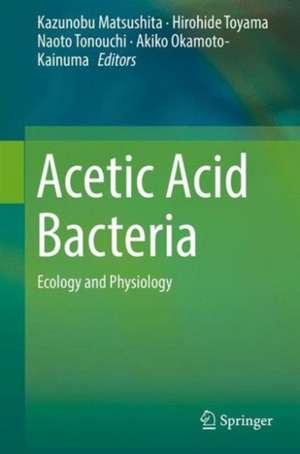
Acetic Acid Bacteria
Editat de Kazunobu Matsushita, Hirohide Toyama, Naoto Tonouchi, Akiko Okamoto-Kainumaen Limba Engleză Hardback – 23 iun 2016
Recomandat ca referință profesională și pentru nivelul de master sau doctorat, acest volum publicat de Springer reprezintă o sinteză exhaustivă a microbiologiei bacteriilor acetice (AAB). Apreciem modul în care editorii Kazunobu Matsushita, Hirohide Toyama și echipa lor au reușit să echilibreze rigoarea academică a taxonomiei cu aplicațiile industriale practice, oferind o perspectivă actualizată asupra unui domeniu cu o istorie de peste un secol. Structura cărții ghidează cititorul de la sistematica și filogenia moleculară a bacteriilor acetice, către rolul lor ecologic fascinant în ecosistemele alimentare și în simbioza cu insectele sau plantele. Capitolele centrale detaliază fiziologia speciilor Acetobacter și Komagataeibacter, insistând pe mecanismele de rezistență la acid și pe metabolismul central al carbonului — aspecte critice pentru eficiența fermentației oxidative. Suntem de părere că această lucrare servește ca o alternativă tehnică superioară la Vinegars of the World pentru cursurile de biotehnologie alimentară, având avantajul unei abordări moleculare profunde care depășește simpla descriere a proceselor de producție. În timp ce Lactic Acid Bacteria: Genetics, Metabolism and Applications se concentrează pe industria lactatelor, Acetic Acid Bacteria deschide noi orizonturi în biotehnologie prin capitolele dedicate biocelulozei și biosenzorilor. Ritmul expunerii este unul dens, specific literaturii de cercetare, fiind susținut de date genomice și diagrame metabolice care explică instabilitatea genetică și strategiile de supraviețuire ale acestor microorganisme în medii extreme.
Preț: 1273.01 lei
Preț vechi: 1552.46 lei
-18%
Carte disponibilă
Livrare economică 09-23 noiembrie
Specificații
ISBN-10: 4431559310
Pagini: 360
Ilustrații: VIII, 350 p. 68 illus., 46 illus. in color.
Dimensiuni: 160 x 241 x 24 mm
Greutate: 0.72 kg
Ediția:1st ed. 2016
Editura: Springer
Locul publicării:Tokyo, Japan
V-ar putea interesa
-
 The Missouri River EcosystemCommittee on Missouri River Ecosystem Science-11%Preț: 502.64 lei564.77 lei
 -
 Handbook on Ingredients for Aquaculture FeedsJ. W. Hertrampf-18%Preț: 1278.25 lei1558.84 lei
 -
 Preț: 478.73 lei
 -
 Agriculture and the Environment: Searching for Greener PasturesTerry L. AndersonPreț: 97.21 lei
 -
 Preț: 191.51 lei
 -
 -24%Preț: 982.88 lei1293.26 lei
 -
 Pot-HoneyPatricia Vit-18%Preț: 1739.61 lei2121.48 lei
 -
 -9%Preț: 1331.16 lei1462.81 lei
 -
 Urban Ecosystem Studies in MalaysiaNoorazuan MD-HashimPreț: 219.20 lei
 -
 Adaptive Management of Renewable ResourcesCarl J. WaltersPreț: 368.65 lei
 -
 The Benthos of LakesRalph O. BrinkhurstPreț: 246.71 lei
 -
 Aims and Methods of Vegetation EcologyDieter Mueller-Dombois-8%Preț: 445.72 lei484.48 lei
 -
 Applied Forest Tree ImprovementBruce Zobel-8%Preț: 448.58 lei487.59 lei
 -
 Perspectives on Plant CompetitionJames B. GracePreț: 430.00 lei
 -
 Upwelling EcosystemsR. Boje-15%Preț: 618.99 lei728.23 lei
 -
 Arctic Animal EcologyHermann RemmertPreț: 376.69 lei
 -
 Perspektiven menschlichen Handelns: Umwelt und EthikKarl-Heinz ErdmannPreț: 469.35 lei
 -
 GorillasAngela MederPreț: 250.54 lei
 -
 Umweltmikrobiologische PraxisBertold SprengerPreț: 466.85 lei
 -
 Radioisotopic Methods in HydrobiologyYuri I. Sorokin-15%Preț: 617.72 lei726.72 lei
 -
 Antarctic Ocean and Resources VariabilityDietrich Sahrhage-15%Preț: 655.72 lei771.44 lei
 -
 Conservation of Living Nature and Resources: Problems, Trends, and ProspectsAlexey V. Yablokov-15%Preț: 615.05 lei723.59 lei
 -
 Acid DepositionJames W. S. Longhurst-20%Preț: 654.62 lei818.28 lei
Public țintă
ResearchDe ce să citești această carte
Această monografie este esențială pentru cercetătorii din microbiologie și inginerie biochimică. Cititorul câștigă o înțelegere profundă a metabolismului oxidativ, de la fermentația tradițională a oțetului la producția de polizaharide utile. Este o resursă rară care conectează genetica moleculară cu aplicațiile practice în biosenzori și biocatalizatori, oferind direcții clare pentru viitoarele ținte de cercetare în biotehnologie.
Cuprins
Textul de pe ultima copertă
AAB research has a long history since the discovery of AAB by Louis Pasteur and the identification of AAB by Martinus Beijerinck in the nineteenth century. In the twentieth century, basic research on the taxonomic study of AAB and on biochemical study for the unique oxidative reactions of AAB had progressed as well as the industrial application of AAB not only in vinegar fermentation but also in the bioconversion process for useful chemical or pharmaceutical products. Entering the twenty-first century, AAB research has expanded more, and further progress is expected to be seen in all fields of AAB: classification and ecology, physiology and biochemistry, genetics, and biotechnology of vinegar fermentation and other oxidative fermentations. Far-reaching development in the last decade makes these bacteria more valuable for various industrial uses. Readers can obtain useful and comprehensive information which is exciting in aspects of basic science and provides hints for the better application of these bacteria to various kinds of practical production scenarios as well.