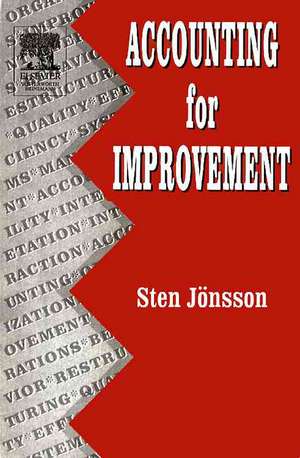
Accounting for Improvement
Autor Sten Jonssonen Limba Engleză Paperback – 14 oct 2004
Several broadly applicable lessons can be learnt, among them: how companies can strengthen their competitive base by patient improvement; how people with operative jobs can take command of their work situation and improve it in quality as well as efficiency.
New bottom-up, people-orientated, empirically-founded approaches to decentralised participative management demonstrate a place for individuals and teamwork in today's "lost relevance" and "smart machine" environment.
Preț: 544.28 lei
Preț vechi: 611.54 lei
-11%
Puncte Express: 816
Carte tipărită la comandă
Livrare economică 04-18 decembrie
Livrare prin curier în România Termenul estimat este afișat lângă disponibilitate.
Transport gratuit pentru acest produs Plată online sau ramburs, în funcție de opțiunile comenzii.
Retur gratuit în 14 zile Comandă securizată și suport în română.
Specificații
ISBN-13: 9780080446080
ISBN-10: 0080446086
Pagini: 250
Dimensiuni: 152 x 229 x 356 mm
Greutate: 0.38 kg
Editura: Emerald Publishing
ISBN-10: 0080446086
Pagini: 250
Dimensiuni: 152 x 229 x 356 mm
Greutate: 0.38 kg
Editura: Emerald Publishing
V-ar putea interesa
-
 -17%Preț: 192.26 lei230.54 lei
 -
 -41%Preț: 215.05 lei364.88 lei
 -
 The Infinite AlphabetCésar A. HidalgoPreț: 191.23 lei
 -
 You Already KnowLaura HuangPreț: 122.17 lei
 -
 The Ends GameMarco Bertini-15%Preț: 104.18 lei123.09 lei
 -
 The Improvement GuideGerald J Langley-19%Preț: 445.95 lei550.56 lei
 -
 -4%Preț: 367.03 lei382.33 lei
 -
 Little Book of Big Management Questions, TheJames McgrathPreț: 106.12 lei
 -
 Management Accounting for Decision MakersPeter Atrill-9%Preț: 497.45 lei546.64 lei
 -
 -19%Preț: 439.33 lei542.38 lei
 -
 Reimagining Operational ExcellencePhilip KotlerPreț: 156.63 lei
 -
 90 Days to Level Up Your TeamworkAmy C EdmondsonPreț: 123.99 lei
 -
 ChangeJohn P KotterPreț: 106.77 lei
 -
 From Values to ActionHarry M Jansen KraemerPreț: 192.15 lei
 -
 Preț: 137.61 lei
 -
 -23%Preț: 148.64 lei193.38 lei
 -
 ClickJake KnappPreț: 137.41 lei
 -
 Shadows At WorkSteven D'SouzaPreț: 112.53 lei
 -
 The Phoenix ProjectMike CollinsPreț: 138.20 lei
 -
 The Octopus OrganizationPhil Le-BrunPreț: 217.12 lei
Public țintă
For academics and researchers in behavioural accounting, organisational design and information systems; Doctoral MBA and other masters students with action research interests; academic libraries, information systems designers; project leaders in quality and productivity improvement.Cuprins
A preview: controlling through trust. Control through practice and understanding. The context: Swedish management style, institutions and our knowledge of participation and budget control. Controlling and communicating. Controlling through problem solving. Controlling through dialogue. Controlling through local planning. Controlling through competence. Controlling by words. Conclusion. References.