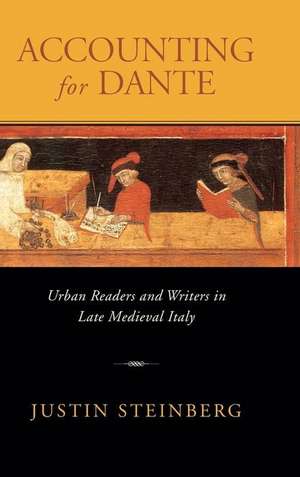
Accounting for Dante
Autor Justin Steinbergen Limba Engleză Hardback – 5 ian 2007
In Accounting for Dante, Justin Steinberg reexamines Dante's relation to his contemporary public, an audience that included those poets who responded to Dante's early work as well as the readers who first copied, preserved, and circulated his poetry. Based on original research of manuscripts and documents, Steinberg's study reveals in particular the importance of professional, urban classes—namely, merchants and notaries—as cultivators of early Italian poetry.
Although not officially trained as glossators or scribes, these newly educated readers were full participants in an emergent vernacular literature, demonstrating at times a marked degree of sophistication in their choices of which lyric poems to include in their personal anthologies. Adapting their methods of memorializing contracts and keeping accounts to the collecting of medieval Italian poetry, these urban readers and writers made copying Italian poetry a crucial aspect of how they understood and represented themselves as individuals and communities. Steinberg describes how notaries and merchants transcribed Dante's poetry in nontraditional formats, such as in the archival documents of the Memoriali bolognesi and the register-book Vaticano Latino 3793.
In bringing to light evidence of the urban reception of the early Italian lyric, Justin Steinberg restores the political, social, and historical contexts in which Dante would have understood the poetic debates of his day. He also examines how Dante continuously responded in his literary career—from the Vita Nuova, to the De Vulgari eloquentia, to the Commedia—to the interpretations and misinterpretations of his early lyrics by this municipal audience.
Although not officially trained as glossators or scribes, these newly educated readers were full participants in an emergent vernacular literature, demonstrating at times a marked degree of sophistication in their choices of which lyric poems to include in their personal anthologies. Adapting their methods of memorializing contracts and keeping accounts to the collecting of medieval Italian poetry, these urban readers and writers made copying Italian poetry a crucial aspect of how they understood and represented themselves as individuals and communities. Steinberg describes how notaries and merchants transcribed Dante's poetry in nontraditional formats, such as in the archival documents of the Memoriali bolognesi and the register-book Vaticano Latino 3793.
In bringing to light evidence of the urban reception of the early Italian lyric, Justin Steinberg restores the political, social, and historical contexts in which Dante would have understood the poetic debates of his day. He also examines how Dante continuously responded in his literary career—from the Vita Nuova, to the De Vulgari eloquentia, to the Commedia—to the interpretations and misinterpretations of his early lyrics by this municipal audience.
Preț: 610.16 lei
Preț vechi: 753.28 lei
-19%
Puncte Express: 915
Carte tipărită la comandă
Livrare economică 02-16 decembrie
Livrare prin curier în România Termenul estimat este afișat lângă disponibilitate.
Transport gratuit pentru acest produs Plată online sau ramburs, în funcție de opțiunile comenzii.
Retur gratuit în 14 zile Comandă securizată și suport în română.
Specificații
ISBN-13: 9780268182021
ISBN-10: 0268182027
Pagini: 250
Dimensiuni: 157 x 235 x 18 mm
Greutate: 0.47 kg
Ediția:1
Editura: University of Notre Dame Press
ISBN-10: 0268182027
Pagini: 250
Dimensiuni: 157 x 235 x 18 mm
Greutate: 0.47 kg
Ediția:1
Editura: University of Notre Dame Press
Recenzii
“It is clear from the first pages that Justin Steinberg's book is innovative and groundbreaking. Returning the rightful importance to the cultural circumstances and social context surrounding some of Dante's most important declarations of poetics, this critical analysis provides new and convincing answers to highly debated issues. It effectively accounts for Dante's repeated attempts at directing his readership, not only using well-known self-referential speech acts, but especially through careful manipulation of the instruments and techniques of book production and circulation.” —Renaissance Quarterly
“By considering Dante primarily in the context of the larger manuscript culture of his time, Steinberg delves deep into the past in order to say something entirely new about Dante and his self-conscious desire to reshape poetic tradition. Such an approach, relying on cutting-edge methods of philology, codicology, and paleography, reveals the degree to which the prevailing manuscript tradition conditioned Dante's views of fellow poets, and indeed of his own work. . . . Recommended.” —Choice
“Justin Steinberg's unusually keen capacity to draw upon historical, paleographical, and sociological realms of literary inquiry introduces to Anglophone audiences these approaches that tend to be more common in scholarship by Italian critics. But it is his readings of lesser-known poets (particularly Monte Andrea and Chiaro Davanzati) that are particularly illuminating and his suggestions concerning the class-conscious motivations behind poetic canon formation that are most suggestive. . . . Steinberg's scholarship effectively bridges some of the widest gaps between European and American sensibilities in literary analysis.” —The Sixteenth Century Journal
“This volume offers a scholarly feast. It aims 'to trace a history of duecento lyric poetry that takes into account the localized and socially stratified centers of textual production active in late medieval Italy.' In fact, it focuses on poetry written in Emilia and Tuscany in the second half of the thirteenth century. . . . This book is essential reading for all students of Dante.” —Speculum
Notă biografică
Justin Steinberg is professor of Italian Literature at the University of Chicago. He is editor-in-Chief of Dante Studies.