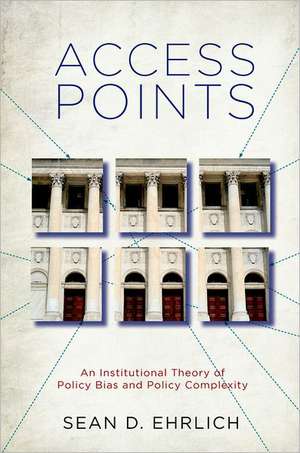
Access Points: An Institutional Theory of Policy Bias and Policy Complexity
Autor Sean D. Ehrlichen Limba Engleză Paperback – 13 oct 2011
Preț: 241.24 lei
Preț vechi: 272.62 lei
-12%
Puncte Express: 362
Carte tipărită la comandă
Livrare economică 26 noiembrie-01 decembrie
Livrare prin curier în România Termenul estimat este afișat lângă disponibilitate.
Transport gratuit de la 400.00 lei Plată online sau ramburs, în funcție de opțiunile comenzii.
Retur gratuit în 14 zile Comandă securizată și suport în română.
Specificații
ISBN-13: 9780199737543
ISBN-10: 0199737541
Pagini: 208
Ilustrații: 3 b/w illus.
Dimensiuni: 155 x 234 x 14 mm
Greutate: 0.28 kg
Editura: Oxford University Press
Colecția OUP USA
Locul publicării:New York, United States
ISBN-10: 0199737541
Pagini: 208
Ilustrații: 3 b/w illus.
Dimensiuni: 155 x 234 x 14 mm
Greutate: 0.28 kg
Editura: Oxford University Press
Colecția OUP USA
Locul publicării:New York, United States
V-ar putea interesa
-
 -31%Preț: 759.94 lei1101.61 lei
 -
 Democracy, Intermediation, and Voting on Four ContinentsRichard Gunther-16%Preț: 218.09 lei261.01 lei
 -
 -28%Preț: 378.34 lei528.47 lei
 -
 -31%Preț: 1027.75 lei1500.31 lei
 -
 -33%Preț: 806.53 lei1196.85 lei
 -
 Electoral MalpracticeSarah Birch-31%Preț: 756.35 lei1099.44 lei
 -
 The Comparative Study of Electoral SystemsHans-Dieter Klingemann-21%Preț: 404.78 lei510.57 lei
 -
 The British General Election of 2001D. ButlerPreț: 390.74 lei
 -
 What Happened in Ohio?Robert J FitrakisPreț: 137.98 lei
 -
 Rules for RevolutionariesBecky Bond-19%Preț: 86.70 lei107.41 lei
 -
 How Ireland Voted 2016Michael GallagherPreț: 255.81 lei
 -
 Political Communication in BritainDominic WringPreț: 286.56 lei
Notă biografică
Sean D. Ehrlich is Assistant Professor of Political Science at Florida State University. His research focuses on international and comparative political economy, particularly how the preferences of the public and of policymakers interact to determine economic policymaking.