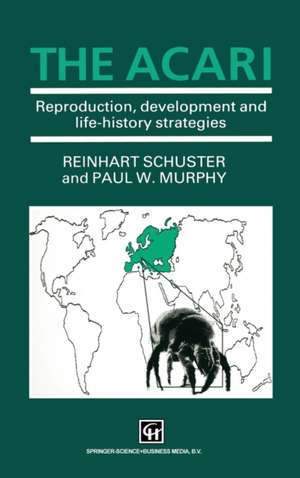
Acari
Editat de Reinhart Schusteren Limba Engleză Hardback – 2 mai 1991
Preț: 621.07 lei
Preț vechi: 730.67 lei
-15%
Puncte Express: 932
Carte tipărită la comandă
Livrare economică 04-18 decembrie
Livrare prin curier în România Termenul estimat este afișat lângă disponibilitate.
Transport gratuit pentru acest produs Plată online sau ramburs, în funcție de opțiunile comenzii.
Retur gratuit în 14 zile Comandă securizată și suport în română.
Specificații
ISBN-13: 9780412360701
ISBN-10: 0412360705
Pagini: 584
Dimensiuni: 160 x 241 x 37 mm
Greutate: 0.98 kg
Editura: SPRINGER NATURE
ISBN-10: 0412360705
Pagini: 584
Dimensiuni: 160 x 241 x 37 mm
Greutate: 0.98 kg
Editura: SPRINGER NATURE
V-ar putea interesa
-
 Preț: 83.89 lei
 -
 How to Pass Intermediate 2 BiologyHARRY HOEYPreț: 87.41 lei
 -
 AQA Psychology A ASJane Willson-6%Preț: 226.08 lei239.29 lei
 -
 Who Will Plant a Tree?Jerry PallottaPreț: 104.99 lei
Cuprins
One Life-history Strategies.- 1 The life strategies of mites.- 2 Life-history evolution of spider mites.- 3 Life-cycle strategies in unpredictably varying environments: genetic adaptations in a colonizing mite.- 4 The evolutionary transformation of osmotic regulation in the life cycle of freshwater mites (Hydrachnidia).- 5 Development and life-history strategies in mussel mites (Hydrachnellae: Unionicolidae).- Two Reproduction.- 6 Spermatology in the Acari: systematic and functional implications.- 7 The distribution, mechanisms and evolutionary significance of parthenogenesis in oribatid mites.- 8 Indirect sperm transfer in prostigmatic mites from a phylogenetic viewpoint.- 9 Spermatophore deposition in relation to atmospheric humidity among terrestrial Parasitengonae (Prostigmata).- 10 The role of Adlerocystis sp. in the reproduction of argasid ticks.- 11 A scanning electron-microscopy study of spermatogenesis in Pergamasus barbarus Berl. (Gamasida.- 12 Precise sex-ratio control in the pseudo-arrhenotokous phytoseiid mite, Typhlodromus occidentalis Nesbitt.- 13 Sex ratio, fitness and capacity for population increase in Pyemotes tritici (L.-F. and M.) (Pyemotidae).- 14 Preliminary observations of ovoviviparity in the gallforming mite, Aceria caulobius (Nal.) (Eriophyidea: Eriophyidae).- 15 Laboratory observations on duration of copulation and egg production of three phytoseiid species fed on pollen.- 16 Precopulatory mate guarding in the spider mite, Tetranychus cinnabarinus (Boisd.) (Tetranychidae).- Three Diapause, Development and Trophic Relations.- 17 Physiological aspects of diapause in plant-inhabiting mites.- 18 Repeated induction and termination of diapause in the predacious mite, Amblyseius potentillae (Garman) (Phytoseiidae).- 19 Inheritance of photoperiodic responses controlling diapause in the two-spotted spider mite, Tetranychus urticae Koch.- 20 Some observations on diapause in winter eggs of Panonychus ulmi (Koch) (Tetranychidae).- 21 Reproduction, embryonic and postembryonic development of Trichouropoda obscurasimilis Hirschmann and Zirngiebl-Nicol 1961 (Anactinotrichida: Uropodina).- 22 Resource allocation and utilization contrasts in Hypoaspis aculeifer (Can.) and Alliphis halleri (G. and R. Can.) (Mesostigmata) with emphasis on food source.- 23 The influence of different host plants on the reproductive potential of Tyrophagus putrescentiae (Schrank) and Tyrophagus neiswanderi Johnston and Bruce (Acaridae).- 24 The relationship between house-dust mites and fungi.- 25 How plants maintain body-guards: plant exudate as a food source for phytoseiid mites.- Four Systematic, Morphology, Physiology and Behaviour.- 26 Distribution of characters and phylogenetic age — systematic problems in the higher taxa of the Oribatida.- 27 A new approach to the systematics of the genus Steganacarus (Oribatida).- 28 The morphology of the immature stages of Phthiracaroidea (Oribatida).- 29 A new interpretation of the epimeral theory of Grandjean.- 30 A comparison of the sclerotized parts of the reproductive organs of house-dust mites of the genus Dermatophagoides using scanning electron microscopy.- 31 Reproductive systems in Acaridida — some peculiar features.- 32 A respiratory apparatus in eggs of certain mites.- 33 Fine structure and functions of the mouthparts involved in the feeding mechanisms in Cenopalpus pulcher (Canestrini and Fanzago) (Tetranychoidea: Tenuipalpidae).- 34 The alveolar salivary glands of the active phases of trombiculid mites (Trombiculidae).- 35 Pigmentation in water mites of the genera Limnochares Latr. andHydrodroma Koch (Hydrachnidia).- 36 Biomass studies of water mites of the genera Limnochares Latr. and Hydrodroma Koch (Hydrachnidia).- 37 The saltatory capacity of an oribatid mite.- 38 Thanatosis or feigning death in mites of the family Scutacaridae.- Five Field Studies and Applied Aspects.- 39 The effects of spider-mite feeding on plant performance in relation to biological control.- 40 Dispersion indices and constant precision sampling programmes for Panonychus ulmi (Koch) and Amblyseius andersoni (Chant) in Spanish apple orchards.- 41 Herbicides and the reproduction of Tetranychus urticae Koch.- 42 Phytoseiid mites associated with vines in Sicilian vineyards.- 43 Studies on mites associated with lucerne in Greece.- 44 Vertical distribution and life stages of oribatid communities on beech trees.- 45 Histiostoma murchiei Hughes and Jackson (Anoetidae) as a parasite in the cocoons of some Danish earthworms.- 46 Rearing deutonymphs of Iphidosoma fimetarium (J. Müller), a mesostigmatic mite associated with carabid beetles.- 47 Mites of the House mouse, Mus musculus L., in the north-eastern part of the Iberian Peninsula in Spain.- 48 Records of Ixodoidea from the Trentino-Alto Adige region in northern Italy.- 49 Seasonal and spatial variation in food intake by the oribatid mites of beech woodland soil.- 50 The effects of ploughing and rotary cultivation on soil mites with particular reference to the Mesostigmata.- 51 The influence of soil cultivation methods on the edaphic fauna, and especially the Gamasina (Mesostigmata), in two southern German vineyards with different cultural treatments.- 52 The density of Tarsonemida in cropped arable soil in relation to fertilizer and crop-protection treatments.- 53 Soil mites and acidification: a comparative study of four foreststands near Heidelberg.- 54 Reactions of mite populations to the influence of environmental chemicals in a beech-wood floor.- 55 Population studies on the house-dust mite. Euroglyphus maynei (Cooreman 1950) (Pyroglyphidae).- 56 Management of mite development in the home.- 57 An indirect effect of cleaning on house-dust mites. (Dermatophagoides spp.) in carpets.- 58 Astigmatic and prostigmatic mites of grain stores, mills and sawmills in Finland.- Index to plant genera and species.- Index to animal genera and species.- Author index.